 小影邮箱
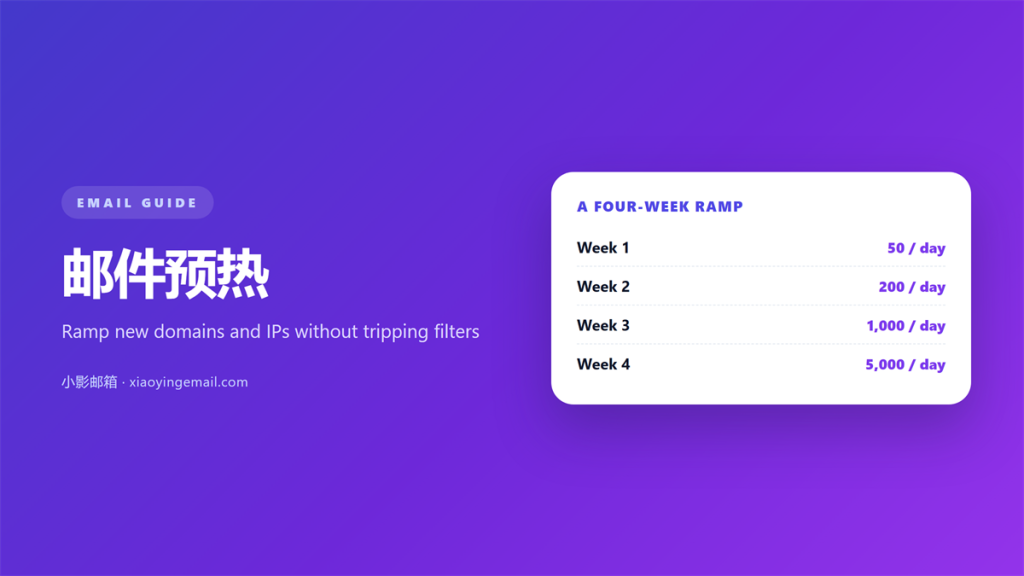
邮件预热怎么做?A Four-Week Ramp for New Domains
Key Takeaways
- 邮件预热 builds a sending history so filters can judge your new domain.
- Volume should rise gradually across about four weeks, not overnight.
- Engaged recipients matter more than raw numbers during the ramp.
- A bounce rate above roughly two percent should pause the schedule.
- Warm every sending IP, not just the domain on the envelope.
What 邮件预热 actually changes
邮件预热 is the practice of sending a small, increasing volume from a new domain or IP until filters trust it. It does not change your content or your records. Instead, it changes your history, because reputation is earned rather than configured.
I ran a warm-up for a new transactional domain last year. The first week produced a handful of spam-folder placements, and by week four the same templates landed in the inbox.
Think of 邮件预热 as a credit score for senders. Nobody hands you a good score on day one, and a sudden burst of activity looks like fraud rather than growth.
The mechanics are less mysterious than they sound. Providers watch how recipients react to your mail. If people open it and reply, the positive signals accumulate in your favour. If they ignore it, the opposite happens, which is why 邮件预热 works best with an audience that already knows you.
Why a new domain needs 邮件预热
Filters treat an unknown sender with suspicion. A brand-new domain has no engagement data, no complaint history and no volume baseline, so the safest default for a filter is the spam folder.
Moreover, sudden volume is the classic signature of a compromised account. Consequently, a domain that jumps from zero to fifty thousand messages in a day looks exactly like abuse.
There is a second reason 邮件预热 pays off. Providers such as Gmail and Microsoft publish guidance for bulk senders, and a steady ramp is the behaviour they explicitly recommend.
A four-week 邮件预热 plan
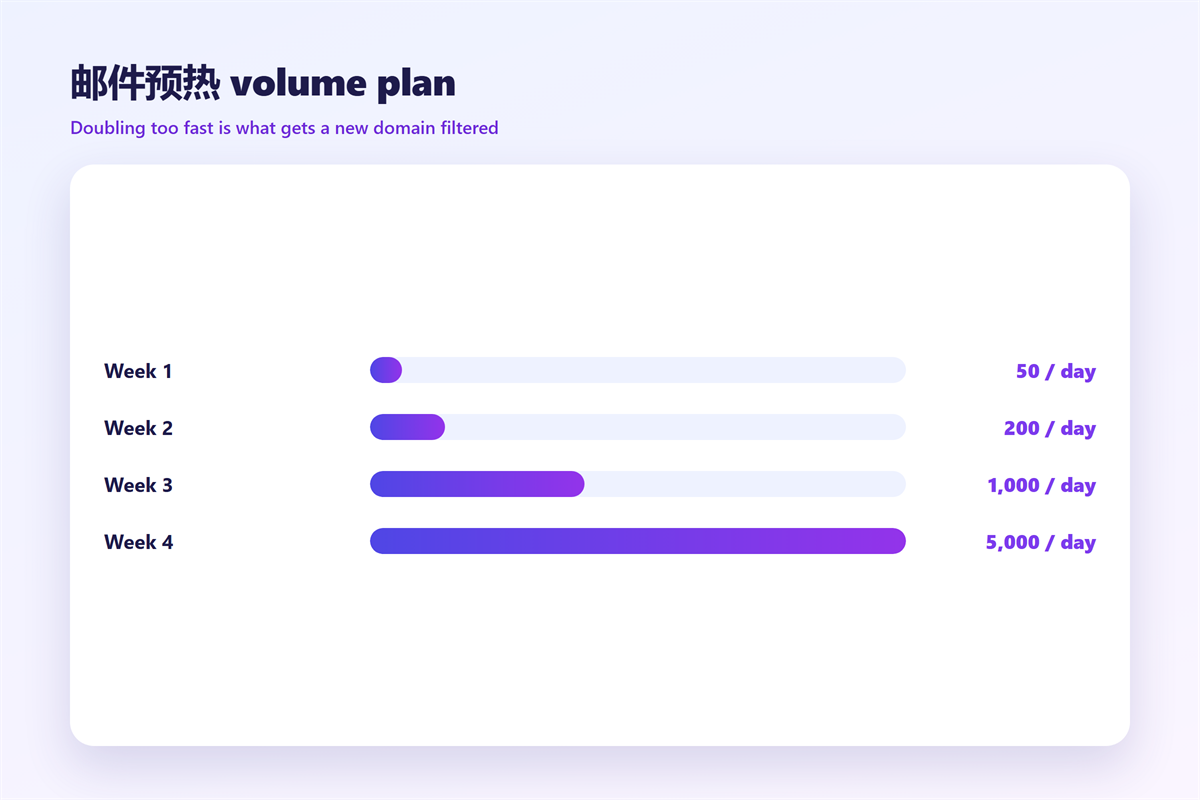
The schedule below is the one I use. It is deliberately conservative, and the exact numbers matter less than the shape of the curve.
Weeks one and two
Start with fifty messages a day, then rise to two hundred. Send to people who already know you, because their opens and replies teach the filter that your mail is wanted.
Weeks three and four
Move to a thousand, then five thousand. Therefore, you reach meaningful volume only after the domain has a track record, and the jump to full production happens last.
What you send matters during the ramp. Transactional messages such as receipts and password resets perform well, because recipients expect them and open them quickly. Promotional mail performs worse, so I keep it out of the first two weeks of 邮件预热 entirely.
Equally important, keep the content stable. Changing templates every day makes it hard to tell whether a placement problem came from your volume or your design.
Six 邮件预热 habits that protect reputation
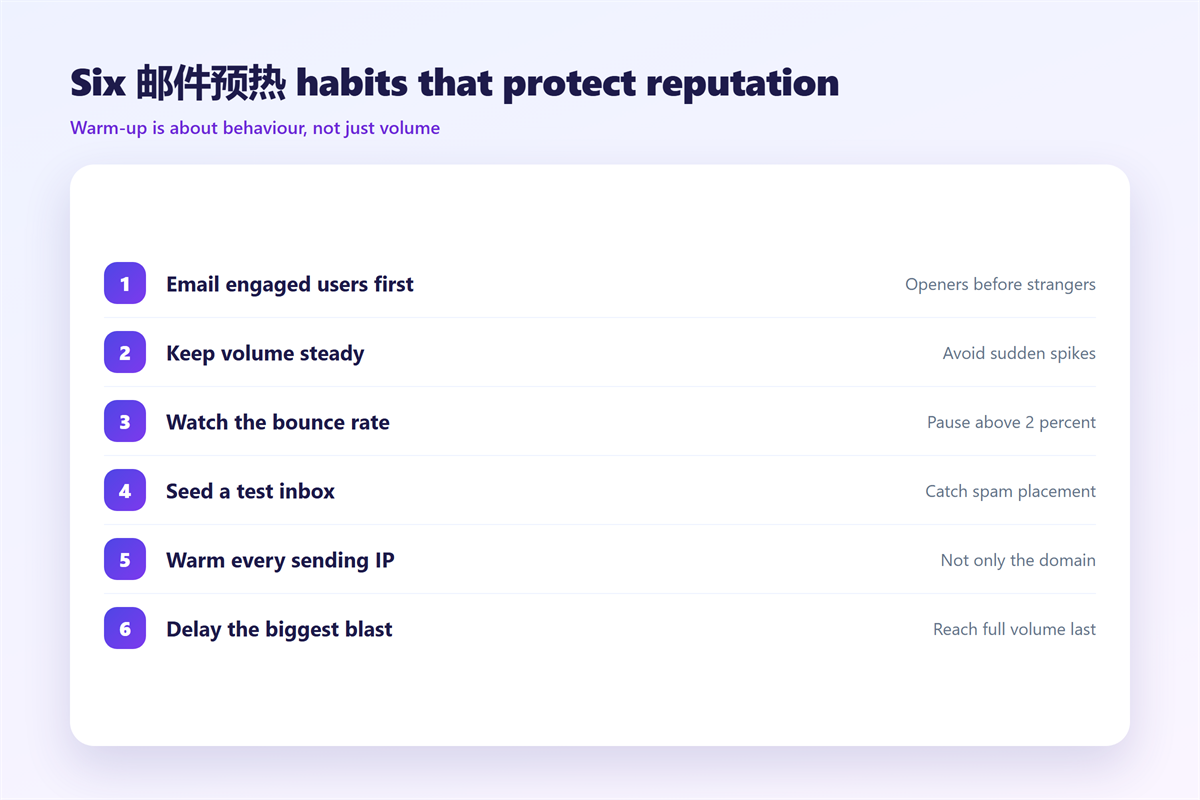
- Email engaged users first, before any cold list.
- Keep daily volume steady instead of spiky.
- Pause the ramp when bounces exceed two percent.
- Seed a test inbox to see where mail actually lands.
- Warm every sending IP, not only the primary one.
- Delay the biggest campaign until the ramp is finished.
Additionally, correct authentication records remove an easy excuse for rejection. If SPF, DKIM and DMARC are still missing, fix that first using our guide to 邮件认证, because 邮件预热 cannot compensate for a broken record.
When 邮件预热 goes wrong
Warm-up fails in predictable ways. The most common is starting too fast, which lands you on a blocklist before the ramp even matters. In that case, read up on 邮件黑名单 and request delisting before you resume.
Another failure is warming the domain but ignoring the IP. Moreover, some senders warm one IP and then add three more at full volume, which resets their reputation problem from scratch. A proper 邮件预热 plan covers every address that will carry mail, not just the first one.
Sending to a purchased list is the fastest way to ruin a ramp. For that reason, keep the strategy permission-based, as described in our notes on 邮件营销.
Measuring whether 邮件预热 worked
Judge the ramp on placement, not on delivery. A message can be accepted and still land in spam, so track inbox placement rate, bounce rate and complaint rate together.
Specifically, I look at three signals each week. First, the share of mail reaching the inbox. Second, the bounce rate against the previous week. Third, the complaint rate reported by major providers. If all three improve, the 邮件预热 schedule is working. Our deeper notes on 邮件投递率 explain how to interpret those numbers.
On balance, expect the improvement to be invisible for the first ten days. Reputation moves slowly at the start and then quite quickly once the engagement signals accumulate.
FAQ
How long does warm-up take?
For a modest list, about four weeks. High-volume senders may need six to eight weeks, especially when several IP addresses are involved in the same 邮件预热 programme.
Can I skip warm-up with a shared IP?
You inherit the provider’s reputation, so a ramp is less critical. However, you also inherit their problems, and a single bad neighbour can drag you down.
Should I warm up again after a pause?
Yes, a short re-ramp helps after a long silence. Reputation decays, so treat a two-month gap like a partial restart of 邮件预热.
Does content matter during warm-up?
It matters throughout. Even a warm domain will struggle if the message looks like bulk mail, so keep the templates clean from day one.
评论
还没有评论,来说两句吧。以下为本文的引用通告: