 小影邮箱
邮件分诊怎么做?Sort Before You Read
Key Takeaways
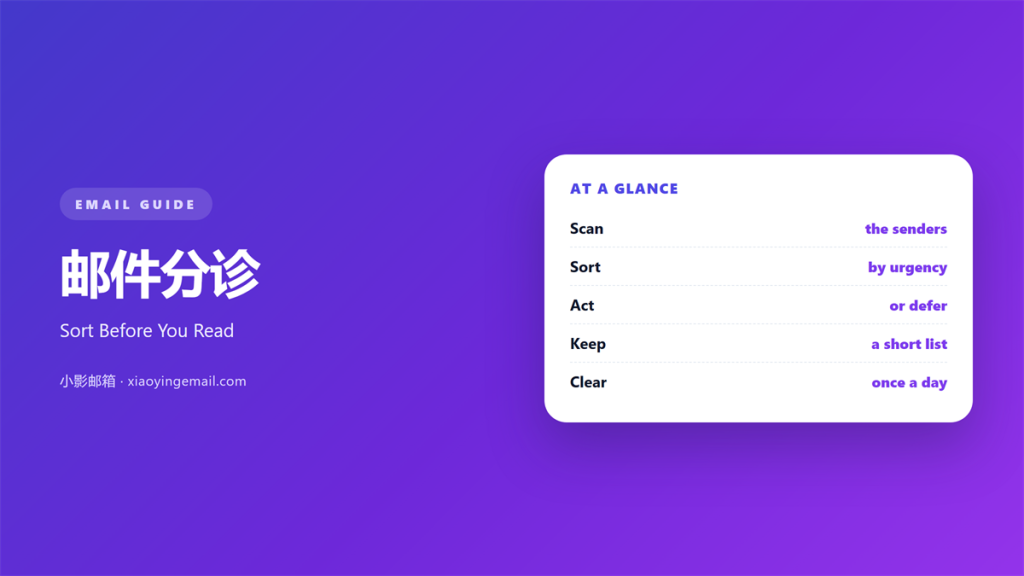
- 邮件分诊 means sorting a full inbox before you read it all.
- Three quick passes beat one slow one.
- Decide: reply, defer, delegate or delete.
- A short 邮件分诊 keeps the urgent items visible.
- Do it twice a day, not all day.
What 邮件分诊 means
邮件分诊 is a quick sort of your inbox before deep reading.
The word comes from hospital practice. Nurses rank patients by need.
You rank messages the same way. Urgent first, the rest later.
It is not the same as answering. You only decide what each mail needs.
A good 邮件分诊 takes a few minutes for a full screen.
You look at each subject and sender for a moment only.
That first look tells you if the message can wait.
The goal is a fast decision, not a full reply.
Why 邮件分诊 saves time
Reading every message twice is the real cost.
The first read tells you it is not urgent. The second acts on it.
A 邮件分诊 pass removes that second read for most items.
It also stops one loud mail from eating the whole morning.
You keep the calm ones calm and the urgent ones fast.
A steady 邮件分诊 also lowers the daily dread of the inbox.
Every switch between tasks costs a little focus.
Sorting in batches keeps those switches to a minimum.
You also stop opening the same mail three times a day.
Sorting in three passes
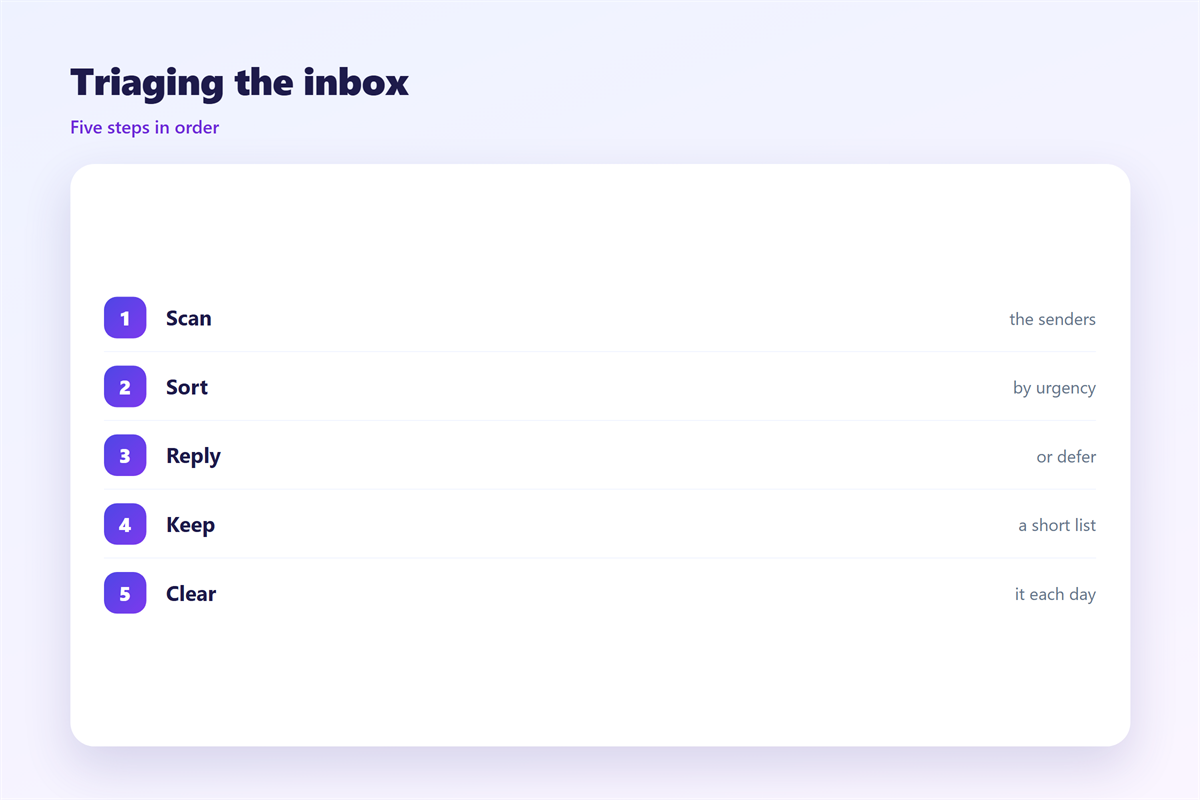
Use one pass for the eye, one for the hand, one for the reply.
The passes are quick. None of them takes more than a few minutes.
Do them in order and do not skip ahead.
First pass: scan
Scroll once and read only the sender and subject.
Mark anything that needs action today. Leave the rest alone.
Ignore the body of the message at this stage.
Second pass: label
Move each mail to a folder or tag in one click.
Group by project, not by sender, so future search is easier.
One folder for later is enough at first.
Tags can wait until the system feels natural.
Third pass: answer
Reply only to the messages you marked. Keep each reply short.
Short answers can be sent now. Long ones can wait a while.
A good reply solves the question and closes the thread.
Each pass has one job. Mixing them makes the work slow.
A simple 邮件分诊 routine
Pick two fixed times each day for the sort.
Open the inbox, scan, label and close it.
Twelve minutes is enough for most people.
Do not open mail between these windows. Protect your focus.
A repeated 邮件分诊 becomes automatic within a week.
Morning and early afternoon suit most working days.
Set a timer so the sort does not stretch.
When the timer rings, close the inbox and start real work.
When 邮件分诊 goes wrong
The first mistake is sorting forever without deciding.
Labeling is not progress if nothing gets answered.
Another error is treating every message as urgent.
If everything is urgent, your 邮件分诊 tells you nothing.
A third mistake is sorting in a panic at midnight.
A tidy inbox is useless if you never answer anything.
Sorting is a step, not the whole job.
Triage on a heavy day
Some days the inbox wins. Plan for that too.
Sort once, answer only the true deadlines, then stop.
Tell the rest the honest time you will reply.
That short note costs far less than a late surprise.
Ask a colleague for help when the load is truly high.
Delegate the items that belong to someone else.
The tools that help
Most mail apps have a star, a flag and a folder.
Use one of them as your action marker.
A single marker beats a dozen clever rules.
Filters can move routine mail quietly out of the way.
Set them once and let them work in the background.
Keep the rules simple so you still trust them.
Check the filtered folder once a day, not every hour.
Unread badges help only if you act on them.
Turn off the sound if it pulls you away too often.
A tidy system should feel light, not heavy.
If a rule causes stress, remove it.
Keeping 邮件分诊 habits
Good sorting habits stay if you review them monthly.
A tidy inbox is described in 邮件收件箱.
Turning mail into tasks is covered in 邮件待办.
Ranking the survivors is explained in 邮件优先级.
Sorting by tab is shown in 邮件标签页.
Then keep the routine and drop what does not fit.
Review the routine each month and cut one slow step.
Small tweaks keep the habit alive for years.
A calm 邮件分诊 pays back every single day.
A quiet mind at the end
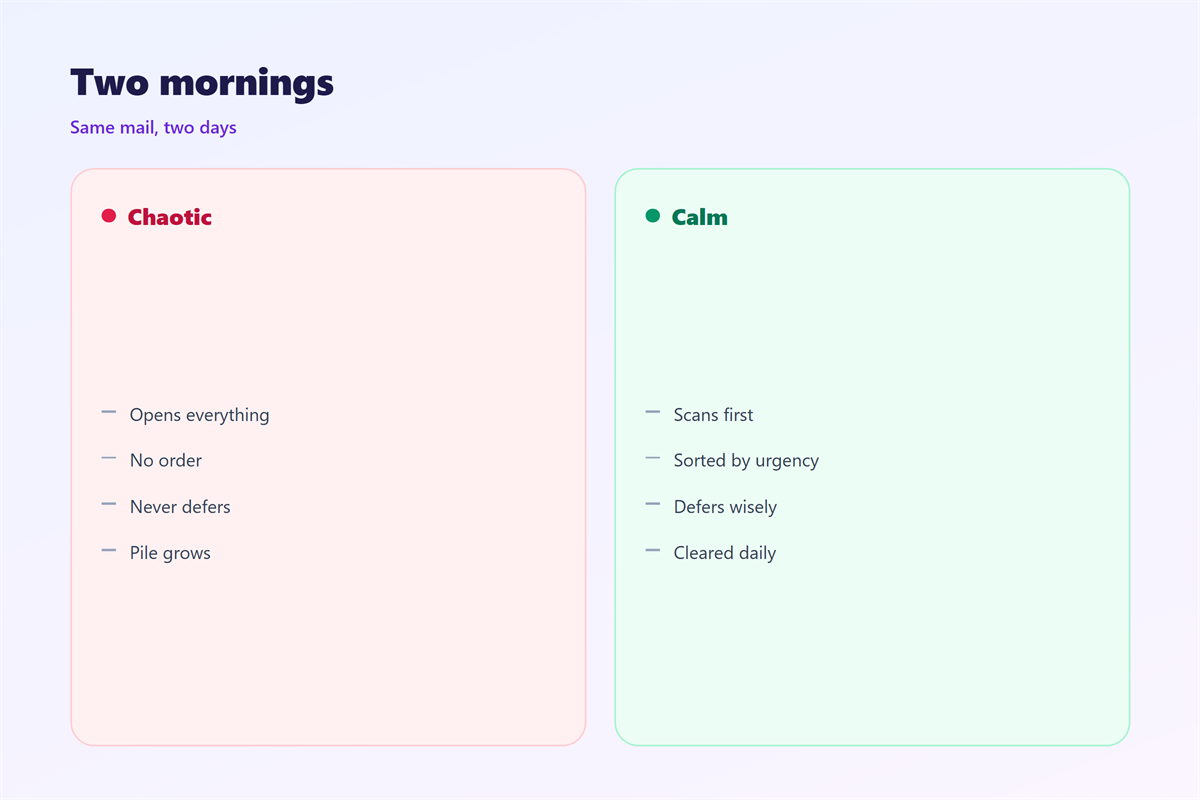
A calm inbox is a habit, not a one time fix.
A good sort ends with an empty screen, not an empty inbox.
You will still have mail to answer in the morning.
The difference is that you know which ones matter.
That knowledge is what makes the next day calm.
Try it for one week and measure your own results.
Most people wonder why they waited so long to start.
Keep the rules small and keep them honest.
FAQ
How long should a 邮件分诊 take?
Ten to fifteen minutes for a normal inbox.
Is it the same as reading mail?
No. Sorting decides what each message needs first.
How often should I sort?
Twice a day works for most working people.
Can I sort on my phone?
Yes, and a short 邮件分诊 fits small screens well.
评论
还没有评论,来说两句吧。
评论功能已关闭。