 小影邮箱
邮件升级怎么做?Escalate Without Friction
Key Takeaways
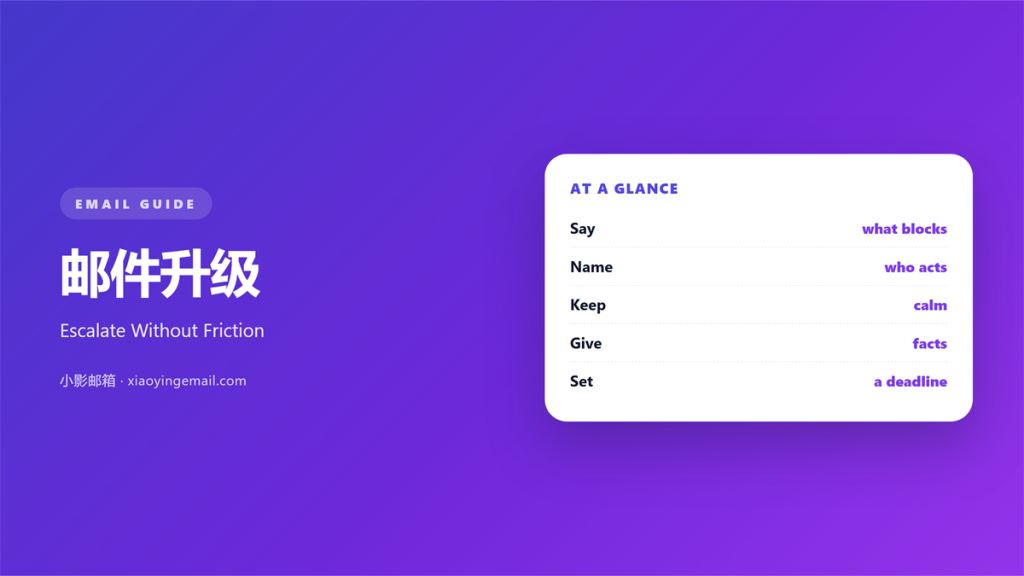
- 邮件升级 moves a stuck request to someone who can act.
- Name the blocker and the person who owns it.
- Keep the tone calm and the facts plain.
- Escalate once, then wait a set time before nudging.
- A short paper trail protects everyone involved.
What 邮件升级 means
邮件升级 is the moment a request moves up a level.
You hand it to a person with more authority.
That person can unblock what you cannot.
It is not a complaint and not a punishment.
It is simply the next step in a chain.
Every request has a normal path.
Escalation is what happens when that path stops.
The move can be tiny or large.
It only needs to reach the right hand.
It keeps the same request, simply higher up.
Nothing is thrown away or hidden.
The chain can have many links.
Why 邮件升级 matters
A request that stalls can cost real time.
The longer it waits, the more it hurts.
Good 邮件升级 keeps a project moving.
It also protects the person who first received it.
That person showed the problem early.
So the record shows they tried.
Without a clear note, blame lands in the wrong place.
A short message fixes that.
It turns silence into a shared decision.
A clear trail also helps the next reader.
They see what was tried and what failed.
It also cuts the number of reminders.
Fewer reminders leave more room for real work.
When to raise it instead of wait
Wait when the owner is simply busy.
Raise it when the owner cannot decide.
Wait when a deadline is far away.
Raise it when a deadline is close and blocked.
The line between the two is often clear.
When 邮件升级 helps
Some situations call for a quick 邮件升级.
A request has waited past its promised date.
A safety or legal issue is at stake.
A customer is about to leave.
The owner is offline for a long stretch.
Money or trust is draining away.
A blocked payment is a classic case.
A stuck approval slows the whole team.
In each case, motion beats silence.
A single sentence can restart the whole thing.
Signs a request is stuck
Watch for the same answer given twice.
Watch for a thread that grows with no owner.
Watch for a date that has quietly passed.
Any of these means the request is stuck.
When 邮件升级 hurts
An 邮件升级 can also backfire.
Send it too early and you seem impatient.
Send it too often and you lose goodwill.
Skip the owner and you break trust.
A vague note gives the reader nothing to do.
The owner may feel skipped over.
Then the next request gets less care.
So state one clear ask.
Tone matters as much as content.
Keep the focus on the problem, not the person.
Doing it too early
Give the owner a fair window first.
A day or two is often enough.
Then raise it if nothing has moved.
邮件升级 across teams
Teams often work on their own clocks.
One team may not know your deadline.
Different teams may use different words.
So spell out the date in plain words.
Name the person who should act next.
Add a short history of what you tried.
Keep that history to three lines at most.
A busy reader should get it in ten seconds.
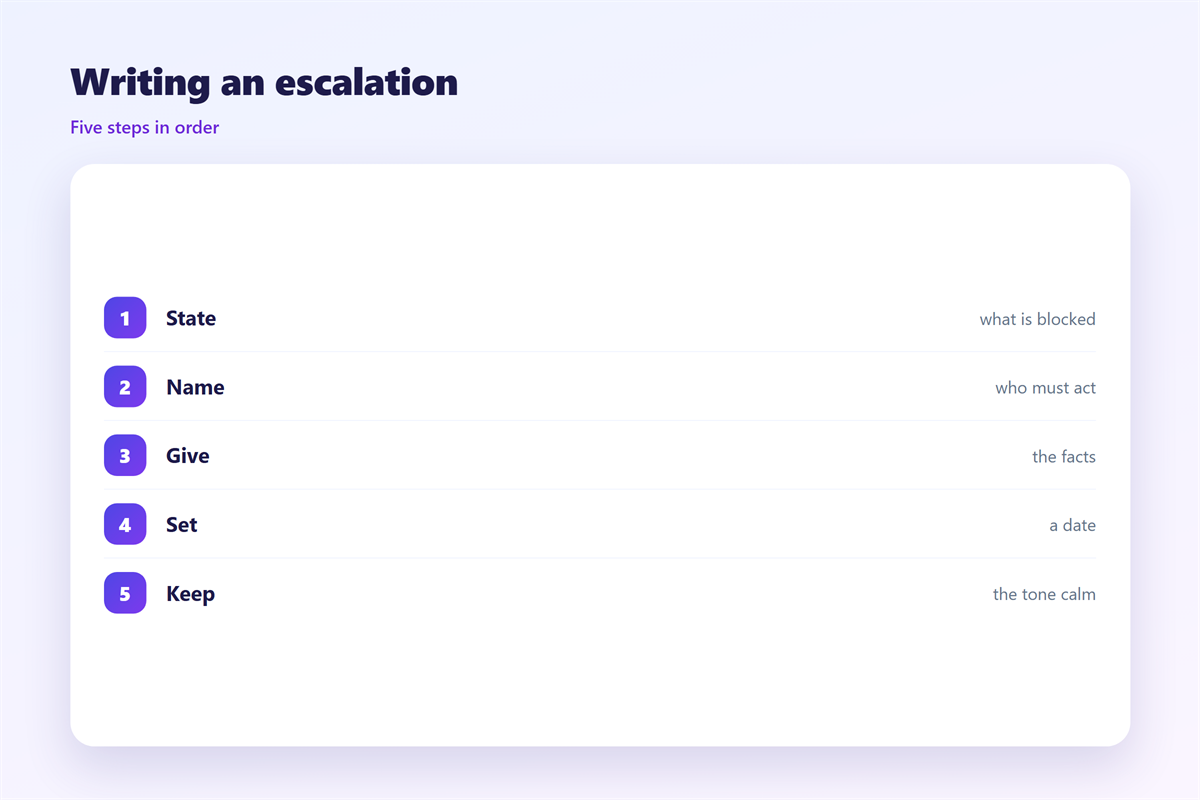
A good note names the blocker and the owner.
That keeps the handoff clean.
How to write a 邮件升级 well
Start with a clear subject line.
Put the word escalate and the topic in it.
Open with one sentence of context.
Then state the blocker in one line.
Name the action you need and from whom.
Give a date for the answer.
Attach the earlier thread below.
Keep the new text short and plain.
Use the same format every single time.
A familiar shape is faster to read.
End with a simple thank you.
Read it once before you send.
Cut any sentence that only vents.
A strong 邮件升级 is short and factual.
邮件升级 and tone
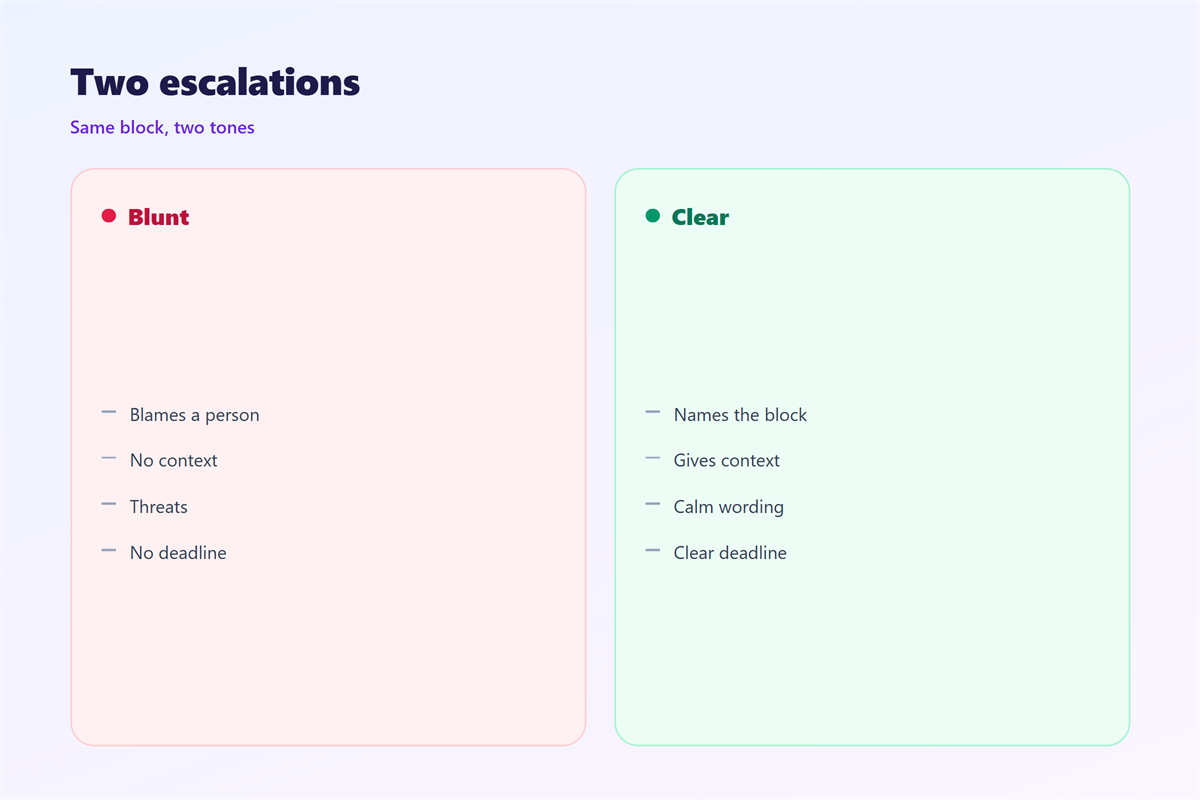
Escalation is easy to read as a threat.
So keep the verbs neutral and calm.
Say what is blocked, not who failed.
Use facts and dates, not feelings.
Read the note as if you received it.
Then soften any line that stings.
A calm note gets a faster answer.
An angry note gets a defensive one.
The reader should feel helped, not blamed.
That is the whole craft of it.
Practice builds the calm over time.
Keeping 邮件升级 consistent
Consistency turns a habit into a system.
The rules of asking for a decision are covered in 邮件审批.
The habit of passing a task along appears in 邮件流转.
The gentle follow-up note sits in 邮件催促.
The question of how long to wait is in 邮件回复时限.
Agree on how long to wait before raising a request.
Write the rule down where all can see.
Keep the same steps for every team.
Review it once a quarter.
Then everyone knows what to expect.
A team that agrees stays calm under pressure.
FAQ
How do I write a 邮件升级 without sounding rude?
State the facts and the ask, then thank the reader once.
How long should I wait before a 邮件升级?
A day or two is fine unless a deadline is close.
Should I copy the owner’s manager?
Only when the owner cannot decide. Keep it between the two of you first.
What makes a 邮件升级 weak?
A vague ask and a missing date. Name both and it gets stronger.
评论
还没有评论,来说两句吧。
评论功能已关闭。