 小影邮箱
邮件合规要做什么?Consent, Sender and Opt Out
Key Takeaways
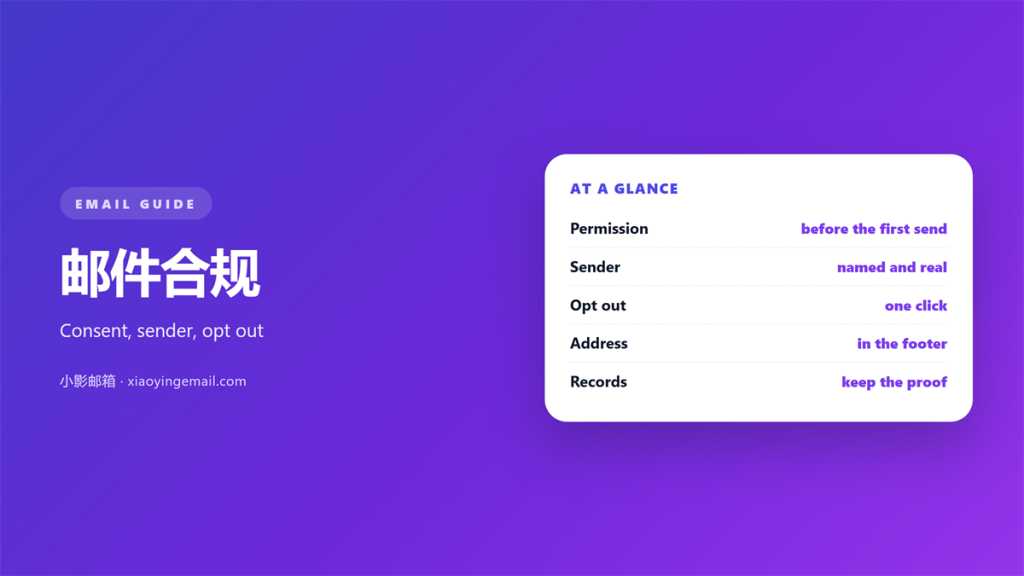
- 邮件合规 starts with permission, not with a list.
- The sender name and address must be honest.
- Every message needs a working way out.
- Rules differ by country, and the basics do not.
- A simple 邮件合规 routine keeps a list healthy.
What 邮件合规 really covers
邮件合规 is the set of rules that govern bulk mail. It decides what you may send and to whom.
The details change by country. The shape of the rules does not.
Three duties appear almost everywhere. Get permission, identify yourself, and offer a way out.
Ignore them and the cost is not only legal. Filters and readers punish the same mistakes.
A 邮件合规 mistake can stay invisible until a complaint arrives.
Many senders assume the rules are only about spam. In practice they cover honesty too.
Rules also differ by message type. A transactional receipt is treated kindly. A sales offer is not.
Know which kind of message you are sending. The duties follow the content, not the tool.
This guide stays with general principles. Your own adviser decides what applies to you.
A rule that is never explained cannot be followed.
Permission comes before volume
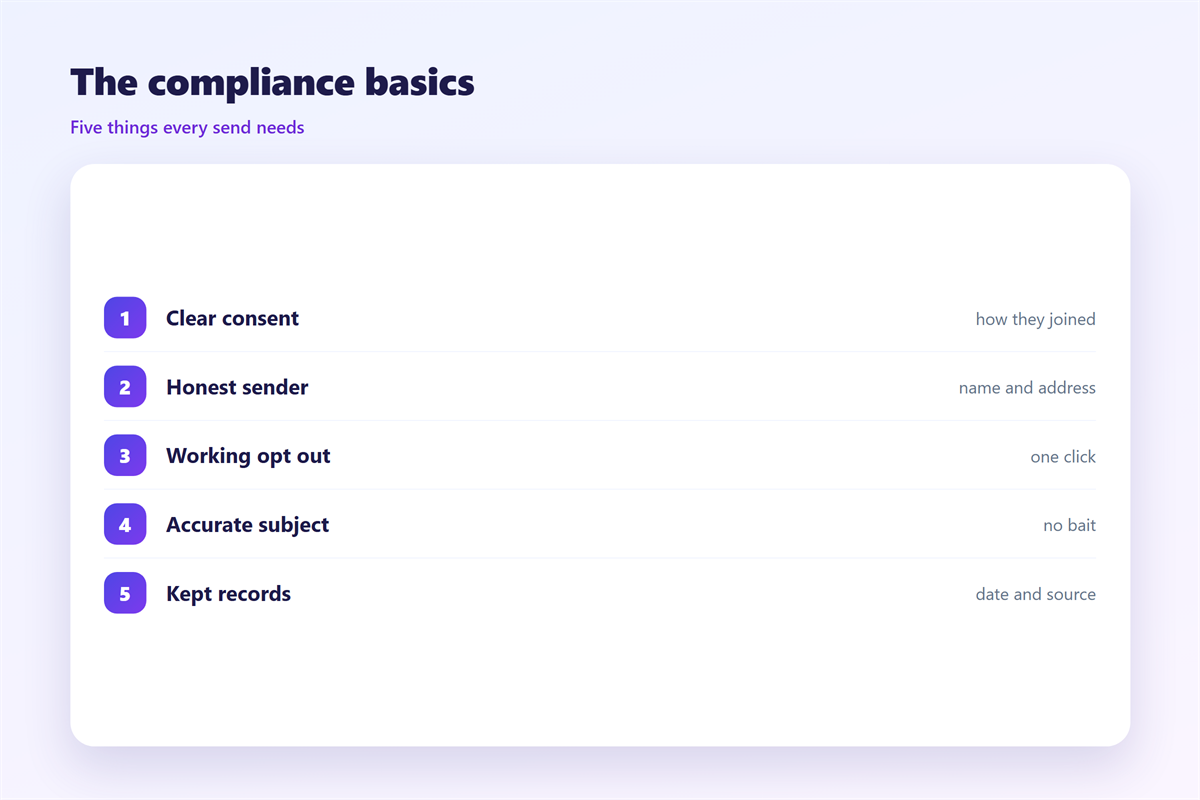
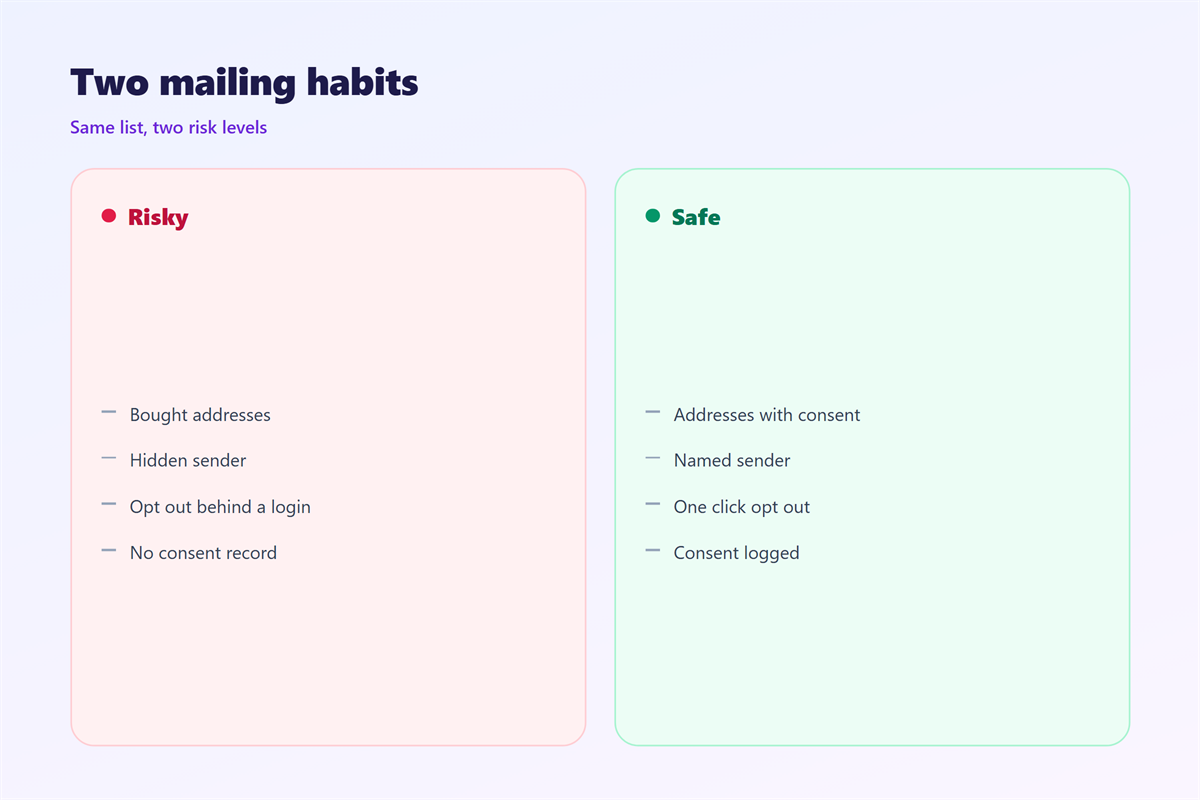
Consent is the first duty. A purchased list fails it immediately.
Permission should be specific. A newsletter sign up does not cover unrelated offers.
Consent is the heart of 邮件合规. Without it, every later step is a patch.
A checkbox that is already ticked does not count. The reader must choose it.
Keep the wording of the sign up form too. It shows what the reader agreed to.
An address collected for support is not a marketing address. Keep the two lists apart.
Keep the evidence as well. Record when and where each address opted in.
Remove an address as soon as it is requested.
Our guide to 邮件营销 explains why permission beats reach every time.
Growing a list slowly is normal. A list of strangers is a liability, not an asset.
Ask one question before every campaign. Would these readers expect this message?
An honest sender and a real address
The second duty is identity. The reader should know who sent the message.
The sender name must match the business. A nickname that hides the brand looks like a scam.
Identity is the second pillar of 邮件合规. A vague sender breaks it in one line.
The physical address should appear in the footer. Most rules ask for a real contact point.
The reply address should also work. A message that cannot be answered looks untrustworthy.
A false subject line is its own offence. It misleads the reader about the content.
Subject lines must match the body. A promise the message does not keep is a breach.
Use a domain you control for sending. A shared domain carries other people’s failures.
If mail is blocked, the cause is often identity. Our notes on 邮件黑名单 explain how blocks start.
邮件合规 depends on the opt out
The third duty is the exit. Every message needs a way to leave the list.
An unsubscribe link must work. It should not ask for a password or a login.
Many senders hide the link in small grey text. A hidden link is a 邮件合规 risk and a bad habit.
An unsubscribe should not require a reason. A form is optional, never a gate.
One click is the modern standard. Two steps lose people who wanted to leave politely.
Process the request within a short window. A few days is normal practice in most places.
Keep a suppression list. It stops a later import from adding the same address again.
Keep a sample of the consent record for each campaign.
Our page on the 邮件退订页 covers what a fair exit looks like.
Honour the request quickly. A list that keeps writing after a request invites complaints.
The related topic of 邮件订阅 is worth reading too. Good lists shrink on purpose.
Where 邮件合规 breaks down
Three failures cause most complaints.
The first is a silent opt out. The link works, but the request is never recorded.
The second is a shared list. Two teams mail the same people with no shared record.
The third is a quiet change of purpose. A support address is reused for marketing.
None of these is exotic. Each one is easy to prevent with one rule.
- Record every sign up.
- Name the real sender.
- Keep the exit to one click.
- Log every opt out.
Review the list source before each campaign. A new import is where old promises break.
Test the unsubscribe link yourself. Click it with a real address once a quarter.
A written 邮件合规 routine settles all three. Write the rule, then follow it.
Review the routine twice a year. Rules change, and so do lists.
Keep one shared record of opt outs. That record is the part teams forget.
The record should be easy to search. Small habits beat a long policy nobody reads.
A 邮件合规 review is cheaper than a complaint. Fix the process before a reader reports it.
FAQ
Does 邮件合规 differ by country?
Yes. The principles of 邮件合规 are stable, and the details move.
Can 邮件合规 survive a bought list?
No. A bought list breaks 邮件合规 in most places. It also damages your sending name.
Is an opt out request permanent?
Treat it as permanent. A new sign up is the only clean way back onto the list.
How often should a sender review this?
Twice a year, and after any change of tool or provider.
References
- FTC: CAN-SPAM Act compliance guide for business
- IETF RFC 8058: One-click unsubscribe
- ICO: Direct marketing and electronic communications
评论
还没有评论,来说两句吧。
评论功能已关闭。