 小影邮箱
邮件黑名单是怎么回事?Two Sides of a Blocked Address
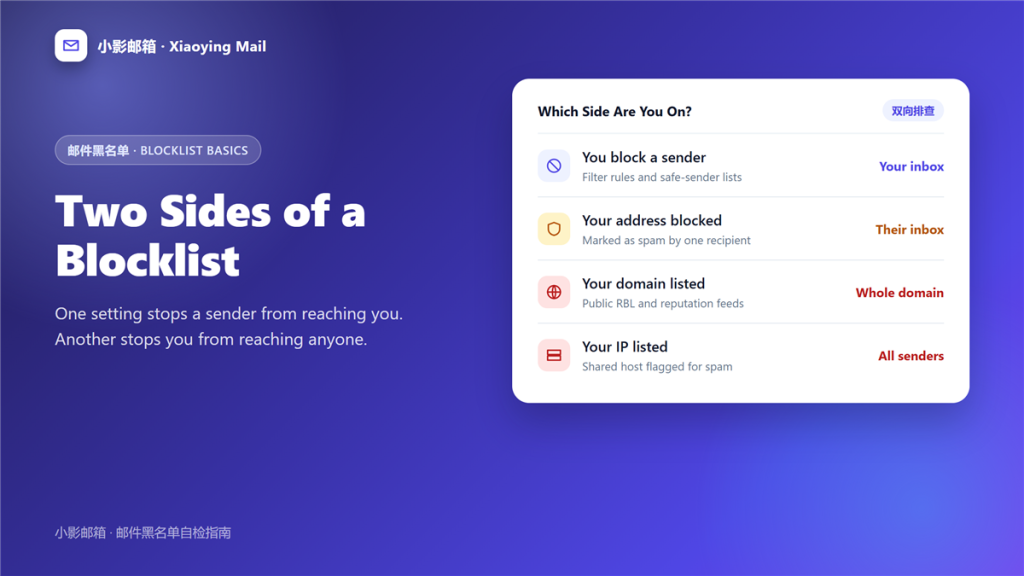
What 邮件黑名单 really covers
邮件黑名单 is a phrase that hides two very different situations. In one, you are the one refusing mail; in the other, someone else is refusing yours.
I have been on both sides in the same week. A filter I wrote in 2019 was quietly eating invoices I needed, and a shared host I used had one address listed on a public blocklist that four large providers query. Both problems looked identical from the inbox, and neither announced itself as a 邮件黑名单 event.
Key Takeaways
- Blocking a sender is local, instant and fully reversible.
- Being blocked can happen at one inbox or across thousands.
- A 邮件黑名单 that matters most often lives at the recipient.
- Public lists are queried by gateways, not by people.
- Shared hosting means a neighbour can list you.
- Authentication records prevent most accidental listings.
- Delisting requests take hours, sometimes days.
When you are the one blocking
Blocking is the simpler half of 邮件黑名单 because you hold the switch. Furthermore, undoing it costs one click, which is why this side never becomes an emergency.
Address and domain rules
A rule that matches an address or a whole domain sends matching mail straight to the bin. However, a domain rule on a shared consumer domain is blunt, because it also hides legitimate senders.
Spam reports
Reporting a message as spam teaches both your client and your provider. Consequently, repeated reports build an automatic list that you never wrote by hand.
Filters and folders
A filter that skips the inbox is a soft form of 邮件黑名单, and it is the version people forget. Notably, mail routed to a folder you never open is invisible rather than deleted.
When you appear on a 邮件黑名单
Here the 邮件黑名单 belongs to someone else, so you cannot inspect it or edit it. Therefore, diagnosis matters more than speed.
Blocked by one recipient
One person marked you as spam once. As a result, only their mailbox refuses your mail, and the fix is a polite request rather than a technical change.
Listed on a public blocklist
Public lists publish ranges and domains that gateways reject on sight. Moreover, a listing can block every message from a domain without a single human decision.
Guilt by shared IP
On shared hosting you inherit the neighbours. In practice, one abusive account on the same address can put a 邮件黑名单 entry next to your name.
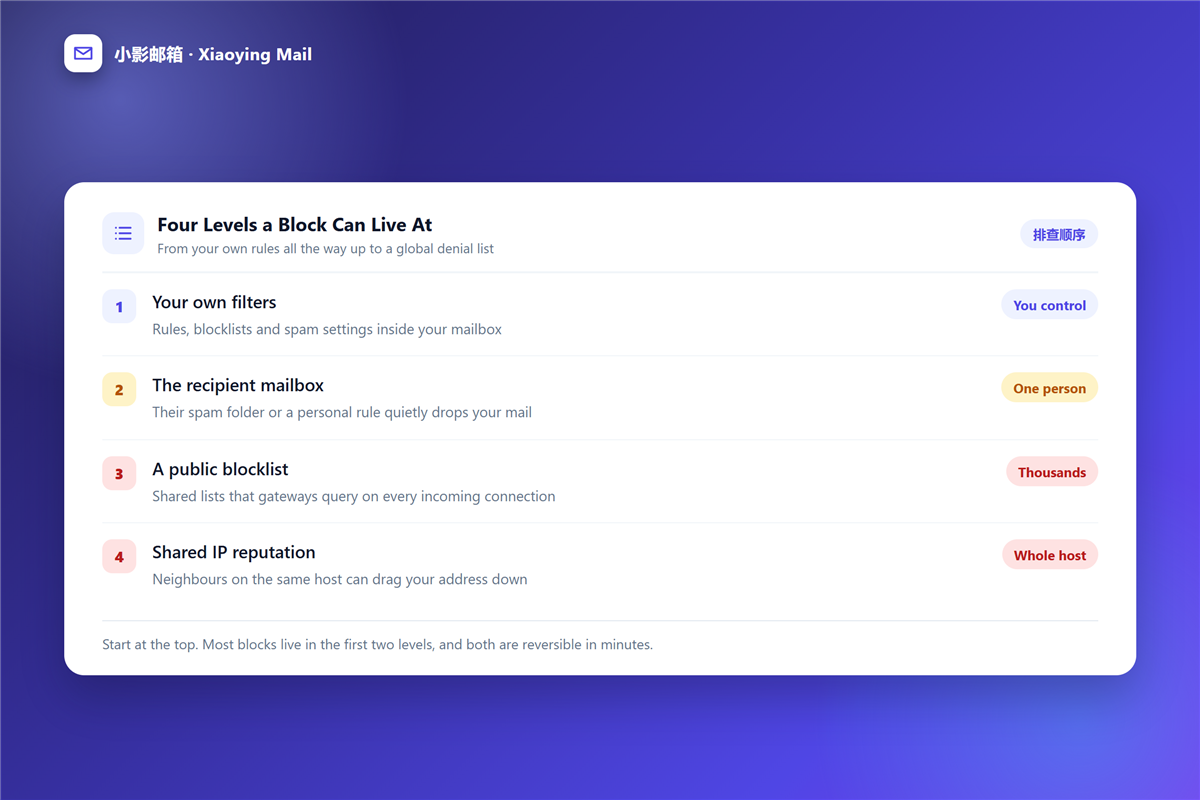
How to check whether a 邮件黑名单 includes you
Start with evidence rather than assumption, because a bounce message names the reason more often than people expect.
Read the 邮件头 first. The rejection line usually quotes the list name and a lookup link, and that single line turns a vague 邮件黑名单 worry into a specific task.
Second, run a lookup against the public lists that large providers use. Additionally, send a test to an address at a different provider, because a local block and a network block behave differently.
What gets an address listed
Most 邮件黑名单 entries trace back to a small number of habits, and none of them require bad intent.
- A sudden spike in volume from a quiet domain.
- Recipients marking bulk mail as 垃圾邮件 in volume.
- Missing SPF, DKIM or DMARC records.
- A compromised account sending on your behalf.
- A shared host with one abusive tenant.
How to get off a 邮件黑名单
Delisting is a process rather than a setting. Consequently, work through the steps in order and expect a delay.
- Confirm the exact list and the exact entry.
- Stop the behaviour that caused the listing.
- Fix authentication records before you ask for removal.
- Submit the delisting form on the list operator site.
- Run a 邮件转发 audit if a rule is amplifying volume.
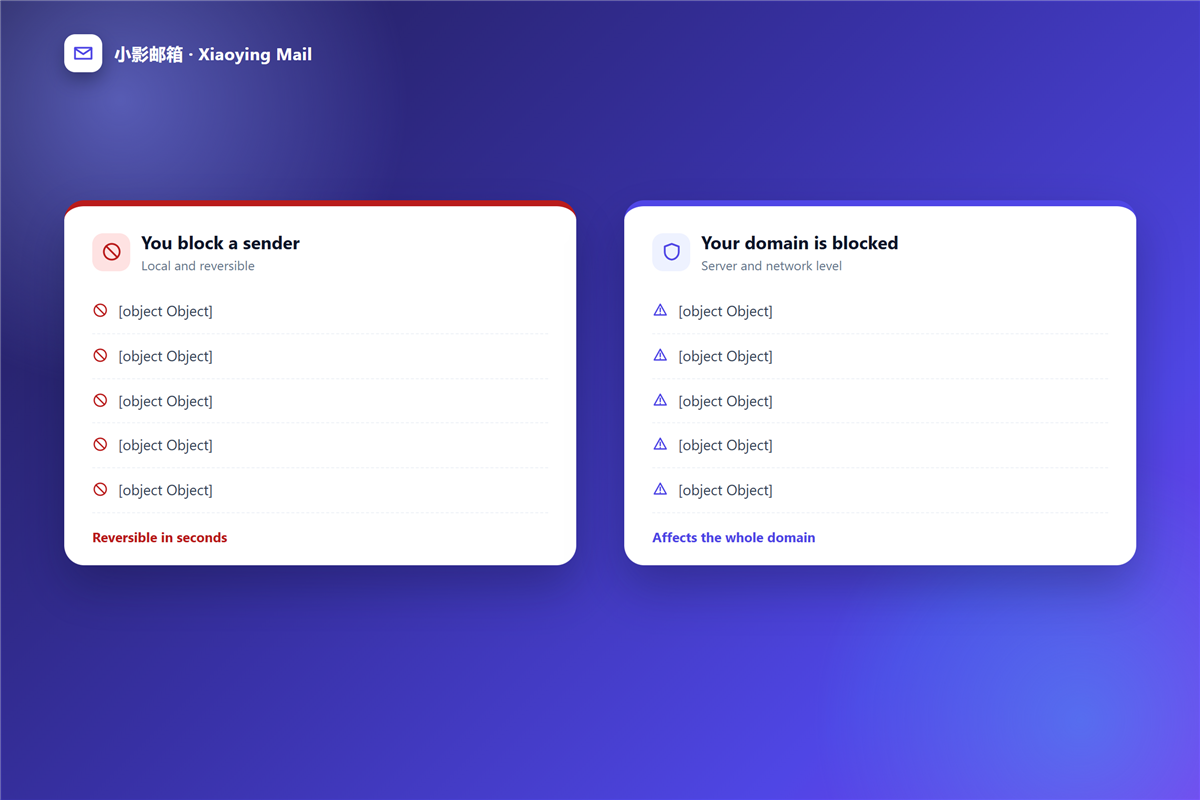
What a 邮件黑名单 cannot do
A public 邮件黑名单 does not read your message, and it does not judge your writing. Instead, it answers one question about reputation, which is why a clean list still allows a poorly written message to land in spam.
Similarly, a local block cannot follow your mail to another provider. Indeed, the two mechanisms rarely overlap, and treating them as one problem wastes time.
How authentication keeps you off the lists
Three DNS records do most of the work, so the effort is front-loaded and small.
SPF states which servers may send for your domain. DKIM signs the message so a receiver can verify it. DMARC then tells that receiver what to do when both checks fail. Together they make forgery harder, which reduces complaints and the chance of a 邮件黑名单 entry you did not earn.
If you also forward mail between providers, check that habit too, since a forwarded message can fail authentication at the destination and produce a 邮件退信 that looks like a block.
Frequently asked questions
Is 邮件黑名单 permanent?
No. Most public lists remove an entry once the underlying cause is fixed, and a local block disappears as soon as a rule is deleted.
Can I check my own domain?
Yes, and you should do it before a campaign rather than after. Free lookups exist for the major lists, and they take seconds.
Does a 邮件黑名单 block a whole domain?
Sometimes. A domain listing affects everyone who sends from it, while an address listing affects one mailbox.
Why does mail go to spam instead of being blocked?
Gateways prefer to soften a verdict. Therefore, a borderline sender often lands in the spam folder rather than on a 邮件黑名单.
References
延伸阅读
- 《邮箱域名怎么用?Running Email on a Domain You Own》
- 《邮件群发怎么发?Sending to Many Without Landing in Spam》
- 《邮件认证怎么做?SPF, DKIM and DMARC》
- 《邮箱解封怎么申诉?Signals, Steps and Timelines》
- 《邮件误判怎么办?Why Good Mail Lands in Spam》
- 《邮件发送失败怎么办?Before It Ever Leaves》
- 《邮件白名单怎么设?Where It Helps and Where It Leaks》
- 《邮件投递率怎么提升?Records, Reputation and Inbox Placement》
- 《邮件预热怎么做?A Four-Week Ramp for New Domains》
- 《邮件信誉怎么养?What Filters Remember About You》
- 《邮件合规要做什么?Consent, Sender and Opt Out》
- 《邮件蜜罐是什么?Addresses Nobody Should Mail》
- 《邮件到达率怎么看?Did It Really Land?》
- 《邮件列表清洗怎么做?Clean Before You Send》
- 《邮件反垃圾怎么做?Keep Junk Out of the Inbox》
- 《邮件质量分怎么看?What Filters Score》
- 《邮件专用IP 是什么?Your Own Lane》
- 《邮件屏蔽怎么做?When to Cut Ties》
- 《邮件投诉率怎么降?Keep Complaints Near Zero》
- 《邮件申诉怎么写?Asking to Be Let Back In》
评论
还没有评论,来说两句吧。以下为本文的引用通告: