 小影邮箱
企业邮箱怎么选?Domain, Records and Admin Work
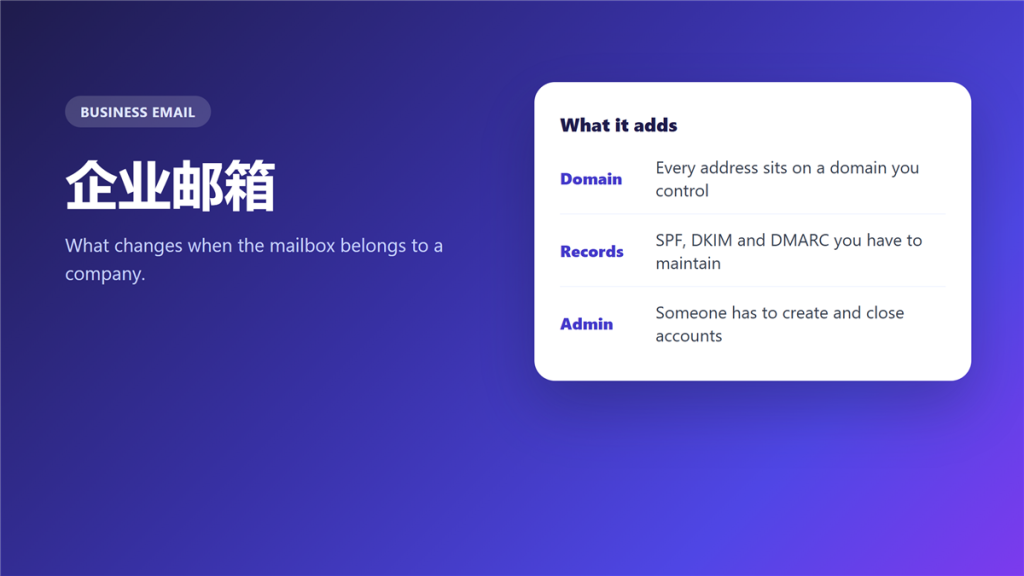
What 企业邮箱 changes about the work
企业邮箱 is not a better inbox. It is a mailbox that carries a domain, and with the domain come duties that a free address quietly handles for you. A five person studio I worked with moved from free addresses to their own domain in an afternoon and then spent three weeks on the DNS records. Nobody had warned them that the sending side is configuration work rather than a purchase.
Key Takeaways
- 企业邮箱 is a mailbox on a domain the company controls.
- Authentication records are the part most teams underestimate.
- Addresses survive a change of mail host.
- Somebody has to own account creation and closure.
- Retention duties arrive with the domain.
- A free address is still the right answer for some teams.
Five things 企业邮箱 adds
- A domain you control, rather than one you use by permission.
- Authentication records that decide whether your mail is trusted.
- An administrator who creates and closes accounts.
- A shared address book that new starters inherit.
- A retention duty, which is a legal question rather than a technical one.
The second item is where most projects stall, and the records are explained in 邮件认证. The first item is a separate purchase, and the setup is in 邮箱域名. 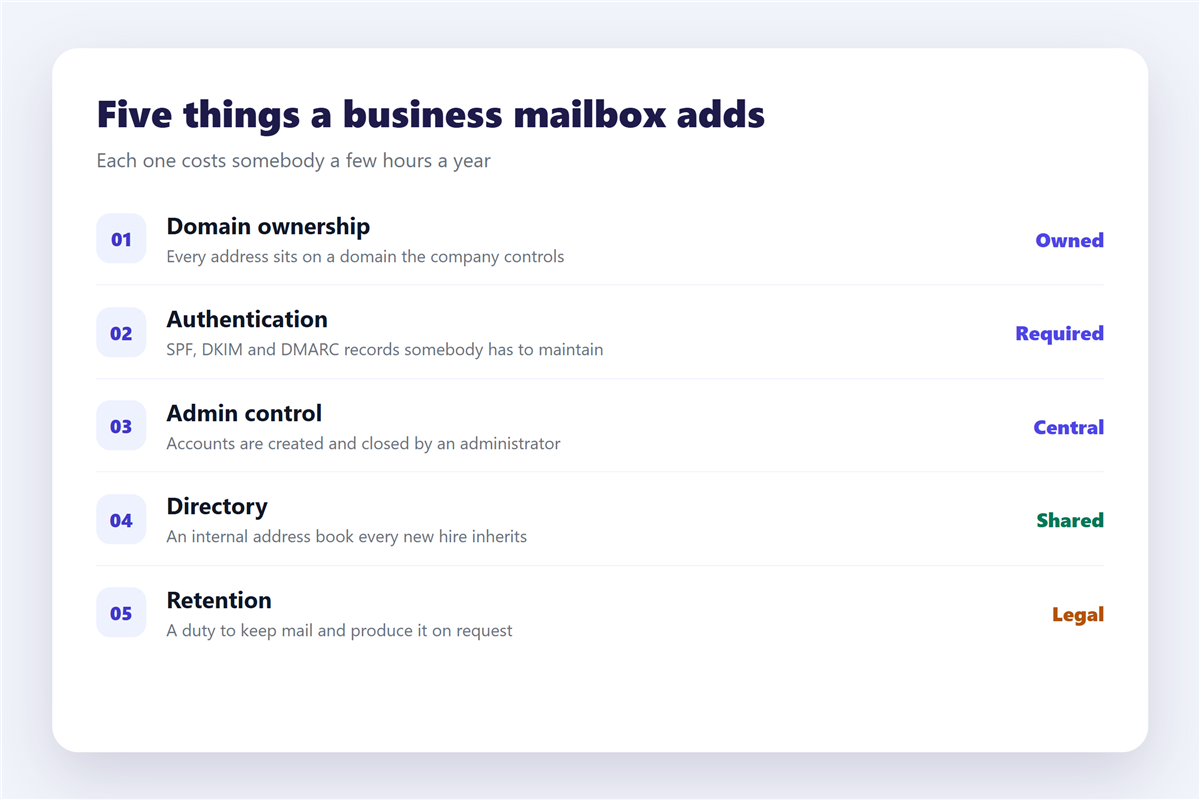
Why the domain is the whole point of 企业邮箱
Because the domain is yours, the address is portable. Changing mail host becomes a DNS change rather than a rename of every person in the company. Furthermore, spoofing protection belongs to you. A stranger can send mail that looks like it comes from a free provider address and nobody notices; a stranger cannot easily forge your domain once the records are published. That asymmetry is the strongest argument for owning one. 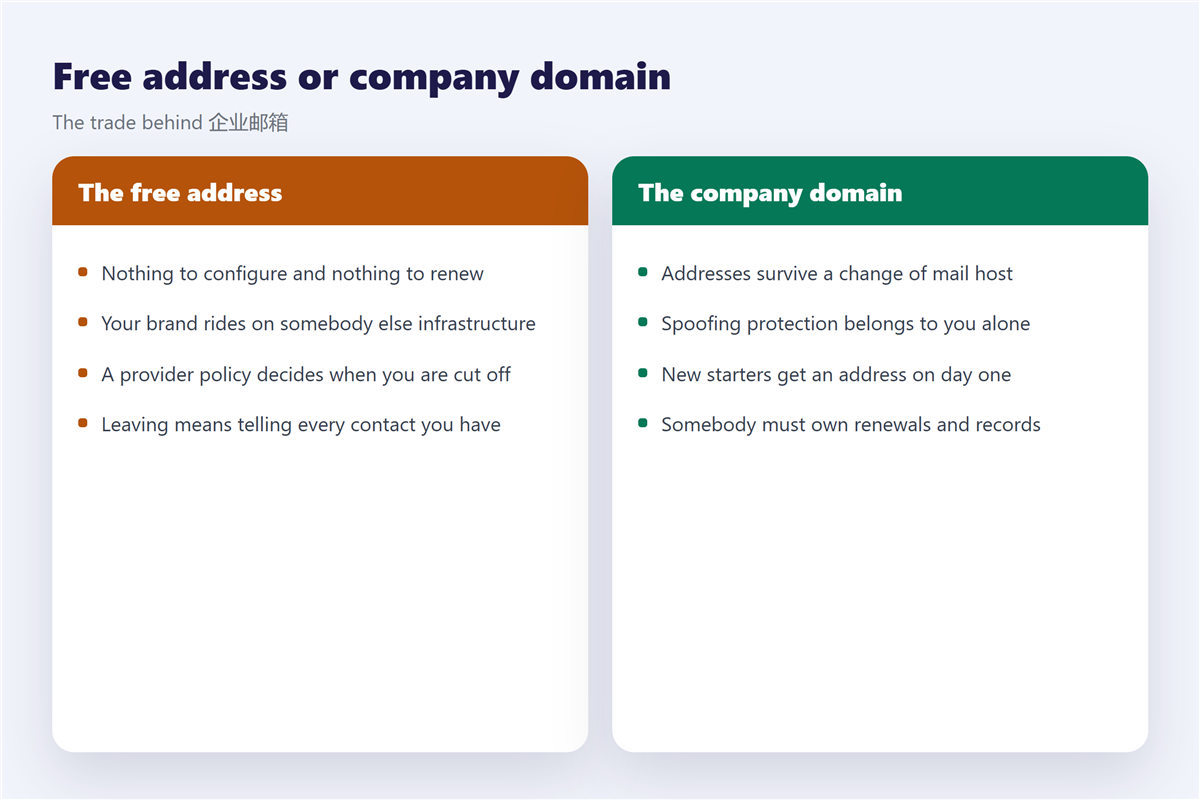
What 企业邮箱 costs beyond the subscription
The fee is the small part. The recurring costs are attention and ownership.
Renewals
Somebody must renew the domain before it expires, because an expired name is the one failure that is genuinely hard to undo.
Records and offboarding
Somebody must keep the authentication records correct when a new tool starts sending mail, and must close accounts when people leave. That last step is the one quietly skipped. The practical split between personal and shared mailboxes is covered in 邮箱多账号.
When 企业邮箱 is the wrong choice
Three situations are better served by something smaller. A team of one who never sends from a branded address gains little beyond a bill. In addition, a project that needs many throwaway reply addresses is better served by aliases on one domain, which is the approach in 邮箱小号. Finally, if you only need a stable address for paperwork, a single address on a domain you own is enough, and the transport behind it is described in 邮件服务器.
Frequently asked questions
Is 企业邮箱 more secure than a free address?
Not automatically. It is more controllable, and control only helps when somebody uses it.
Can 企业邮箱 work with a free mail host?
Yes, if the host lets you publish your own domain records. That is the usual low cost route.
How long does 企业邮箱 take to set up?
The mailbox takes an hour. The records take a week to settle, and reputation takes longer still.
Do I need 企业邮箱 for a one person business?
It helps when clients see the domain, and it is optional when they never do.
评论
还没有评论,来说两句吧。以下为本文的引用通告: