 小影邮箱
邮件审计怎么做?Evidence, Scope and Custody
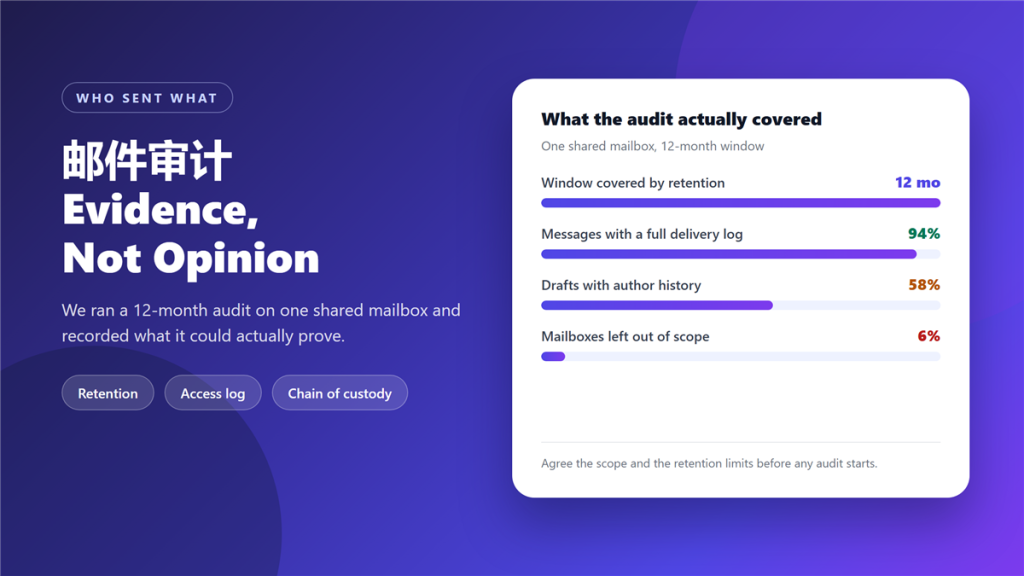
A 邮件审计 answers questions about who sent what, when, and whether the record behind it can be trusted. It is an evidence exercise, so the useful output is a list of things you can prove rather than a story about what probably happened.
We ran a 12-month audit on one shared mailbox and recorded what the evidence actually supported. The gap between what people assumed and what the logs showed was wider than we expected.
Key Takeaways
- 邮件审计 documents evidence rather than intent.
- It can show that a message left your server, and which account sent it.
- It cannot show that a person read the message.
- Retention policy sets a hard boundary on what a 邮件审计 can reach.
- Drafts are the weakest evidence, because author history is often absent.
- Delivery records are the strongest, because servers timestamp everything.
- Agree the scope in writing before the first export.
What a 邮件审计 can prove
Server records are precise about transport. A 邮件审计 can establish that a message was accepted by your server, which authenticated account submitted it, and when it left your infrastructure.
It can also establish whether the content changed in transit, provided the message was signed. Notably, that is the part most people assume is automatic, and it only works when DKIM is in place. Our explainer on 邮件认证 covers what a valid signature actually guarantees.
What a 邮件审计 cannot prove
It cannot prove that a person read a message. A delivery record shows acceptance by a server and nothing more, so any claim about reading has to come from another source, and most of those sources are unreliable.
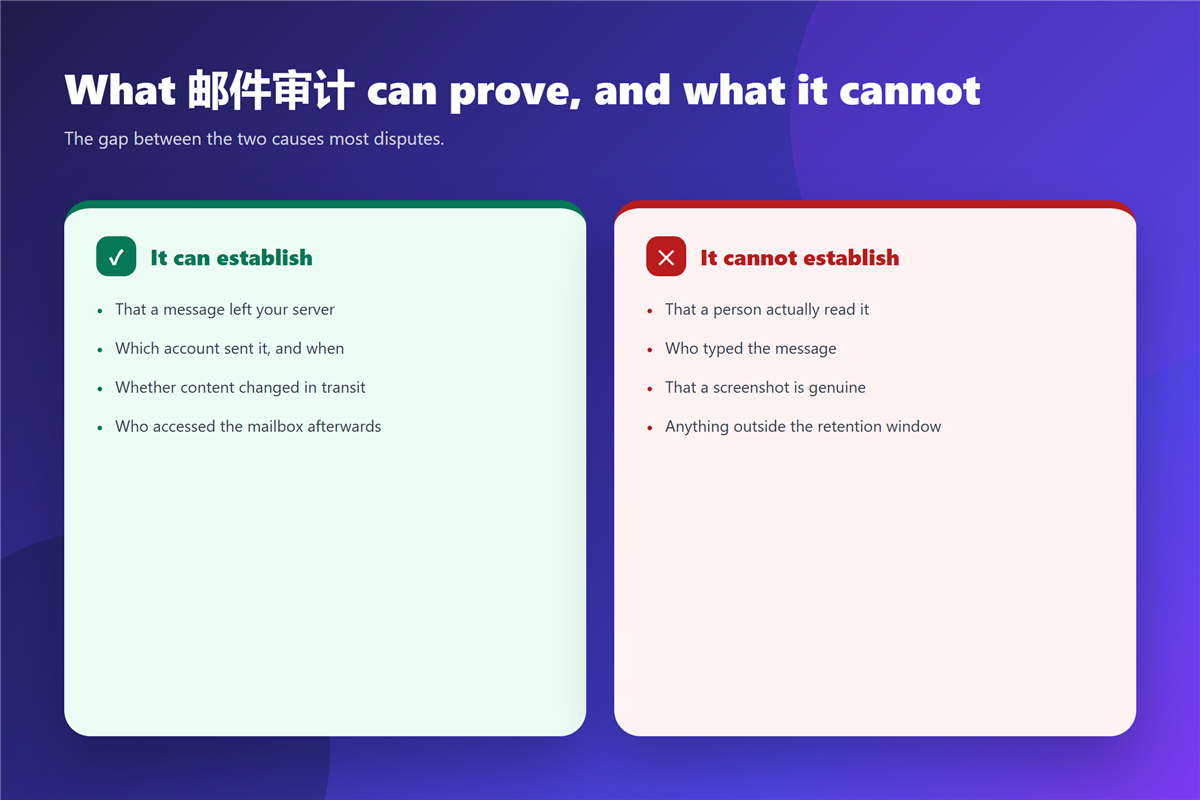
It also cannot prove who typed a message, unless the account was single-user and the session history is intact. Shared mailboxes break that link completely, which is why our guide to 邮件日志 treats the log as transport evidence rather than human evidence.
The five areas a 邮件审计 must cover
An audit that skips any of these five areas produces conclusions that will not survive scrutiny.

- Scope: which mailboxes, which period and which people.
- Retention limits: what has already been deleted by policy.
- Access history: who opened the mailbox, and from where.
- Delivery evidence: send, relay and acceptance records.
- Chain of custody: how the export was created, hashed and stored.
Chain of custody is the item most often missing. Without a hash taken at the moment of collection, any later copy can be challenged, and the whole 邮件审计 turns into a debate about the file rather than the facts.
Retention decides what a 邮件审计 can reach
Retention is not a technical detail. It is the outer boundary of the investigation. If your mail server keeps 30 days of logs, an audit covering last year has no delivery evidence at all.
Check two numbers before you promise anything. The first is how long message logs are retained. The second is whether deleted mail is recoverable, and for how long. Our notes on 邮件归档 and 邮件备份 cover the difference between the two, which matters here.
Running a 邮件审计 without breaking trust
Technical scope is easy compared with the human side. State the purpose, the scope and the limits in writing before collection begins, and tell the people whose mailboxes are in scope.
Surprise audits produce accurate evidence and lasting damage. A 邮件审计 announced in advance still finds what it needs, and it leaves you with a team that does not assume the worst. Where the account belongs to an organisation rather than a person, our overview of 企业邮箱 covers the administrative controls that make scope easy to define.
FAQ
Do I need legal advice before a 邮件审计?
Usually yes, and certainly whenever the result may be used in a dispute. Local rules on monitoring employee mail vary more than people expect.
How long should an audit take?
Collection is fast and interpretation is slow. Two weeks of review for a single mailbox is a realistic figure.
Can a 邮件审计 use screenshots?
Only as supporting material. Screenshots are easy to alter, so they rarely stand alone as evidence.
Should employees be told about a 邮件审计?
In most cases yes, and in advance. Covert audits are legally riskier and rarely produce better evidence.
评论
还没有评论,来说两句吧。以下为本文的引用通告: