 小影邮箱
共享邮箱怎么用?Ownership, Labels and Handover
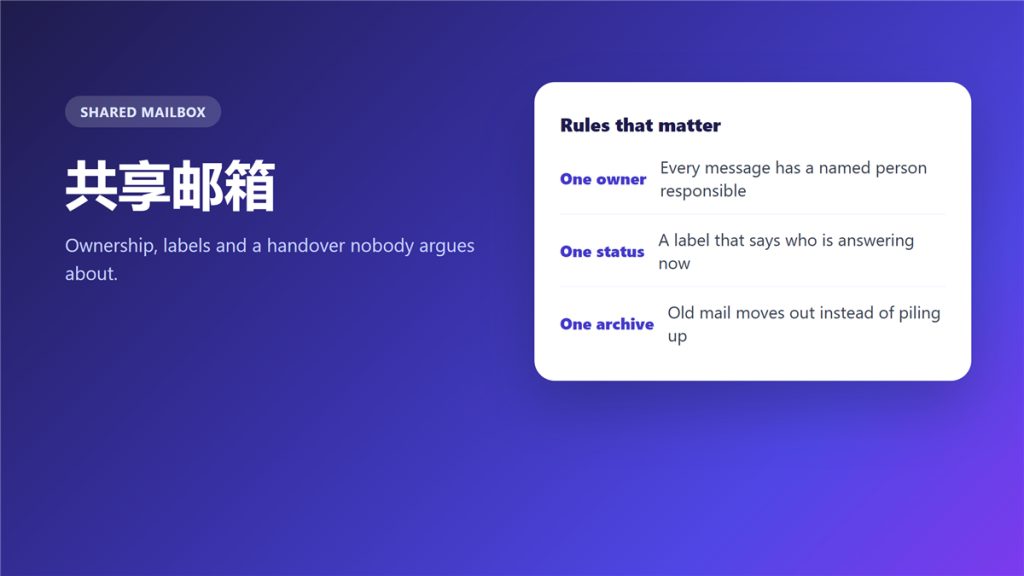
What 共享邮箱 changes about ownership
共享邮箱 removes the assumption that a message belongs to one person. That is its whole value, and it is also the reason shared mailboxes rot faster than personal ones.
A two person agency ran support from one address for a year and then found three unanswered threads from the same client. Both partners had assumed the other had replied, and the 共享邮箱 had never made that assumption visible to either of them.
Key Takeaways
- 共享邮箱 works when every thread has one named owner.
- A status label replaces the guesswork.
- Reply identity has to be decided once, in writing.
- Closed threads should leave the shared box.
- Confidential mail does not belong in a shared box.
- Holiday handover is the real test.
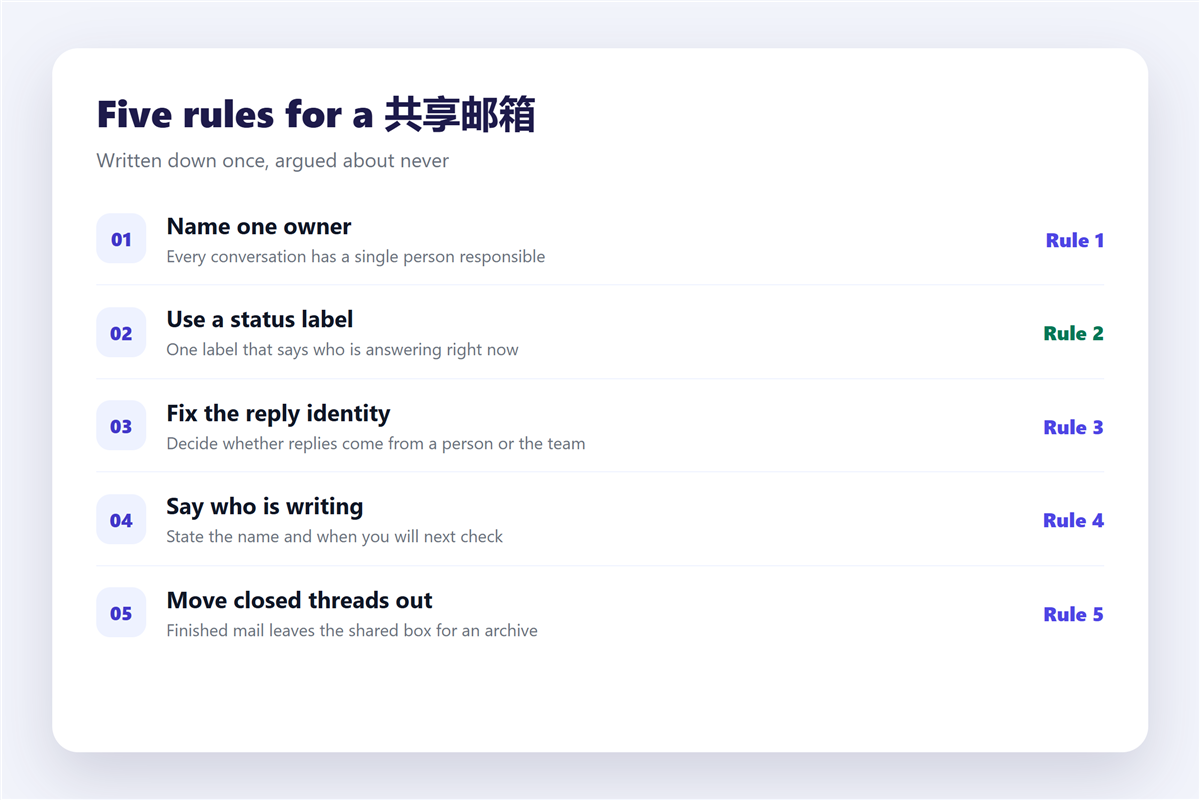
Five rules for a 共享邮箱
- Name one owner for every conversation.
- Use a single status label that says who is answering.
- Decide whether replies come from a person or from the team.
- State the writer name and when they will next check.
- Move closed threads out to an archive.
The first rule prevents the most damage, so it belongs in writing rather than in habit. Claiming a message is simpler than it sounds, and the routine is in 邮件标记.
Who answers as whom in a 共享邮箱
The identity question causes more friction inside teams than any technical setting does.
The team address
Replies go out under the shared address, with the writer name in the body. Therefore the customer always sees one correspondent, which is the point of the arrangement.
The individual address
Replies go out under a personal address, with a note that the shared box was read. Notably, this is easier to trace and harder for the customer to follow.
Mixing the two within one week is what confuses people. Choose one as the default and use the other only for exceptions, and the fields that make the first pattern clear are described in 邮件签名.
Keeping a 共享邮箱 from filling up
A box shared by three people fills about three times as fast, and the arrival of new mail is the only thing anybody notices.
Because nothing feels like somebody else problem once it is closed, agreed closing rules matter far more than storage. Moving resolved threads into a shared archive keeps the working box readable. Meanwhile the address book has to be shared too, or each person builds a private copy and the team loses track of who is a customer, which is the problem behind 邮箱联系人.
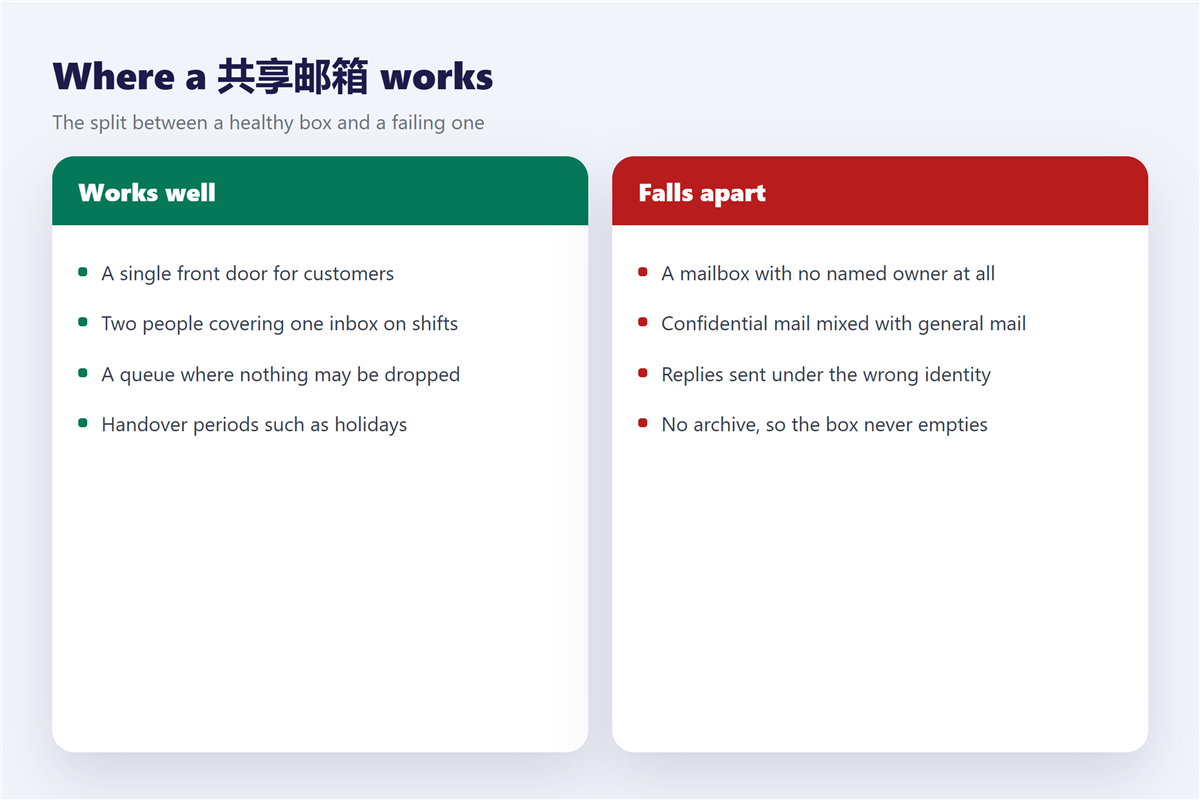
Where a 共享邮箱 falls apart
Two failure modes account for most of the mess.
Nobody owns anything
Without a named owner, ambiguous threads wait for a volunteer who never arrives. Notably, the busiest person is usually the one who picks it up, which is how the queue drifts toward one desk.
Confidential mail in the general queue
Salary letters and legal notices should not sit where four people can read them by accident. Separating that traffic at arrival costs one rule, and the migration angle is covered in 邮箱转移.
If the box is really serving one person, the simpler arrangement is described in 邮箱多账号.
Frequently asked questions
How many people can share one 共享邮箱?
Technically many. Practically, past four or five the status labels stop keeping up and a ticketing tool earns its place.
Should a 共享邮箱 have a password per person?
Ideally yes, and most providers now support individual logins. A single shared password removes all traceability.
Can a 共享邮箱 send as an individual?
Usually yes, with the right setting. Decide the default before customers start guessing who wrote to them.
When should a 共享邮箱 become a shared inbox tool?
When two people answer the same thread, or when nothing can be measured. Those two signals are enough.
评论
还没有评论,来说两句吧。以下为本文的引用通告: