 小影邮箱
邮件多语言怎么写?One Message, Two Languages
Key Takeaways
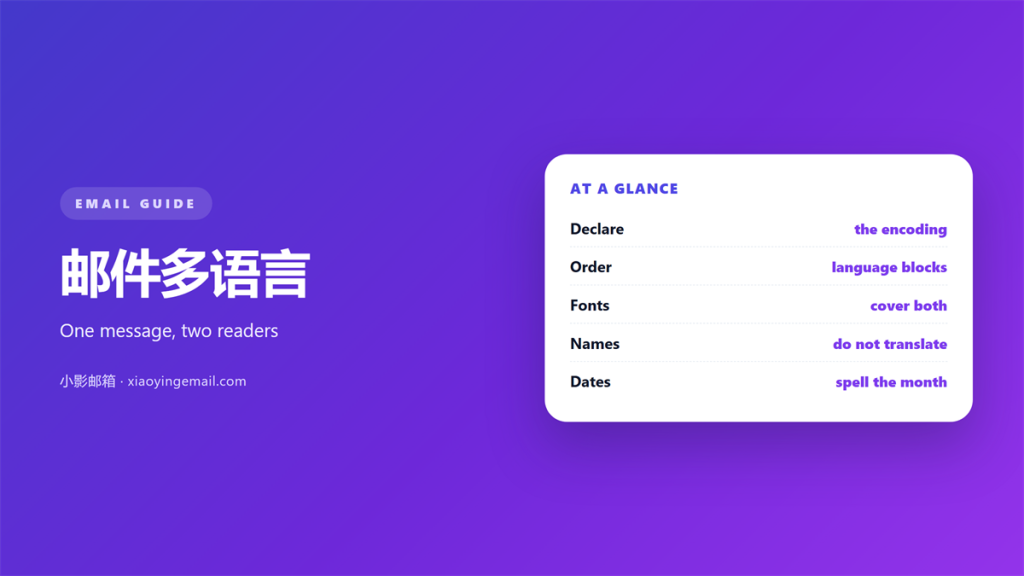
- 邮件多语言 means one message, two readers.
- Encoding decides whether text survives.
- Pick one primary language for the body.
- Keep names and addresses in their own script.
- Test on a client you did not write for.
What 邮件多语言 actually means
邮件多语言 is a message built for readers who do not share a first language. It may hold two languages at once. It may also hold one language and very clear words.
The hard part is not translation. The hard part is survival. Text must arrive intact on a client you have never seen.
That turns the task technical. Encoding, fonts and ordering decide the result.
A translation is only one tool. Clear structure and short words often do more work.
A good 邮件多语言 message reads as one message, not as two stitched halves.
Why 邮件多语言 breaks on encoding
Encoding is the map between bytes and characters. The sender picks one map. The reader may guess another.
When the guesses differ, text turns into strange symbols. That is the classic mojibake problem.
Modern mail uses UTF-8 in almost every case. It covers Latin, Greek, Cyrillic, Arabic and Chinese in one map.
Old clients may still default to a local encoding. Test that case before you send a 邮件多语言 message to a mixed list.
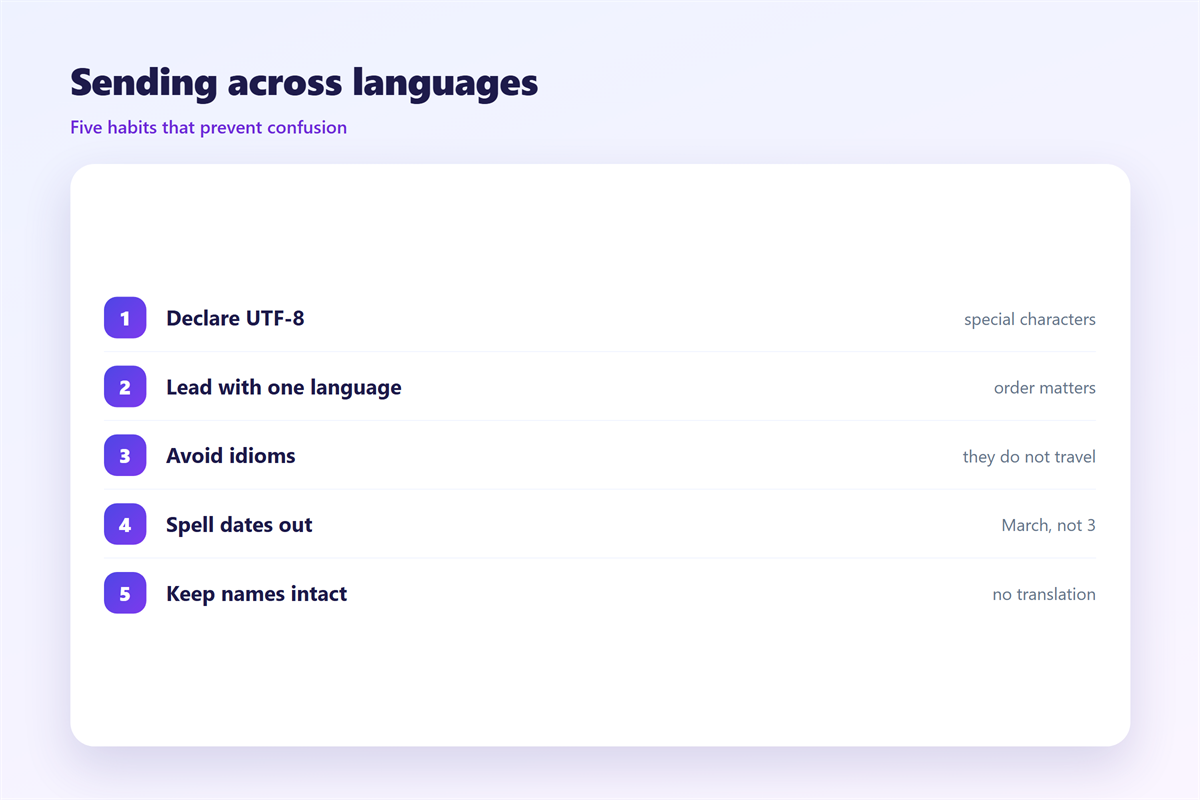
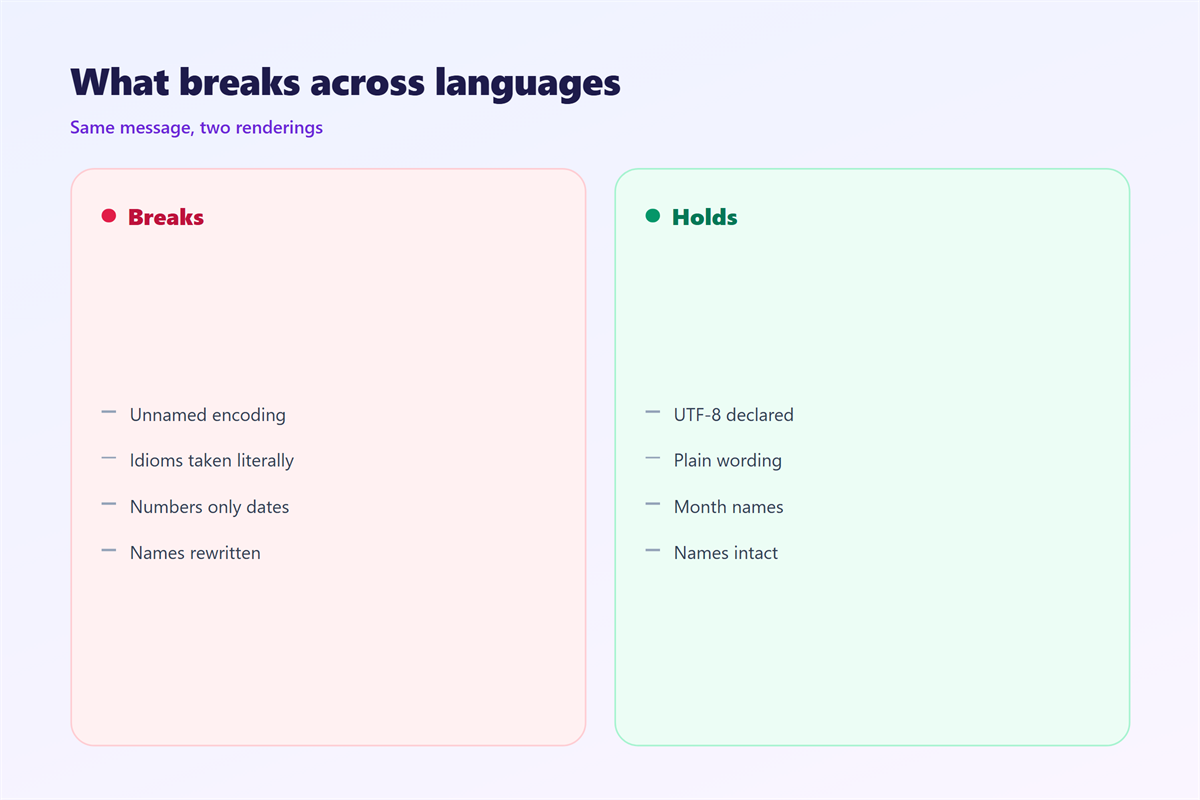
So the rule is short. Use UTF-8, and state it in the message headers.
Writing 邮件多语言 without a babble
Choose one primary language for the body. Put the other one second.
Keep sentences short in both. Short lines survive translation better than long ones.
Avoid idioms and jokes. They rarely cross a language border well.
Repeat the key point in both languages if the topic is serious. A single version can be misread.
Name people and places exactly. A translated name is often the wrong name.
Naming people and places
邮件多语言 work often starts with names. A list of names is the first thing to check.
Keep a name in its original script. A transliterated name may not match a passport or a company record.
Add a short note when a name is unusual. That helps a reader who has not seen it before.
Do not shorten a name to fit a column. A clipped name looks careless.
Be consistent across the thread. One spelling error is easy. Two spellings of one name is confusing.
Fonts that carry more than Latin
A font must contain the letters you use. A Latin-only font cannot show Chinese or Arabic.
Stay with common system fonts. They exist on almost every device.
A 邮件多语言 message may need two fonts. Set a stack that covers both scripts.
Test the file in a client that lacks your first choice. The fallback is what the reader will actually see.
Ordering two languages in 邮件多语言
Order signals who is first. Put the reader’s language first when you know it.
When the audience is mixed, stay with one order. Switching order inside a thread confuses people.
Do not mix the two languages inside one sentence. That slows every reader down.
Format dates and numbers the same way throughout. A mixed format reads as a mistake.
Keep both versions visually equal. A smaller second language looks like an afterthought.
Greetings and closings
A greeting sets the tone. A wrong one sounds cold or too familiar.
When in doubt, use a plain greeting. Titles and first names vary by country.
Keep the closing short. A simple closing travels better than a formal phrase.
Match the greeting to the relationship. A new contact and an old client need different words.
Keeping the reply in the same language
Reply in the language of the last message. A sudden switch feels like a new person.
If a reader writes in their own language, mirror it when you can.
When you cannot mirror it, say so once. A short note is better than silence.
Record the language on the contact card. That saves the next writer.
Where 邮件多语言 fail
邮件多语言 fail at the encoding step first. One wrong setting turns a greeting into symbols.
They fail again on the recipient’s name. A missing font hides half of it.
They fail a third time on dates. A short date means two different days in two countries.
They also fail in a signature. A translated job title may mean something else abroad. Keep the local title too.
None of this needs a translation agency. It needs care with the basics.
Testing your 邮件多语言
Send the message to a colleague abroad. Ask them to open it in their own client.
Ask a reader to reply with the key fact. If they cannot, one of the basics is wrong.
Check three things. The characters are correct. The names look right. The dates cannot be misread.
Test each 邮件多语言 message in a client you did not write it in. The encoding faults are explained in 邮件乱码, and the type choices sit with 邮件字体. The rich and plain forms are compared under 邮件格式, while the setup itself is covered in 邮件客户端.
FAQ
Does 邮件多语言 need translation?
Not always. A short message in simple English often works. Add a translation only when the topic is legal or risky.
Which encoding should I use?
Use UTF-8 whenever the client allows it. It covers almost every script in one setting.
How do I order two languages?
Put the reader’s language first. Keep that order across the whole thread.
Why does 邮件多语言 break on names?
Usually because a font is missing a letter. A system may also replace a character. Check the full name after sending.
评论
还没有评论,来说两句吧。
评论功能已关闭。