 小影邮箱
邮件法律效力怎么看?When Mail Becomes a Record
Key Takeaways
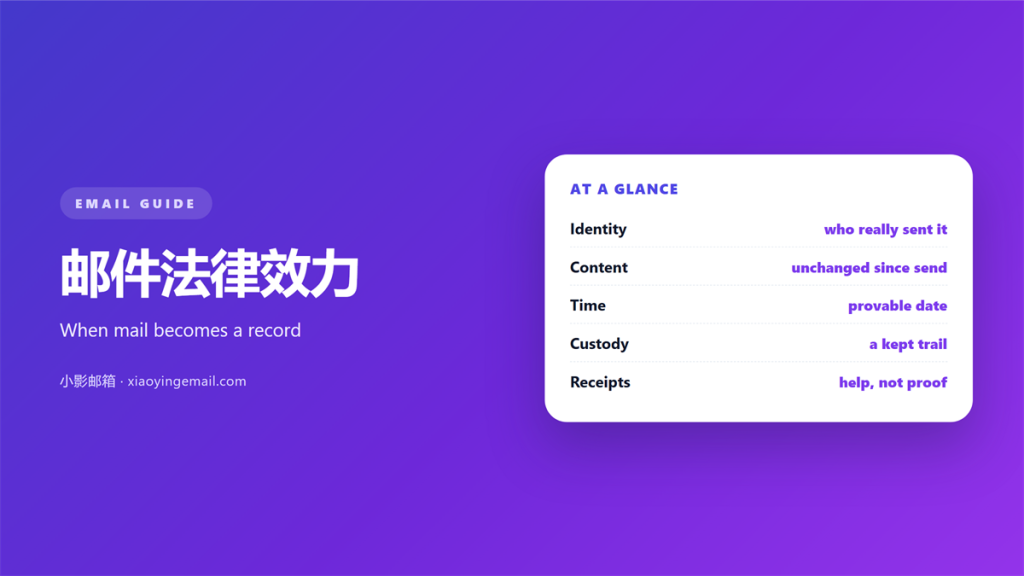
- A message is only useful later if it can be trusted.
- 邮件法律效力 starts with a complete and unedited copy.
- Keeping a record means controlling who can change it.
- A read receipt proves far less than people assume.
- Plain, dated mail beats a clever format in most cases.
What 邮件法律效力 depends on
邮件法律效力 is about whether a message can stand as a record. It is not about how official it looks.
Two things matter most. The message must be genuine, and it must be kept intact.
Courts do not treat email as special. It is judged like any other document.
That is good news for careful senders. A clear message with a date is easy to trust.
A 邮件法律效力 question usually arrives long after the message. By then the habits are already set.
What counts as a record varies by place. The habits that protect you do not.
A clear message helps years later. A vague one helps nobody.
Ask what a reader would need to see. Then keep exactly that.
This article gives general principles only. A lawyer decides how they apply to your case.
Facts matter more than how official the file looks.
A message must be authentic
Authenticity means the message is what it claims to be.
The header carries the proof. It shows the sender, the route and the time.
邮件法律效力 begins with the original header. Lose it and the message is only a copy.
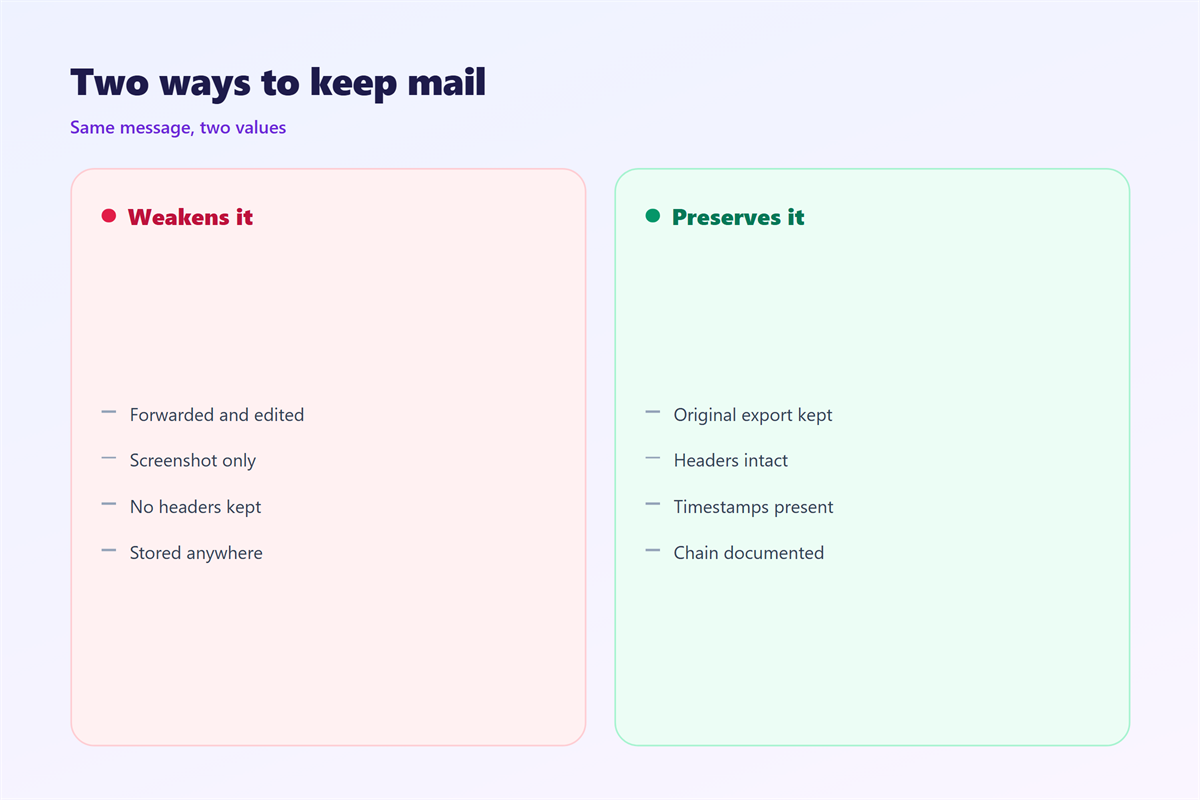
A forward usually breaks that proof. The original header is copied into the body, not kept whole.
An authentic message keeps its 邮件法律效力. A pasted copy often does not.
Time zones can confuse a date. Note the offset when timing matters.
A digital signature can strengthen a message. It is useful and rarely required.
That is why the raw message is the safe version. Our notes on 邮件日志 list the header lines that matter most.
Keep the original. An edited copy invites doubt about everything else.
Keep the envelope as well as the body.
A message without a header is hard to trust. Keep the full item, not a screenshot.
The record, custody and 邮件法律效力
A record is only as good as its custody. Someone must control it over time.
A shared mailbox looks convenient and weakens control. Anyone with access can change it.
Good practice is boring. Store the message where edits are logged or prevented.
邮件法律效力 depends on custody, not on the file size.
A backup alone is not a record. It restores a system and proves little about a file.
Our guide to 邮件归档 explains how a stable archive works.
The chain of custody answers one question. Who held this, and could they have changed it?
邮件审计 is the process that answers it. A simple log of access is often enough to help.
That is where 邮件法律效力 is won or lost.
Set the archive so changes are visible. An audit trail beats a tidy folder.
Name the person responsible for the archive. Shared care becomes no care.
Set the rules before a dispute. A policy written afterwards looks like an excuse.
What a 阅读回执 does and does not prove
A read receipt feels strong and proves little.
邮件法律效力 does not grow because a receipt exists.
It can show that a message was opened. It cannot show who read it or what they understood.
A receipt also says nothing about the content. It proves a click, not agreement.
Receipts can also be refused. Many clients ask the reader before sending one.
Our page on the 阅读回执 covers this in detail. Treat it as a hint, not as proof.
Delivery is easier to prove. A server log shows the message was accepted.
Acceptance is not reading. Keep the two ideas apart when you describe events.
Delivery logs live with the provider. Export them if a dispute is likely.
Ask who could have opened the message.
When 邮件法律效力 is weakest
Some messages are hard to rely on later.
邮件法律效力 is weakest with informal messages, and they are the easiest to write.
The first is an unsigned forward. The original context is usually gone.
The second is a message with no clear author. A shared name hides who wrote it.
The third is an informal promise. A joke can read like a commitment years later.
None of these is a lost cause. They are simply weaker than a clear, dated message.
A summary written later is weaker than the message itself.
Keep the attachments with the message. A file without its context proves little.
Test 邮件法律效力 with one question. What would a stranger conclude from this message alone?
A short 邮件法律效力 review saves trouble later.
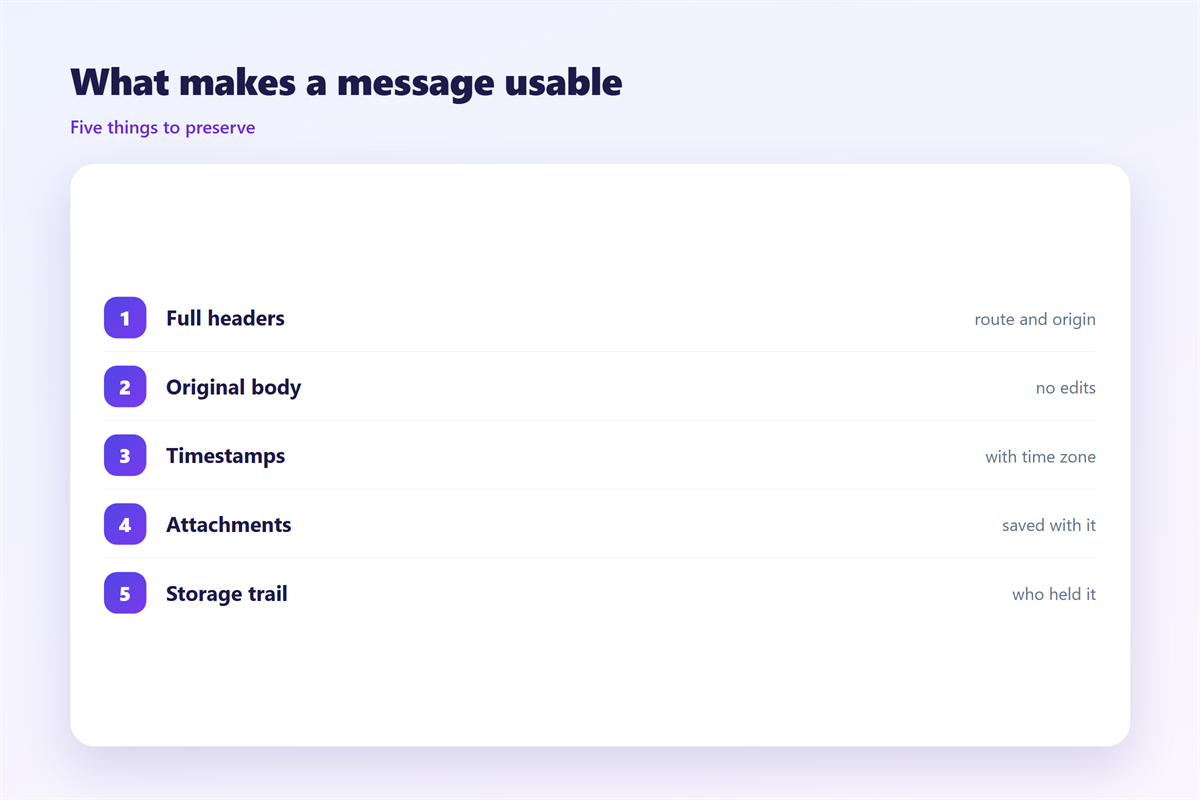
Then act. Write plainly, keep the original, and store it where it cannot change.
Three habits decide most of it. Be clear, keep the raw copy, and record who held it.
Act early, not after the dispute starts. Records are easier to protect in calm times.
Short notes age better than long ones.
FAQ
Is an email a legal document?
It can be. 邮件法律效力 depends on the facts of each case, not on the file type.
Does a 邮件法律效力 check need software?
Not always. A consistent archive and an access log cover many cases.
Do read receipts help in a dispute?
Only as a small hint. They rarely show who read a message or why.
What weakens 邮件法律效力 most?
Edited copies and unclear authorship. Both invite doubt about the whole record.
References
- IETF RFC 5322: Internet Message Format
- Cornell LII: Federal Rule of Evidence 901
- NARA: Email records frequently asked questions
评论
还没有评论,来说两句吧。
评论功能已关闭。