 小影邮箱
邮箱解封怎么申诉?Signals, Steps and Timelines
What 邮箱解封 actually means
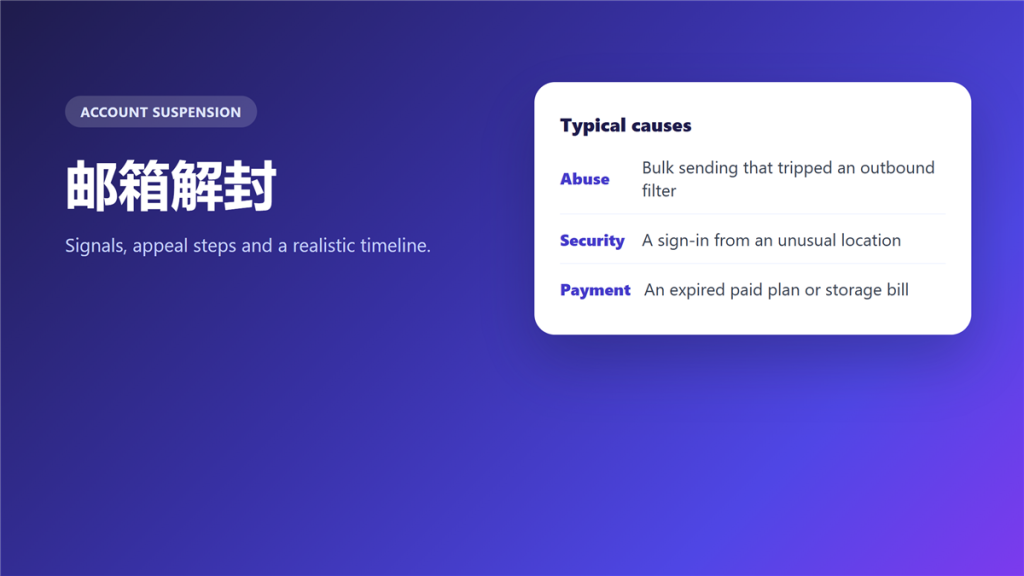
邮箱解封 is not one process, and the phrase covers three situations that behave differently. An account can be blocked for security, for billing or for abuse, and the appeal path differs in each case.
A client lost access on a Friday and wrote four appeals over the weekend, all from a second address, and every one of them was ignored. Once he used the official recovery flow tied to the account, the 邮箱解封 request was answered in two days.
Key Takeaways
- 邮箱解封 differs for security, billing and abuse blocks.
- Appeals sent from other addresses are usually discarded.
- Security blocks clear fastest and abuse blocks slowest.
- Never open a second account to argue the first one.
- Write one message and answer only the questions asked.
- Treat three to five working days as the baseline.
Three kinds of block behind 邮箱解封
The notice usually names the category, and the wording tells you which appeal to use.
Security blocks
These follow unusual sign-in activity and are the easiest to reverse. Therefore a verified recovery address and a working phone number resolve most of them without human review.
Billing blocks
A paid plan that lapsed restricts sending and sometimes sign-in too. Notably, these clear the moment payment lands, and no appeal is needed at all.
Abuse blocks
These follow complaints about bulk sending, phishing or fraud. Consequently a person reviews them, and they take the longest to resolve.
Five steps in a 邮箱解封 appeal
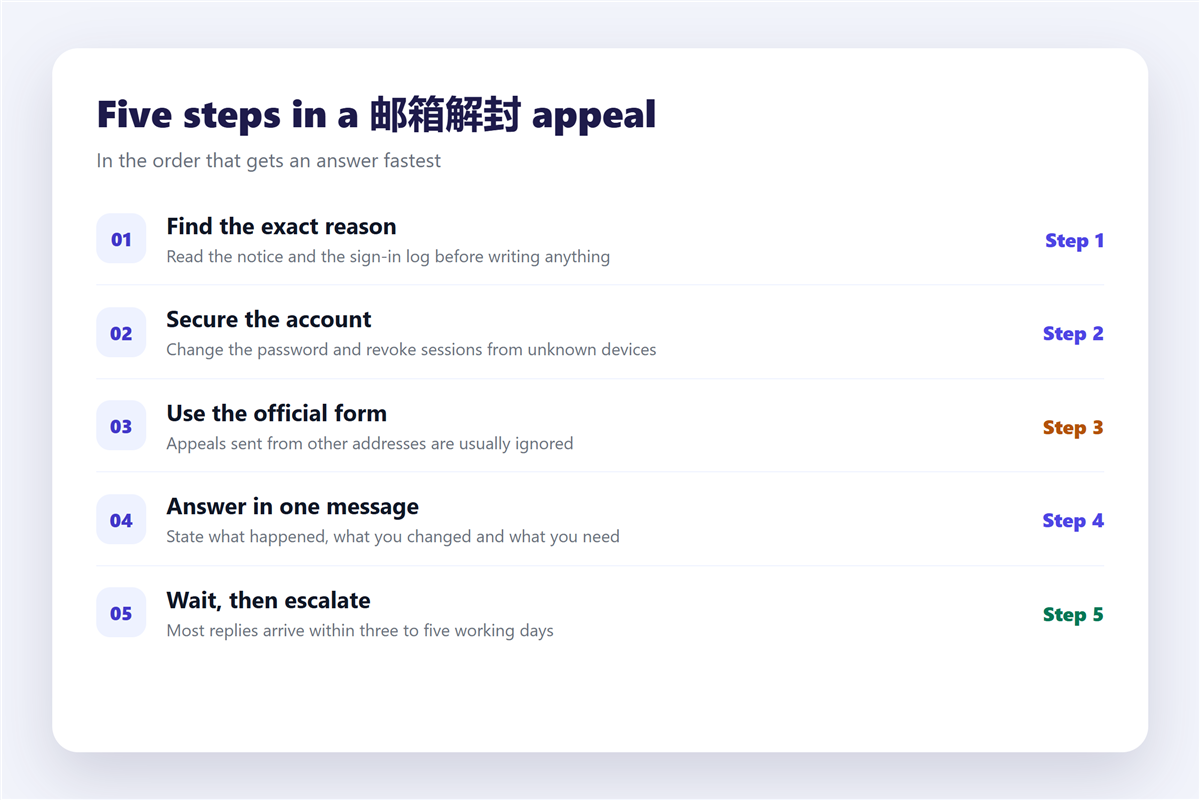
- Read the notice and the sign-in log before writing anything.
- Secure the account: change the password and revoke unknown sessions.
- Use the official recovery form, never a support address found elsewhere.
- Answer in one message: what happened, what you changed, what you need.
- Wait three to five working days, then escalate once.
The second step matters more than it looks. Moreover, an account restored without a password change is usually blocked again within a week. The signals that come before a security block are listed in 邮箱登录异常, and the credential rules in 邮箱密码 prevent the repeat.
What makes 邮箱解封 fail
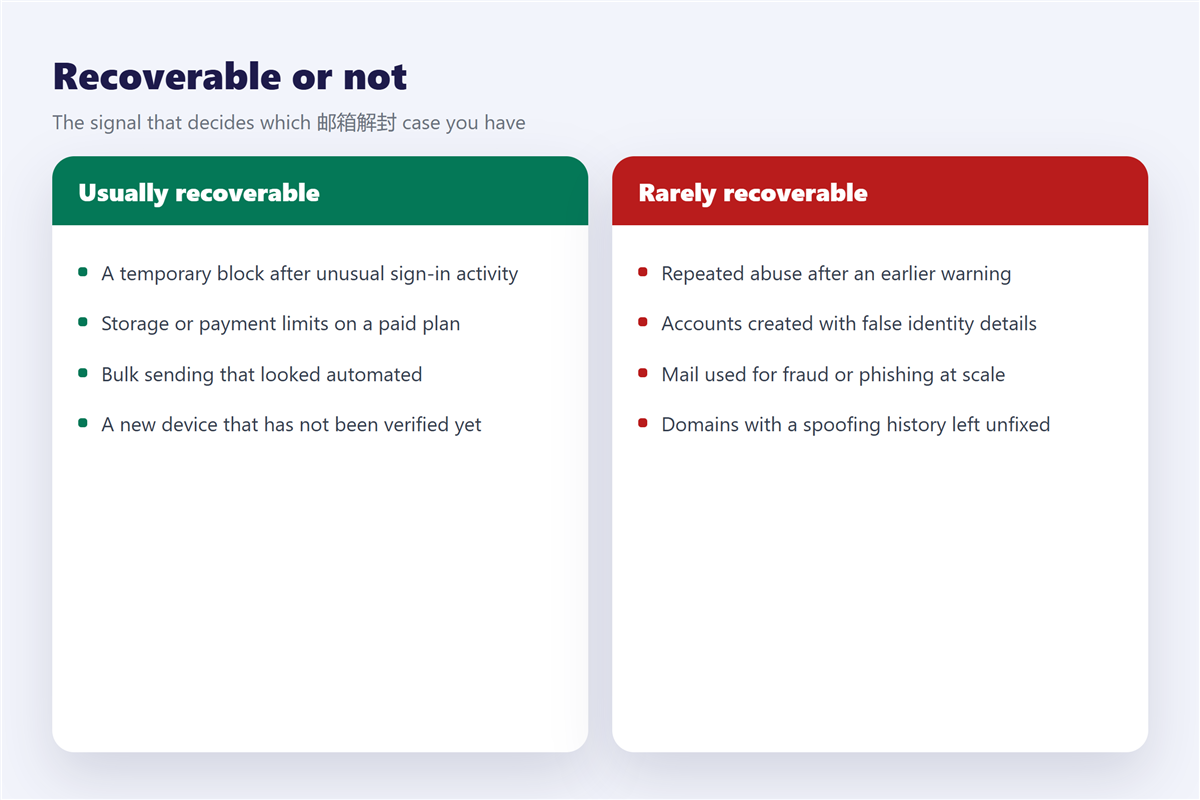
Most failed appeals share one of four mistakes.
The first is volume, because five short messages read as impatience and push the case to the back of the queue. The second is a second account, which looks like an evasion attempt even when the intent is innocent. The third is arguing about the policy instead of describing the facts. The fourth is silence after a partial answer, which closes the ticket.
If the block came from a third-party list rather than from the provider, the appeal goes somewhere else entirely, and that process is described in 邮件黑名单.
When 邮箱解封 is not the right goal
Some accounts should be closed rather than restored, and recognising that early saves weeks.
Because an abuse block stays on the domain record, a mailbox used for bulk sending may be worth abandoning in favour of a new address with proper authentication. In addition, if the account holds nothing you need, closing it deliberately is faster than appealing. What deletion does and does not remove is covered in 邮箱注销.
For sign-in problems that are not blocks at all, the checklist in 邮箱无法登录 covers the ordinary cases first, because half of them turn out to be a client setting.
Frequently asked questions
How long does 邮箱解封 take?
Security blocks often clear within hours. Abuse reviews commonly take three to five working days, and sometimes longer.
Can I speed up 邮箱解封 with a phone call?
Rarely. Free providers have no phone queue for this, and paid plans usually route faster through the same ticket.
Should I mention a lawyer in a 邮箱解封 appeal?
No. It moves a routine request into a legal queue and slows the process down.
Will 邮箱解封 restore my old mail?
Usually, when the account was suspended rather than deleted. Deleted accounts rarely come back, which is why the routine in 邮件备份 matters long before anything goes wrong.
References
- Google Account Help: Disabled accounts
- Microsoft Support: Account reinstatement
- Wikipedia: Email spam
评论
还没有评论,来说两句吧。以下为本文的引用通告: