 小影邮箱
邮件汇报怎么写?Progress, Blockers and Next Steps
Key Takeaways
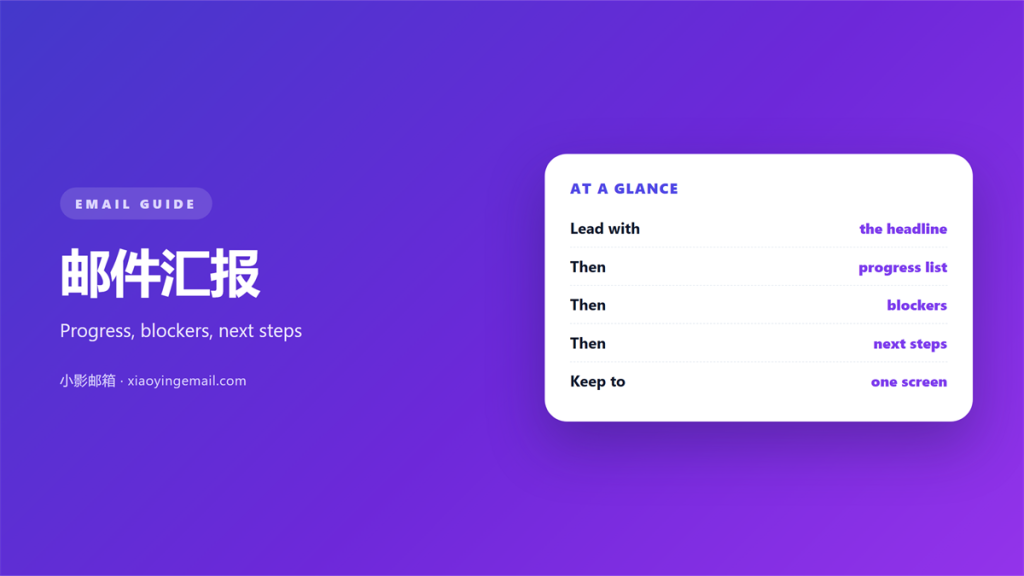
- 邮件汇报 is a short update that tells a busy reader where a project stands.
- Managers read the top line and the blockers first, then skim the rest.
- A fixed structure beats good prose, because it lowers the reading cost.
- Numbers with a date attached are worth more than adjectives.
- Bad news belongs in the body, not buried under three cheerful paragraphs.
What 邮件汇报 is for
邮件汇报 is a periodic message that answers one question: where does this project stand right now? I write one every Friday for a small team, and the format has barely changed in three years. The goal is not to impress anyone with writing. The goal is to let a reader decide in twenty seconds whether they need to act.
Early on I wrote long reports. They were accurate and almost nobody read them. Therefore, I cut the length and moved the essential facts to the top, and the questions I received dropped sharply.
A good 邮件汇报 is written for a reader who has thirty other things open. It assumes no memory of last week and no patience for background.
How a good 邮件汇报 is built
Three parts carry almost all the value: what moved, what is stuck, and what happens next. Everything else is optional. Fortunately, this order matches how people actually read a message. A reader can scan this structure in seconds and still catch every item that needs action.
Progress
Progress in a 邮件汇报 is a short list of finished items, each with a date or a number attached. “Draft approved by legal on Tuesday” is useful. “Made good progress” is not. Consequently, I keep a note open during the week and paste the finished lines in on Friday.
Blockers
Blockers need a name and a request. A blocker without an owner is just a complaint, and it will still be open next week. Moreover, stating the ask plainly saves the reader from guessing what you want from them.
Why 邮件汇报 matters
A regular update does more than inform. It creates a written record of decisions, which matters when memory differs later. Furthermore, it reduces the number of status meetings, because people stop asking for updates they already received.
There is a quieter benefit. When a 邮件汇报 is consistent, small problems surface early, while they are still cheap to fix. In other words, the report becomes an early warning system rather than a chore.
A five-part structure for 邮件汇报
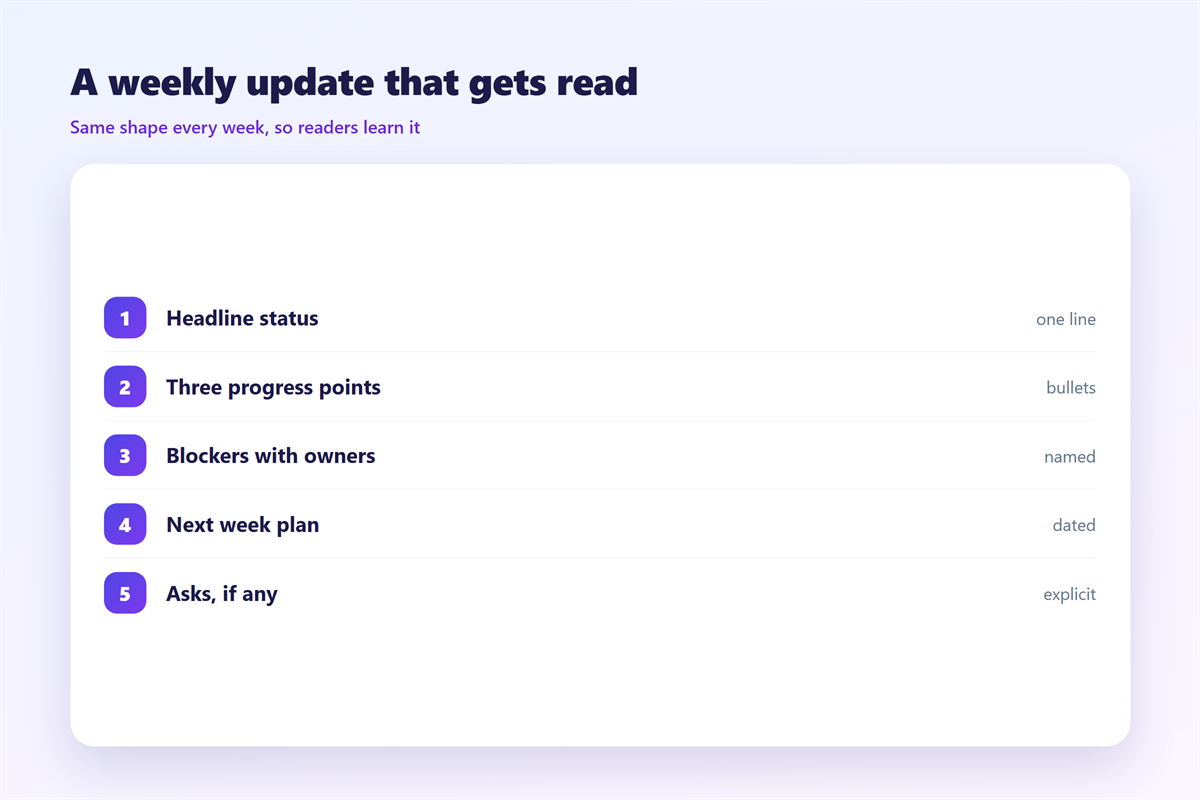
I use the same five headings every week. Readers learn the shape once and then find what they need without reading every line.
- Status in one line at the very top.
- What shipped since the last report.
- What is blocked, with an owner and a date.
- What is planned for the next period.
- What I need from the reader, if anything.
| Section | What goes in it |
|---|---|
| Status line | The single most important fact |
| Blockers | Owner, cause and date |
| The ask | What you need, or nothing |
The subject line deserves the same care as the body. A line such as “Weekly update, week 12” tells the reader nothing, so I add the single most important fact. Our notes on 邮件标题 explain the same principle for other kinds of mail. If the report includes a table or a long list, the choice between plain text and rich formatting also matters, and 邮件格式 covers that trade-off.
Where 邮件汇报 goes wrong
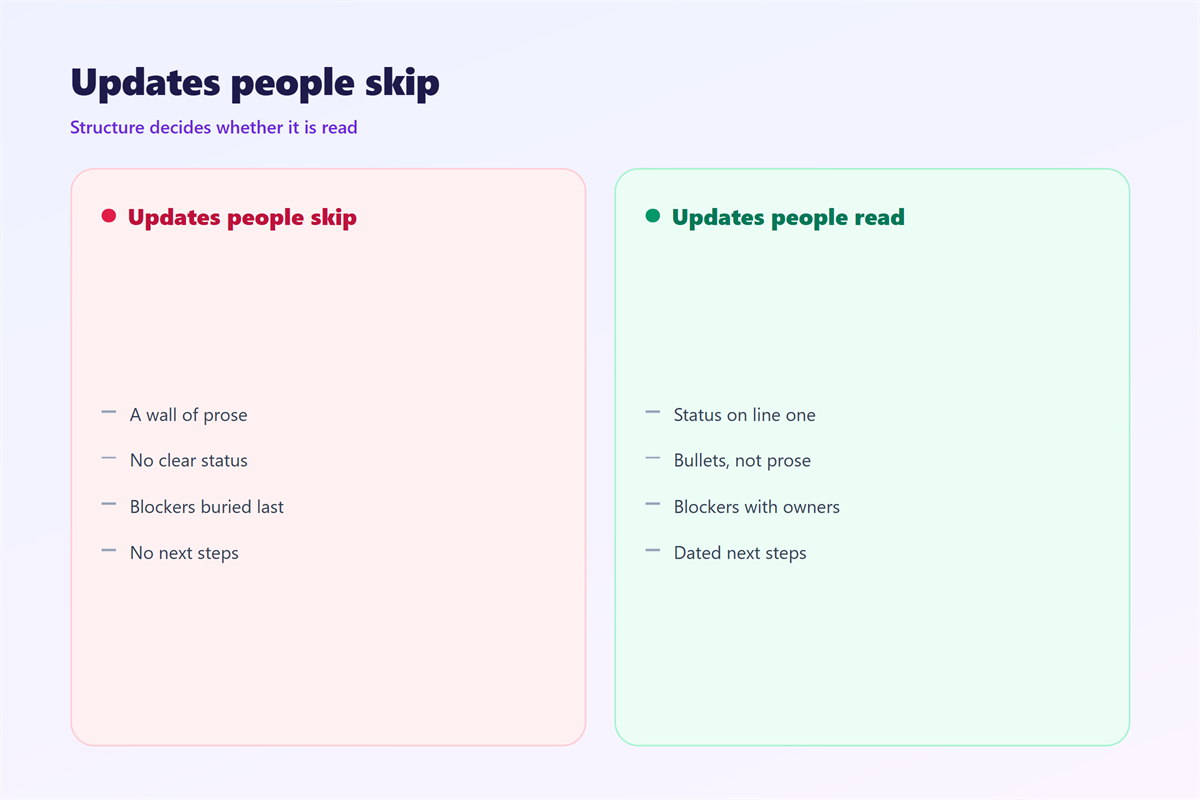
The most common failure is burying the news. When the first paragraph is a polite warm-up, the reader may stop before reaching the part that needed a decision. Notably, a delayed decision costs far more than a blunt opening sentence.
A second failure is reporting activity instead of outcome. Meetings attended are not progress, and a 邮件汇报 full of them hides whether anything actually changed. As a result, the reader cannot tell success from motion.
A third failure is inconsistency. When reports arrive at random times, people stop trusting them. Therefore, I send mine on the same day each week, even when the news is thin.
How to send 邮件汇报 that gets read
Keep the whole message scannable. Bold the status line, keep paragraphs to two sentences, and put any table near the top. I also avoid attachments for the summary itself, because a table inside the message is read far more often than a file.
End with the ask, even if it is “nothing needed this week”. That sentence closes the loop and tells the reader they can move on. Moreover, a clear close makes the next 邮件汇报 easier to write, because the thread already has a rhythm.
Confirm decisions in writing
When a meeting changes the plan, a short confirmation keeps the record straight. The pattern in 邮件确认 is a good template for that follow-up.
Stay brief and human
A terse report can read as cold, so I keep one plain sentence of thanks where it fits. The advice in 邮件致谢 applies here.
Over time, the discipline pays off. A reader who trusts your 邮件汇报 will open the next one first, and that habit is worth more than any single well-crafted paragraph.
FAQ
How long should a 邮件汇报 be?
Under two hundred words for most teams. If it grows beyond that, move the detail into a linked document and keep the summary short.
How often should I send it?
Weekly suits most projects. Daily reports become noise, while monthly reports arrive too late to change anything.
Should I include bad news?
Yes, and early. A 邮件汇报 that only carries good news loses credibility the first time something slips.
Who should be on the list?
Anyone who acts on the information, plus anyone who asked to be copied. Adding readers who never act only dilutes attention.
References
- Plain Language: Federal plain language guidelines
- Wikipedia: Business writing
- Nielsen Norman Group: How users read on the web
延伸阅读
- 《邮件简报怎么写?Updates People Actually Read》
- 《邮件周报怎么写?Align Without a Meeting》
- 《邮件述职怎么写?Reporting on Your Work》
- 《邮件复盘怎么做?What Just Happened》
- 《邮件要点怎么写?The Bullet Summary》
- 《邮件绩效怎么写?Talking About Results》
- 《邮件建议怎么写?Suggest Without Push》
- 《邮件月报怎么写?A Monthly Mail That Gets Read》
- 《邮件总结怎么写?Wrapping It Up》
- 《邮件请示怎么写?Asking Up the Chain》
评论
还没有评论,来说两句吧。
评论功能已关闭。