 小影邮箱
邮件信誉怎么养?What Filters Remember About You
Key Takeaways
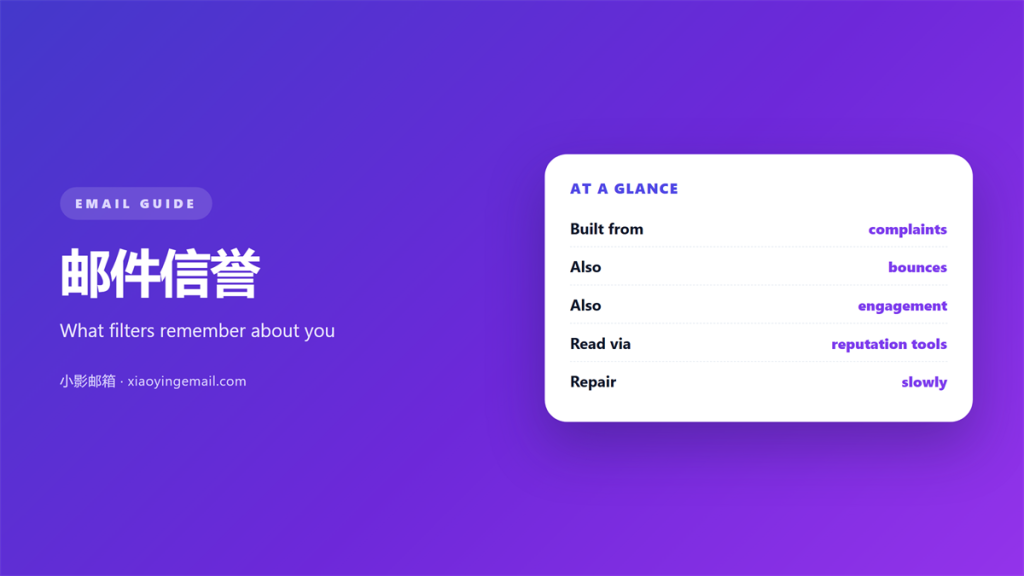
- 邮件信誉 is the score filters assign to your domain and address.
- Complaints hurt faster than engagement helps.
- Authentication proves who you are; it does not earn trust by itself.
- A new domain starts with no history and must build one slowly.
- Repair is possible, but it takes weeks of quiet, clean sending.
What 邮件信誉 means
邮件信誉 is the accumulated judgement a mailbox provider makes about your sending. It is built from complaints, bounces, spam traps and how people react to your mail. I learned this the hard way after a client sent a large batch from a domain that had never sent anything at all.
The results were predictable. Most of the mail went to spam, and the few messages that arrived drew complaints, which made the next batch worse. Therefore, I now treat reputation as a resource that is spent as carefully as money. A single bad week can undo months of careful sending, and rebuilding takes longer than most people expect.
A healthy 邮件信誉 is invisible. You notice it only when it is gone.
How 邮件信誉 is measured
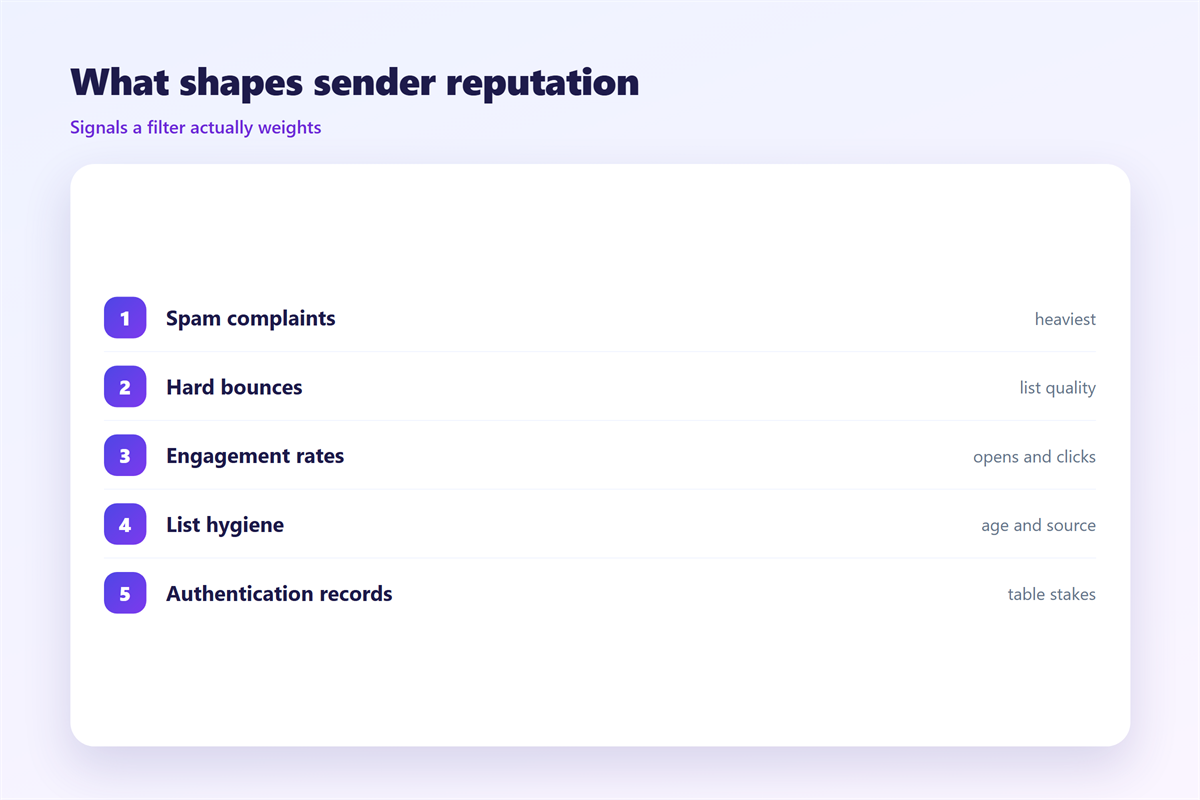
No provider publishes a single number, but the inputs are well known. Each one reflects how recipients behave, which is why engineering alone cannot fix a reputation problem. Providers also weigh these signals differently, and the mix changes over time as their filters learn.
Complaints and bounces
A complaint is a recipient pressing “mark as spam”. Even a rate near one in a thousand can damage a 邮件信誉 quickly. Hard bounces matter too, because sending repeatedly to dead addresses is a clear sign of an unmanaged list.
Engagement and authentication
Replies, clicks and moved messages all count in your favour. Alongside them, SPF, DKIM and DMARC records prove the mail really came from you. Consequently, authentication is the floor, not the ceiling.
Why 邮件信誉 decides the inbox
Filters are making a bet about your next message. A strong 邮件信誉 buys a little benefit of the doubt, which is often the difference between the inbox and the spam folder. Notably, that benefit applies to the whole domain, so one careless campaign can affect every sender who shares it. On a shared address, your neighbours’ choices land on your record too.
The effect compounds. Poor placement lowers engagement, low engagement weakens the 邮件信誉 further, and the next campaign starts from a worse position. In other words, reputation problems rarely fix themselves.
A five-step routine to protect 邮件信誉
These steps take little time and prevent most of the damage I have seen. I run through them before every campaign, because each one has to happen before the send rather than after a complaint.
- Authenticate the domain with SPF, DKIM and DMARC.
- Warm up a new domain over several weeks.
- Send only to people who expect to hear from you.
- Remove hard bounces after the first failure.
- Watch complaint rates weekly, not yearly.
| Signal | Direction |
|---|---|
| Replies and clicks | Lifts reputation |
| Complaints | Damages it fast |
| Hard bounces | Signals an unmanaged list |
Before these steps, check where your mail actually lands. The method in 邮件投递率 shows how to tell an inbox from a promotions tab. The records that make your domain verifiable are covered in 邮件认证, and the slow ramp I use for new domains is set out in 邮件预热.
Where 邮件信誉 breaks down
The fastest way to lose a 邮件信誉 is to buy a list. Those addresses never asked for your mail, so complaints follow almost immediately. Moreover, a purchased list often contains spam traps that were planted to catch exactly this behaviour.
A second failure is a sudden change in volume. Sending ten times more than usual overnight looks like a hijacked account, and providers respond by throttling the whole domain. A gradual increase over weeks looks normal, while the same volume in one afternoon does not. As a result, even legitimate messages start to slow down.
A third failure is neglect. Lists age, interests change, and an address that welcomed you last year may ignore you now. Therefore, pruning inactive recipients protects the reputation of the ones who remain.
How to repair damaged 邮件信誉
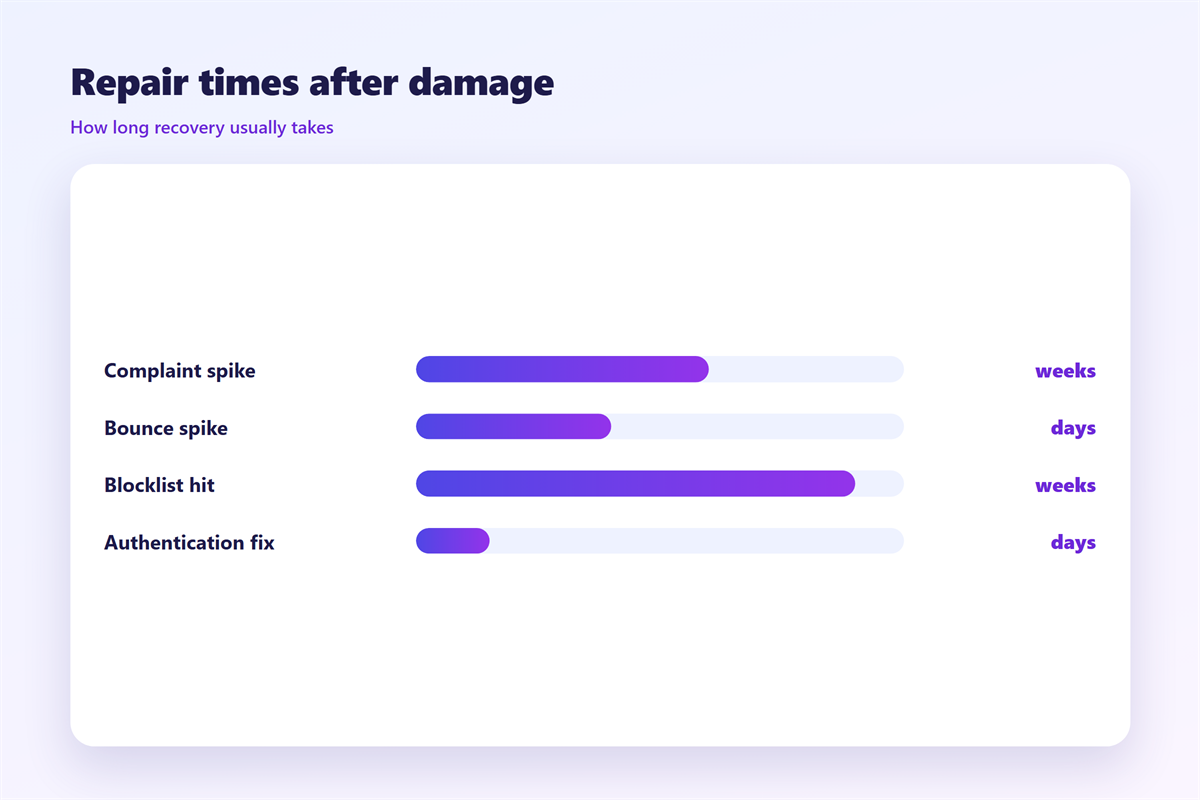
Repair starts with a pause. Stop the campaigns that caused the problem, fix the records, and confirm that every address on the list opted in. Tell the people who still engage that you are slowing down, so the quiet weeks are expected. Rushing back to volume only deepens the hole.
Then send less, to the most engaged people only, for several weeks. Open and click data tells you who those people are. Consequently, a small, responsive audience rebuilds more 邮件信誉 than a large, silent one ever could.
Check every blocklist
Remove your domain from the well-known blocklists before you resume. The difference between being blocked and doing the blocking is explained in 邮件黑名单.
Give it time
Expect weeks, not days. Reputation recovers on the schedule of recipient behaviour, and there is no shortcut around that. I mark the calendar and check blocklists monthly until the record looks clean again.
Finally, write down what went wrong. A short note about the cause turns one expensive lesson into a rule you will not repeat, and a steady 邮件信誉 becomes easier to keep than to rebuild.
FAQ
How long does 邮件信誉 take to build?
Several weeks of consistent, clean sending for a new domain. Rushing the volume restarts the clock.
Can I check my 邮件信誉?
Partly. Blocklists and postmaster tools give useful signals, but no provider shows the full picture.
Does a subdomain help?
It can isolate risk, because a bad campaign on one subdomain is less likely to affect another. It does not hide a poor record from filters.
What complaint rate is safe?
Keep it well under one in a thousand. Anything higher invites filtering.
References
延伸阅读
- 《邮件发送频率怎么定?How Often Is Too Often》
- 《邮件蜜罐是什么?Addresses Nobody Should Mail》
- 《邮件预热域名怎么做?Start Slow, Send Safe》
- 《邮件到达率怎么看?Did It Really Land?》
- 《邮件BIMI 是什么?Your Logo in the Inbox》
- 《邮件质量分怎么看?What Filters Score》
- 《邮件专用IP 是什么?Your Own Lane》
- 《邮件投诉率怎么降?Keep Complaints Near Zero》
- 《邮件IP池怎么管?Pool Strategy》
- 《邮件发件人名称怎么写?The Name They See》
评论
还没有评论,来说两句吧。
评论功能已关闭。