 小影邮箱
邮件台账怎么记?A Register That Stays True
Key Takeaways
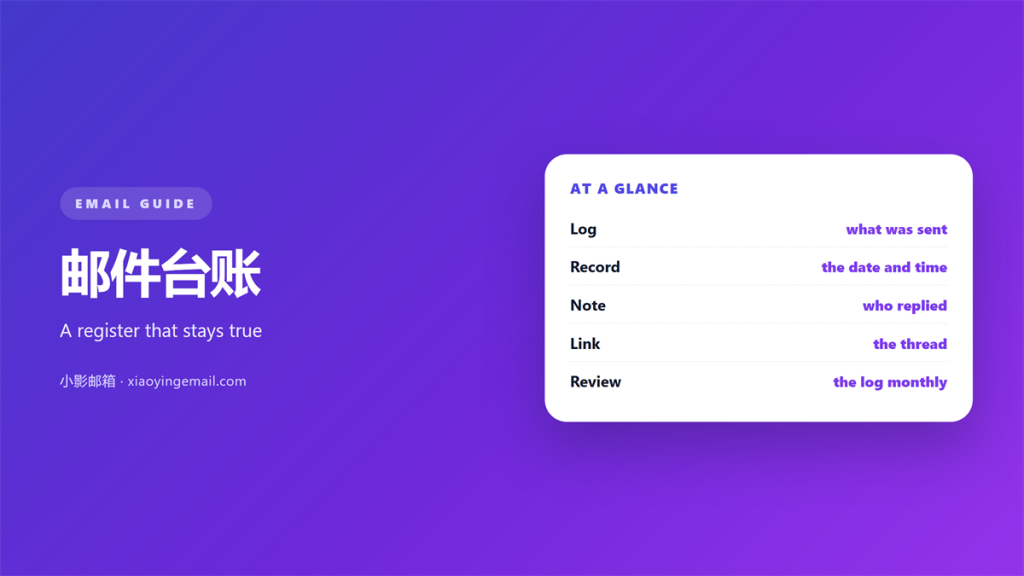
- 邮件台账 logs what was sent, to whom and when.
- Five columns cover almost every case.
- Write the entry the same day you send.
- Keep one register, not three half copies.
- Review entries before you archive them.
What 邮件台账 means
邮件台账 is a simple register of important messages.
It records what was sent, to whom and on which date.
Think of it as a diary for the mail that matters.
It is not a copy of every message in the mailbox.
Only the important ones earn a line.
Contracts, invoices and formal notices top the list.
The register stays short and easy to scan.
An accountant keeps a ledger. A careful team keeps a 邮件台账.
The habit takes a minute and saves hours later.
A good 邮件台账 stays under a page per month.
That small size is what makes it useful.
Some teams log calls as well, but that is optional.
Start with the messages you already send often.
A register should reflect your real work.
Do not copy a template from another industry.
Why 邮件台账 matters
People forget what they sent last month.
A 邮件台账 answers that question in seconds.
It also proves a message left your outbox on time.
When a client claims they never received a notice, the log helps.
It supports any later review or dispute.
A shared 邮件台账 ends the blame game.
A calm answer often ends a complaint fast.
A shared memory
The register outlives staff changes and holidays.
A new colleague can catch up from the log alone.
It also stops the same question being asked twice.
The log also helps when a colleague is away.
Their work stays visible without a long handover.
Less panic
You stop searching a huge inbox for one date.
The answer sits on one calm line.
That calm matters during a busy audit.
That continuity keeps clients from feeling lost.
Small teams gain the most from this habit.
What a 邮件台账 should record
Keep each entry short but precise.
A missing field turns the log into a riddle.
Columns that matter
Record the date, the recipient and the subject.
Add the person who sent it.
Note any attachment by name.
Add a reference or case number if one exists.
Dates and versions
Use one date format across the whole team.
Add a version when a message is resent.
Small details stop big arguments later.
Keep the number of columns fixed over time.
New columns confuse readers and break sorting.
Review the field list twice a year.
Drop any column nobody ever reads.
How to keep 邮件台账 accurate
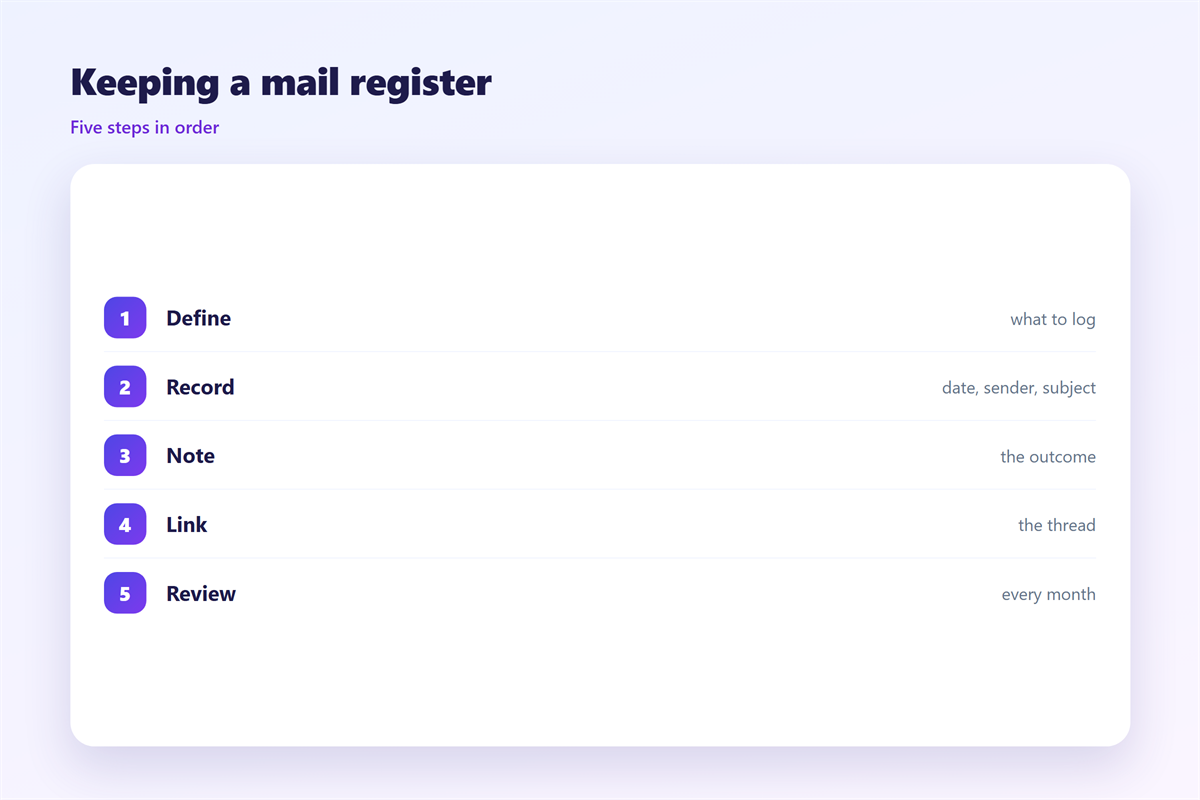
Write the entry the same day you send.
Memory fades fast, even overnight.
Keep one register instead of several drafts.
A single file beats three half copies.
Use a shared sheet so everyone edits one source.
Lock the columns so rows stay neat.
Add a new row at the top, not the middle.
Check spelling on names and numbers.
Update the 邮件台账 before you leave for the day.
A wrong address in the log misleads everyone later.
Correct an entry the moment you spot an error.
Note the correction in the same row.
A small note explains the change to the next reader.
Never delete a row without a reason.
Keeping a register readable
A register helps only when it is easy to read.
Use plain words and short entries.
Keep the same order of fields in every row.
Widen a column instead of wrapping long text.
Add a short title at the top of the sheet.
Freeze the header row so it stays visible.
Use color once, and only for real flags.
Too much color hides the point.
Common mistakes
The first mistake is logging every trivial message.
A register full of noise gets ignored.
The second is leaving gaps for busy days.
The third is keeping the log in one person’s inbox.
Another 邮件台账 mistake is trusting memory over a written line.
Do not mix two projects in one row.
Do not write the entry a week later.
Do not skip the date format rule.
Another slip is a column that holds two ideas.
Split it, or the sorting stops working.
Avoid abbreviations only you understand.
Write names in full the first time.
Reviewing 邮件台账 over time
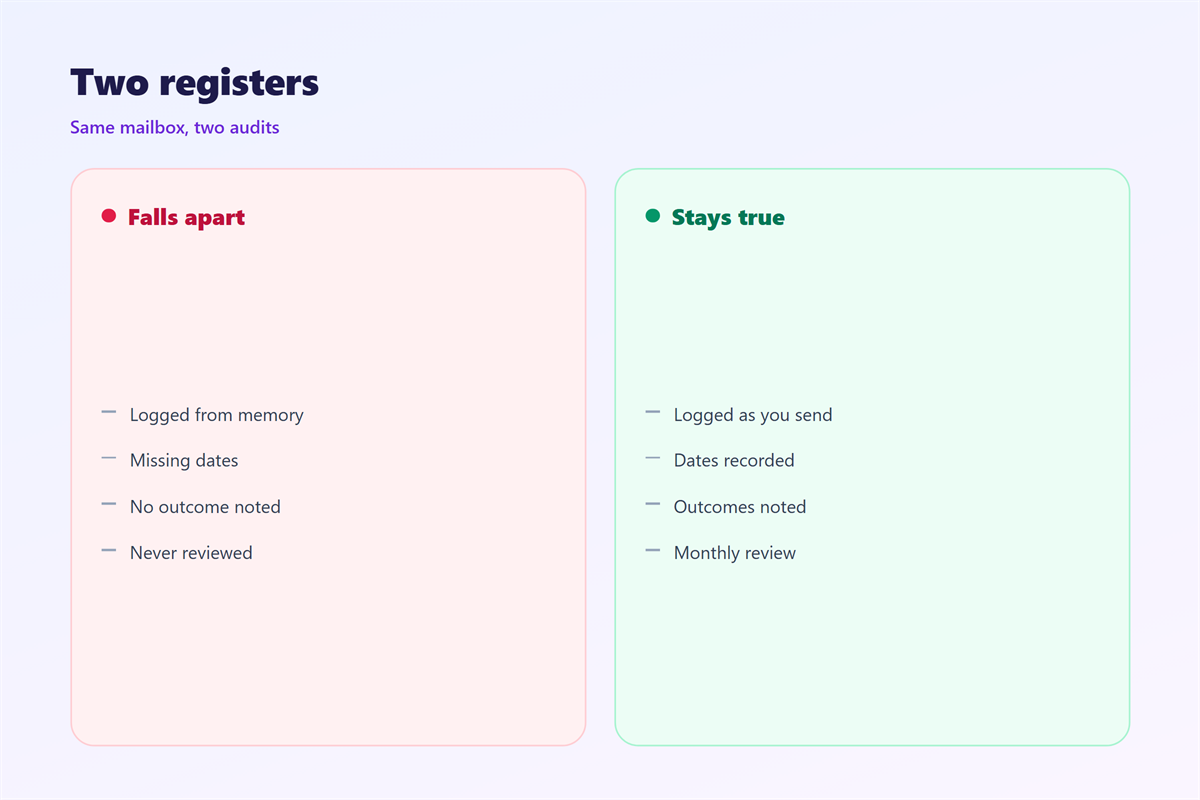
A register needs a light review each month. Our notes on 邮件日志 cover the daily habit. A review looks at 邮件审计 questions too. Older rows may pass into 邮件归档 at year end. How long to keep them is set by your 邮件留存 rule.
Fix small errors while they are fresh.
Close the month with a quick count of entries.
Check that each row has a real date.
Look for rows with a missing reference number.
Fix them before the month closes.
A yearly 邮件台账 review catches old gaps.
Archive the finished year in one place.
A tidy register is far easier to search.
A short review beats a long apology later.
FAQ
Who should read the 邮件台账?
Anyone who manages clients or contracts. A manager may check it during a review. Keep access limited to the people who need it.
How long do we keep 邮件台账 entries?
Follow your retention rule and any local law. Many teams keep business records for several years. Note the rule in the sheet so everyone follows it.
Can software build the 邮件台账?
Partly. A tool can import send times and addresses. A person still decides what matters. Start with a plain sheet if a tool feels heavy.
Is a 邮件台账 the same as a backup?
No. A backup copies messages. The register only lists the ones that matter. You still need both a backup and a register.
References
- IETF RFC 5322: Internet Message Format
- Google Workspace: Email retention
- Microsoft: Retention policies
评论
还没有评论,来说两句吧。
评论功能已关闭。