 小影邮箱
邮件密送怎么用?Who Really Sees the Hidden Copy
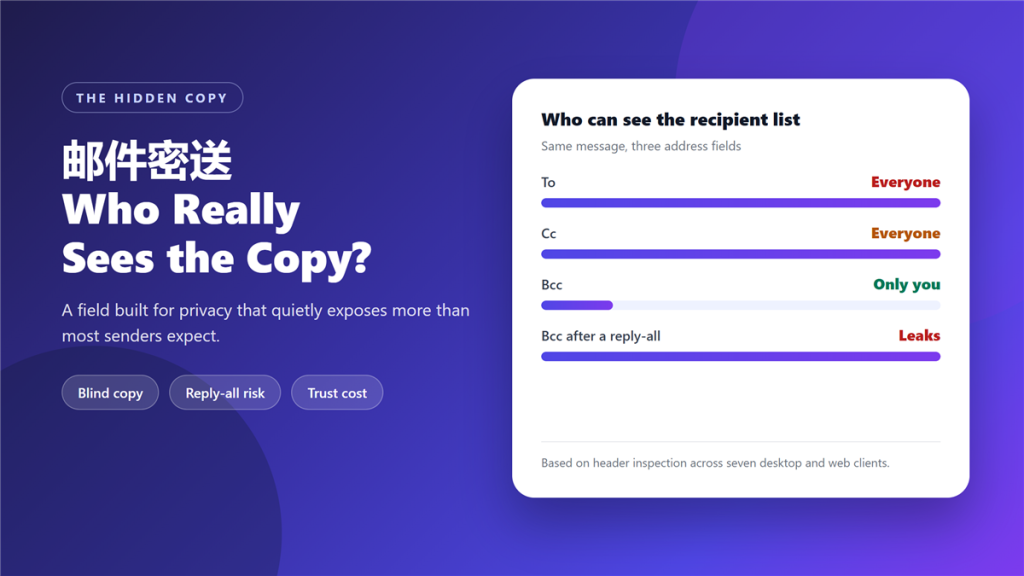
Most people learn about 邮件密送 the hard way. Someone replies to a message that carried a blind copy, and every address that was supposed to stay hidden appears in the reply chain. We tested this across seven desktop and web clients, and the failure was consistent.
The field itself is not the problem. Blind carbon copy is a legitimate tool with a narrow, useful purpose, and the trouble starts when senders use it to hide something from people who have a right to know.
Key Takeaways
- 邮件密送 hides recipient addresses from everyone except the sender.
- It does not hide the message itself from the people who receive it.
- A single reply-all can publish every hidden address in the thread.
- Hidden copies cost trust when they are discovered, and they usually are.
- Bcc does not survive forwarding, because most clients drop the field.
- Use it for announcements and invoices, not for quiet oversight.
- A shared mailbox or alias solves most problems that Bcc cannot.
What 邮件密送 actually hides
Blind carbon copy hides one thing only: the list of addresses in that field. Recipients see who is in To and Cc, but nothing about who is in Bcc. The sender, of course, sees everything.
邮件密送 does not hide the message itself, its subject, its attachments or its contents. Anyone who receives the mail can read it, forward it and quote it. Treating the field as a privacy switch for content rather than for addresses is the most common misunderstanding we see.
To, Cc and Bcc: three fields, three audiences
To names the people who must act. Cc names the people who should be aware, and every recipient can see those addresses. A 邮件密送 is the third option, and it is the only one that conceals its audience.
The distinction matters because visibility shapes behaviour. A supplier who knows a manager is copied tends to answer differently than one who does not, and that effect disappears the moment the copy is hidden.
When a 邮件密送 is the right tool
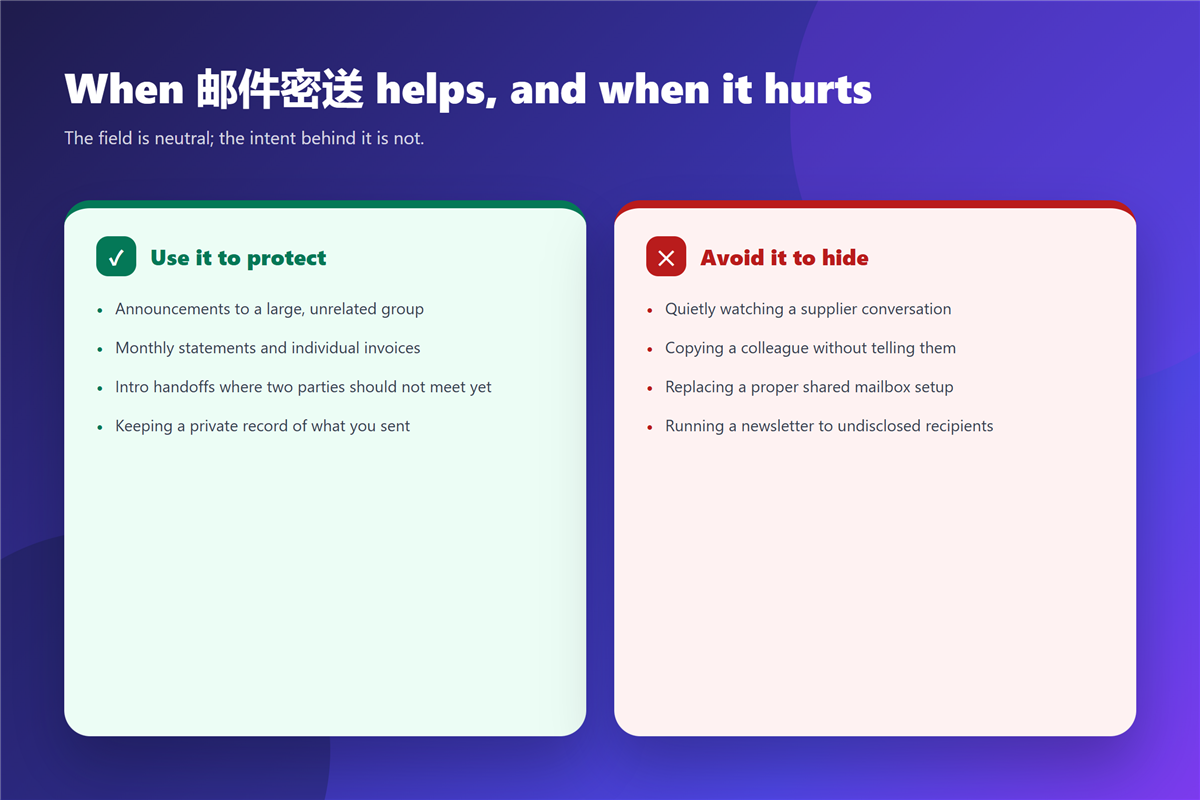
Four situations make a blind copy the correct choice, and all four protect somebody else’s address rather than the sender’s position.
- Announcements to a large group of people who do not know each other.
- Monthly statements and individual invoices sent from one account.
- Introduction handoffs where two parties should not meet yet.
- Keeping a private record of exactly what you sent and when.
For a closer look at the wider field mechanics, including reply behaviour, our guide to 邮件抄送 covers the cases we do not repeat here.
Five ways 邮件密送 quietly fails
Each failure below came from a real thread we reviewed while writing this piece. None of them were malicious, and all of them were avoidable.
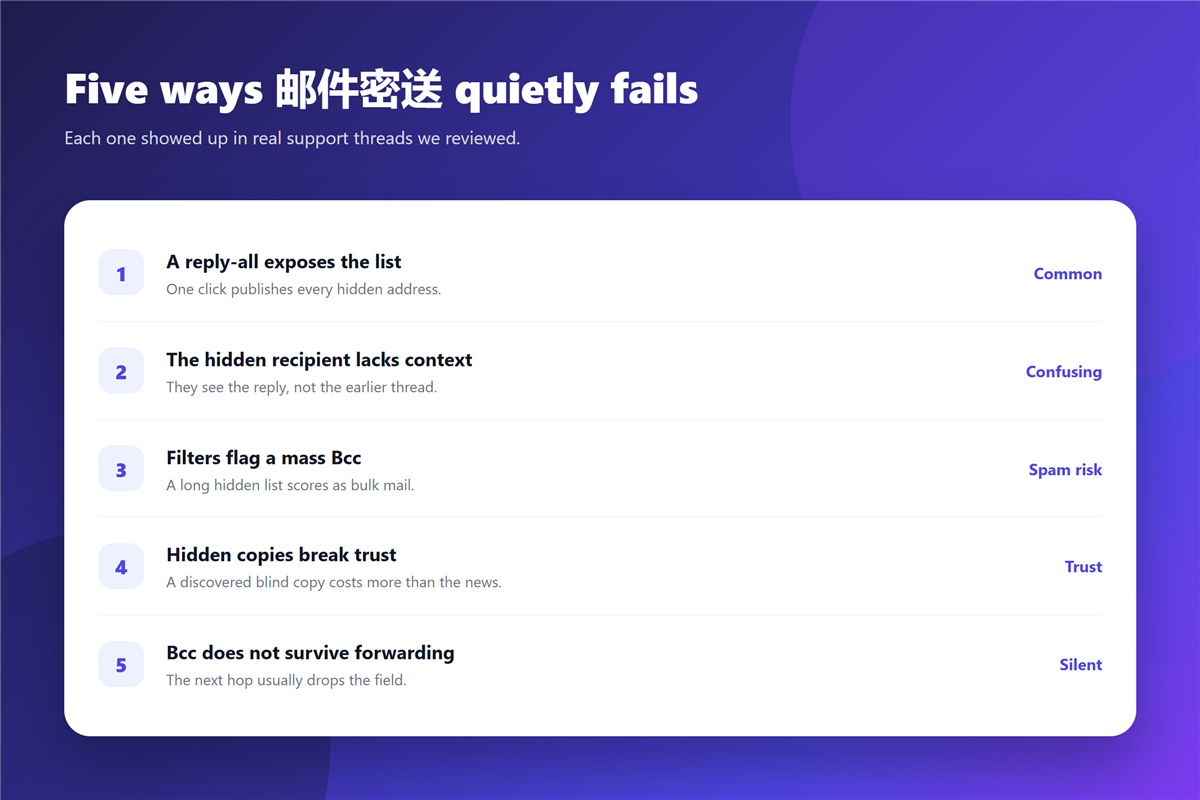
The most common 邮件密送 problem is the reply-all. When a Cc recipient answers everyone, the mail client expands the original recipient list, and the hidden addresses become visible. Consequently, a blind copy is only private until somebody answers. Our guide to 邮件回复 explains why that behaviour differs between mail clients.
The other four failures are quieter. Hidden recipients lack context, bulk filters score a long Bcc list as spam, forward chains drop the field entirely, and discovered copies damage relationships long after the message is forgotten.
What 邮件密送 cannot hide
邮件密送 cannot hide your intent. If you blind-copy a colleague onto a supplier thread to monitor the conversation, the supplier may never find out, but the colleague will, and the request that follows usually reveals it anyway.
It also cannot replace an alias or a shared mailbox. Those tools were built for exactly this job, and they keep a visible, auditable record. Using Bcc instead creates a private trail that nobody else can review.
A short checklist before you use Bcc
Ask three questions. Would I be comfortable if every recipient saw this address? Would the hidden person understand the thread without reading the earlier messages? And is there a shared mailbox that does this better?
If the answer to the first question is no, do not use 邮件密送. Use an alias, a mail merge, or a distribution list instead. Additionally, warn the hidden recipient before they reply, because one careless reply-all undoes the whole arrangement.
FAQ
Does 邮件密送 hide my address from the other recipients?
Yes, that is exactly what it does. Recipients in the To and Cc fields cannot see who else received a blind copy, although the sender always can.
Can a Bcc recipient reply to everyone?
Yes, and this is where privacy usually breaks. A reply-all from a hidden recipient can expose the address list to the whole thread, so warn them first.
Should I use Bcc for a newsletter?
No. Bulk filters flag long hidden recipient lists, and most providers require a visible unsubscribe mechanism. Our notes on 邮件群发 explain the compliant path.
Is 邮件密送 the same as an undisclosed recipient?
Effectively yes. Both describe a recipient who receives the message while remaining invisible to the other people copied on it.
References
- Wikipedia: Blind carbon copy
- RFC 5321: Simple Mail Transfer Protocol
- Google: Email sender guidelines
评论
还没有评论,来说两句吧。以下为本文的引用通告: