 小影邮箱
邮件群发怎么发?Sending to Many Without Landing in Spam
What 邮件群发 actually tests
邮件群发 looks like a writing problem and behaves like a plumbing problem. The wording rarely decides whether a message arrives; the volume, the recipient list and the reputation of the sending domain do.
I once sent a notice to 84 parents from an ordinary mailbox. Sixty of them received it and the rest were throttled for six hours without a single bounce message. Nothing about the text changed between the two halves of that list, which is why I now treat 邮件群发 as a delivery question first.
Key Takeaways
- 邮件群发 fails on limits and reputation before it fails on wording.
- Most mailboxes cap recipients per message and messages per hour.
- Bcc hides the list, but it does not make a send personal.
- One complaint per thousand recipients is already a warning.
- An unrecognised domain filters 邮件群发 on the first large send.
- A bulk service exists because personal mailboxes are not built for this.
- Small groups are usually better served by individual messages.
Where 邮件群发 goes wrong first
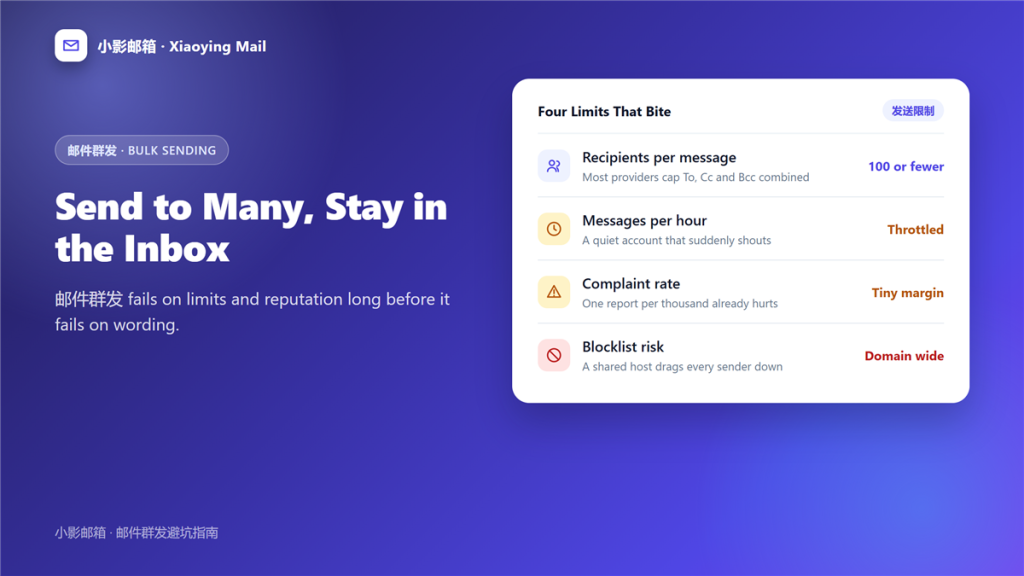
Three limits bite long before anyone complains about the content.
Recipients per message
Providers cap the addresses in a single send, often near one hundred across the To, Cc and Bcc fields combined. Consequently, a long list fails silently rather than returning an error, and that is the first wall 邮件群发 hits.
Messages per hour
A quiet account that suddenly sends two hundred messages looks compromised. Therefore the provider slows the queue, and the delay looks like a delivery fault rather than a limit, so 邮件群发 often gets the blame.
Complaint rate
Every spam report counts against the sending domain. Notably, one complaint per thousand messages is enough to trigger filtering, which leaves very little room for 邮件群发 to be approximate.
Five ways to send to a group
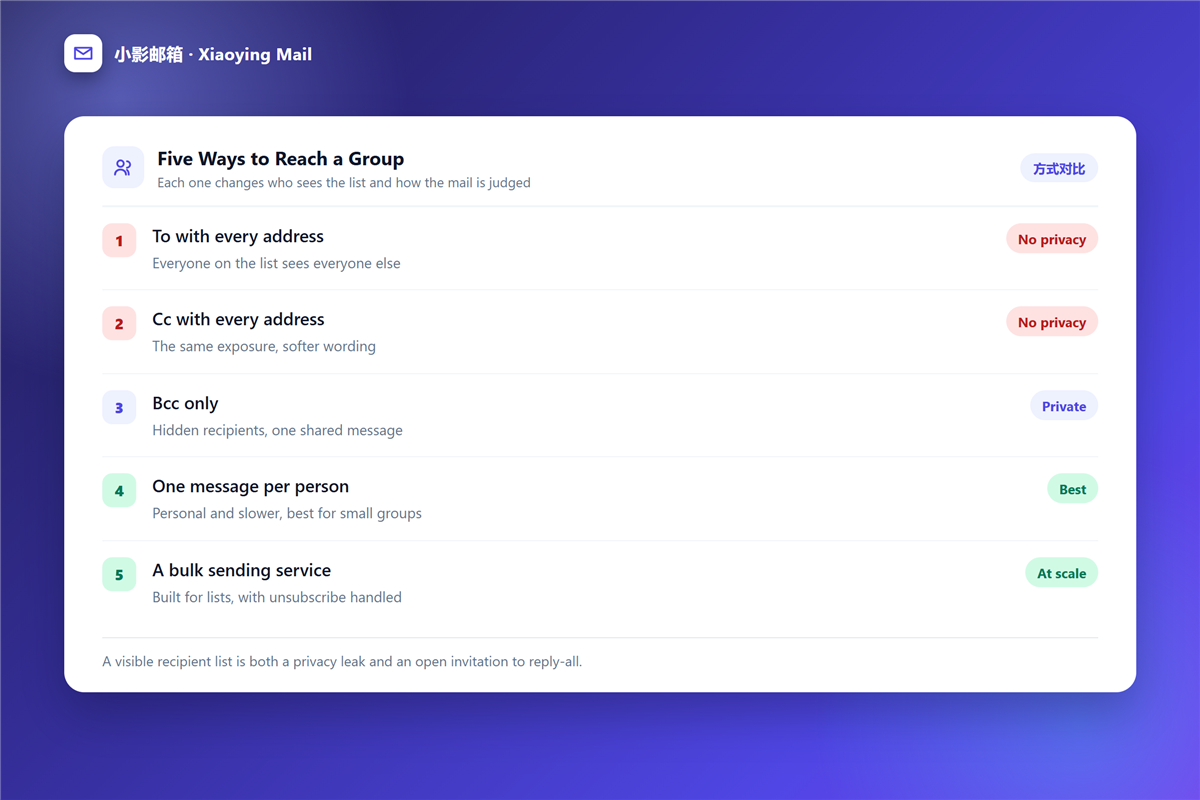
Each method trades privacy against effort, and 邮件群发 is judged on all five in the same way.
- To with every address listed, which exposes the whole group.
- Cc with every address listed, which exposes it just as clearly.
- Bcc only, which hides recipients while still sending one message.
- One message per person, which is personal and slow.
- A bulk sending service, which handles lists, bounces and unsubscribes.
A single 邮件抄送 decision is what most people get wrong here, because a visible list is both a privacy leak and a reply-all hazard.
Privacy in 邮件群发
Visibility is the part recipients notice, and it is also the easiest to fix.
To and Cc
Every address in these fields is visible to everyone. Moreover, a reply-all storm follows naturally, and cleaning it up takes longer than the original send, so the privacy cost of 邮件群发 outlives the message.
Bcc
Bcc hides the list, but it does not hide that a group exists. In particular, an identical message with no visible recipient still reads like 邮件群发 rather than a personal note.
For anything under about twenty people, individual messages avoid both problems. The extra minutes are usually cheaper than the apology.
When a personal mailbox stops being enough
There is a threshold for 邮件群发, and it arrives earlier than most people expect.
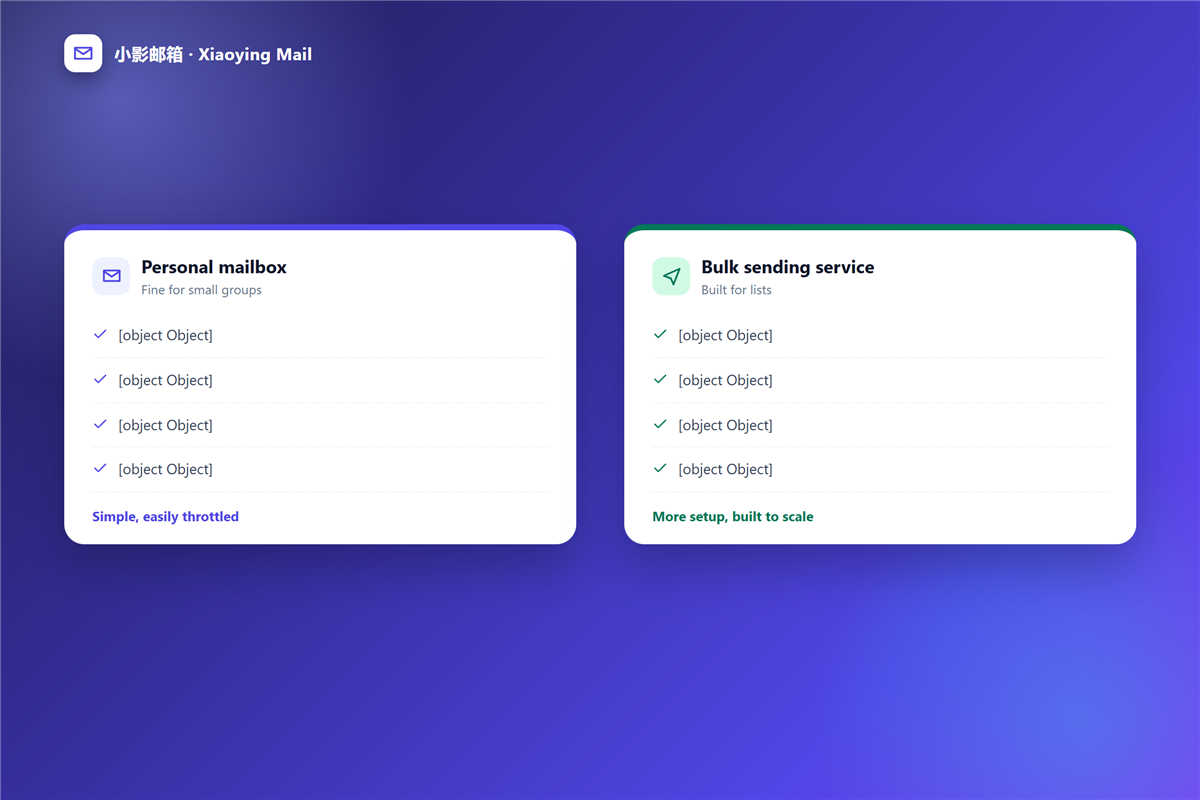
Above a few dozen recipients, a bulk service earns its setup cost. It authenticates your domain, manages unsubscribe requests and reports which addresses failed. Those three features are exactly what a personal mailbox cannot do, and they are the reason 邮件群发 through a consumer account is fragile.
Making 邮件群发 land in the inbox
Five habits reduce the risk, and none of them require new software.
- Authenticate the domain before the first large send.
- Send in batches rather than in one burst.
- Keep the list current and remove hard bounces immediately.
- Offer a plain way to opt out, even for a small list.
- Send from a subdomain if the main domain carries important mail.
A 邮件黑名单 entry is the worst outcome of ignoring these habits, and it affects every sender on the domain rather than one message. A missed 邮件订阅 request is the quieter version of the same mistake.
Writing a message people do not report
Delivery gets 邮件群发 there; the wording decides whether it survives.
Say who you are in the first line, because a recipient who cannot identify the sender reports the message. Additionally, keep the subject factual and skip the 邮件标题 tricks that work in marketing and fail in a personal inbox.
One more rule matters for 邮件群发. Write to one person in your head, then send it to the list, because a message addressed to nobody reads like advertising even when it is not.
Frequently asked questions
How many people can I email at once?
Usually under a hundred, across all recipient fields combined. The exact figure depends on the provider and on your account history.
Is 邮件群发 always a bad idea?
No. It is normal for announcements and small groups. Problems start with scale, cold lists and missing authentication.
Does Bcc count as 邮件群发?
Technically yes. Each recipient still receives one copy of the same message, and filters judge it in the same way.
Why did half my 邮件群发 arrive late?
Throttling, most likely. A provider that sees an unusual volume slows the queue rather than rejecting the message.
References
延伸阅读
- 《邮件格式怎么选?Plain Text or HTML》
- 《邮件列表是什么?Group Addresses and Reply Rules》
- 《邮件营销怎么做?Permission, Flows and a Six-Item Pre-Send Check》
- 《邮件密送怎么用?Who Really Sees the Hidden Copy》
- 《邮件发送限制有哪些?Quota, Recipients and Rate》
- 《邮件个性化怎么做?Name, Context, Nothing Else》
- 《邮件打开率怎么看?A Number You Cannot Fully Trust》
- 《邮件点击率怎么提升?Clicks Beat Opens》
- 《邮件公告怎么写?Announcements That Get Read》
- 《邮件群发单显是什么?One Mail, Many Copies》
- 《邮件合并怎么用?One Template, Many Inboxes》
- 《邮件表单怎么做?Forms That Reach an Inbox》
- 《邮件周报怎么写?Align Without a Meeting》
- 《邮件抽奖活动怎么做?Giveaways Without Spam》
- 《邮件裂变怎么做?A Referral Loop That Grows》
评论
还没有评论,来说两句吧。以下为本文的引用通告: