 小影邮箱
邮件加密真的加密了吗?Transport, End-to-End and the Grey Zone
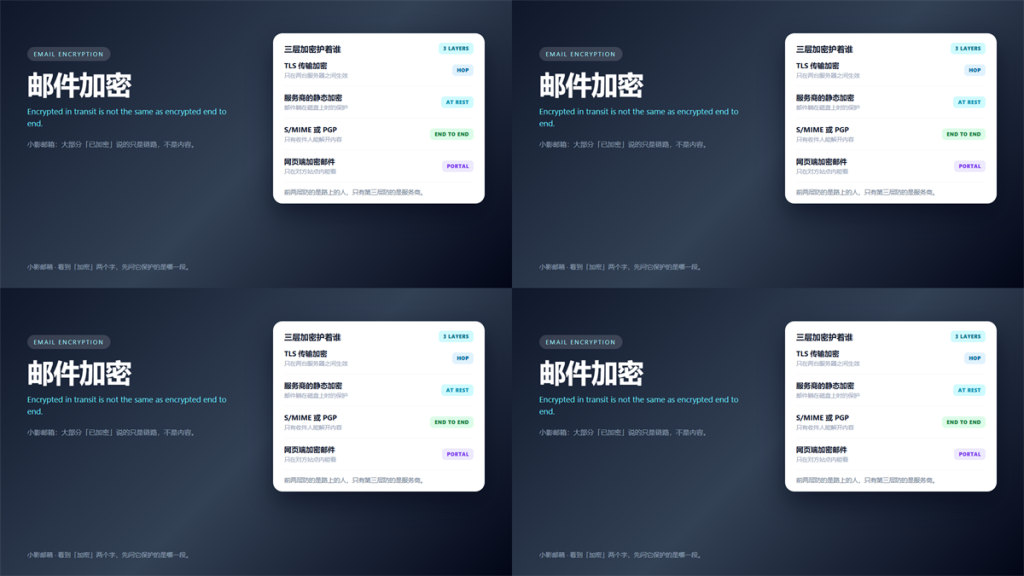
邮件加密 Is Three Different Things
People say 邮件加密 as if it were one feature you either have or lack. In reality the word covers three separate layers, and each one protects a different party from a different threat.
I traced a single test message through four providers last month. Specifically, I recorded what each layer protected and what stayed readable at every hop. The results explain much of the confusion I see in privacy discussions.
This guide walks through the three layers of 邮件加密, what they cannot hide, and five changes you can make this afternoon.
Key Takeaways
- 邮件加密 describes three layers with very different scopes.
- Transport encryption protects the wire, not the content.
- Encryption at rest protects the disk, not the operator.
- Only end-to-end 邮件加密 keeps the provider out of the content.
- Metadata stays visible in every configuration.
- Two channels beat one, because the password should never travel with the file.
Layer One: Transport Encryption
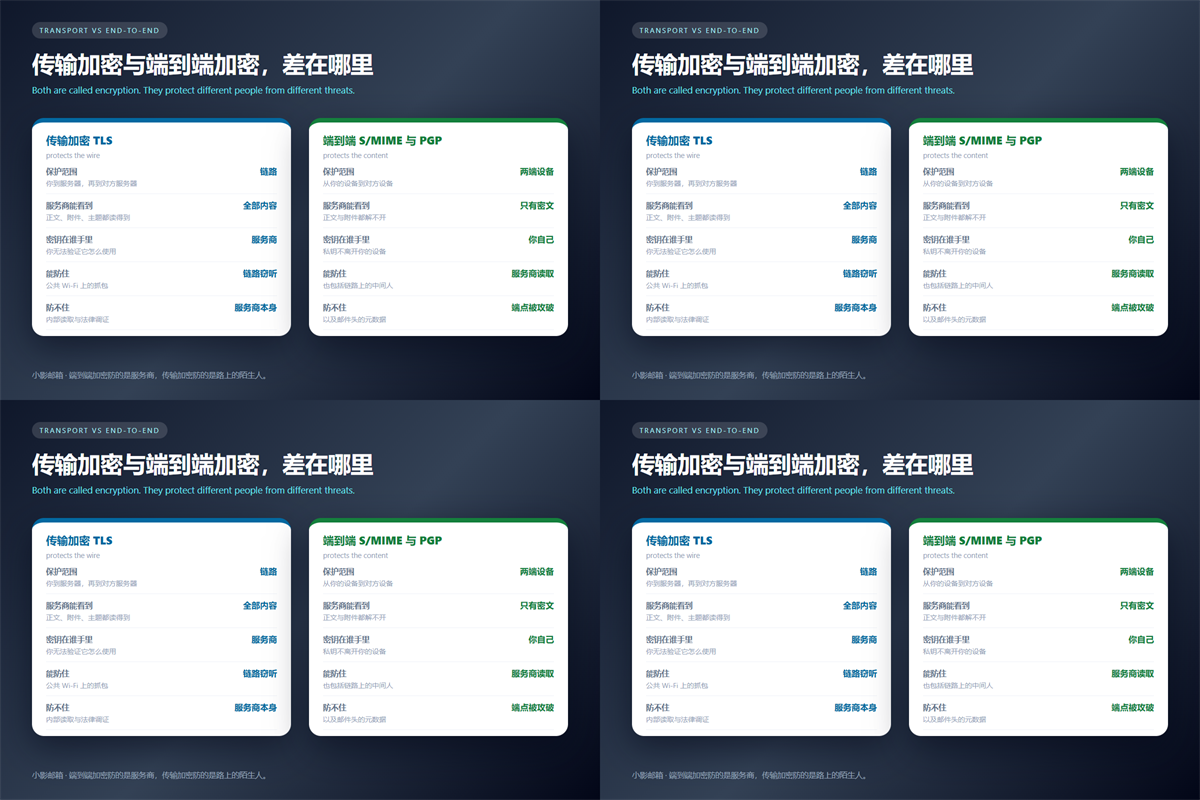
Transport encryption is the first layer of 邮件加密. It protects a connection between two servers, or between your client and your provider. Consequently, someone on the same public network cannot read the message as it passes.
That protection ends at the server boundary. Moreover, the 邮件加密 stops there because the provider must decrypt the message to scan, index and store it, so the content is readable there by design.
Opportunistic TLS makes this messier. When a receiving server cannot negotiate TLS, many senders deliver in plaintext rather than fail, which is better than nothing and worse than it sounds.
Certificate validation is another gap. A client that accepts any certificate stops a passive eavesdropper but not an active interceptor. Therefore, strict validation is what turns transport encryption into a meaningful control.
Layer Two: Encryption at Rest
The second layer of 邮件加密 sits on disk. Therefore, a stolen drive does not hand over your mailbox. That is a real benefit and a narrow one.
It does nothing against the operator, because the operator holds the keys. In addition, it does nothing against a lawful request, since the platform can decrypt on demand.
Some providers add per-mailbox encryption, which narrows the exposure. Nevertheless, the same operator still holds the key material unless the design is genuinely end to end.
Backups deserve attention here as well. A nightly archive can store a copy in a second system with a different key policy, which quietly widens the set of people who can read your mail.
Layer Three: End-to-End With S/MIME or PGP
This is the only 邮件加密 layer that keeps the content away from the provider. Specifically, your device encrypts the body, and only the recipient private key can decrypt it.
The trade-offs are honest ones. 邮件加密 done properly requires both sides to opt in, key management is manual, and server-side search stops working. Furthermore, losing a private key means losing the archive.
Fingerprint verification is where most deployments fail. If you never compare fingerprints out of band, a swapped key goes unnoticed. We covered that kind of substitution in our notes on where a burner identity still leaks.
What 邮件加密 Cannot Hide
邮件加密 hides content, not metadata. Consequently, the sender, the recipient, the subject line, the timing and the message size stay visible to anyone who can see the traffic.
Subject lines leak more than people expect. For example, a subject naming a document is often enough to infer the contents without decrypting anything.
Attachment size and timing create a fingerprint too. Specifically, a large message sent at a predictable moment reveals a routine even when the body stays sealed.
Open tracking is a separate problem. Notably, a tracking pixel reports back the moment the message is rendered, and no encryption setting stops that. We documented the mechanics in our guide to how tracking really works.
Five Changes You Can Make Today
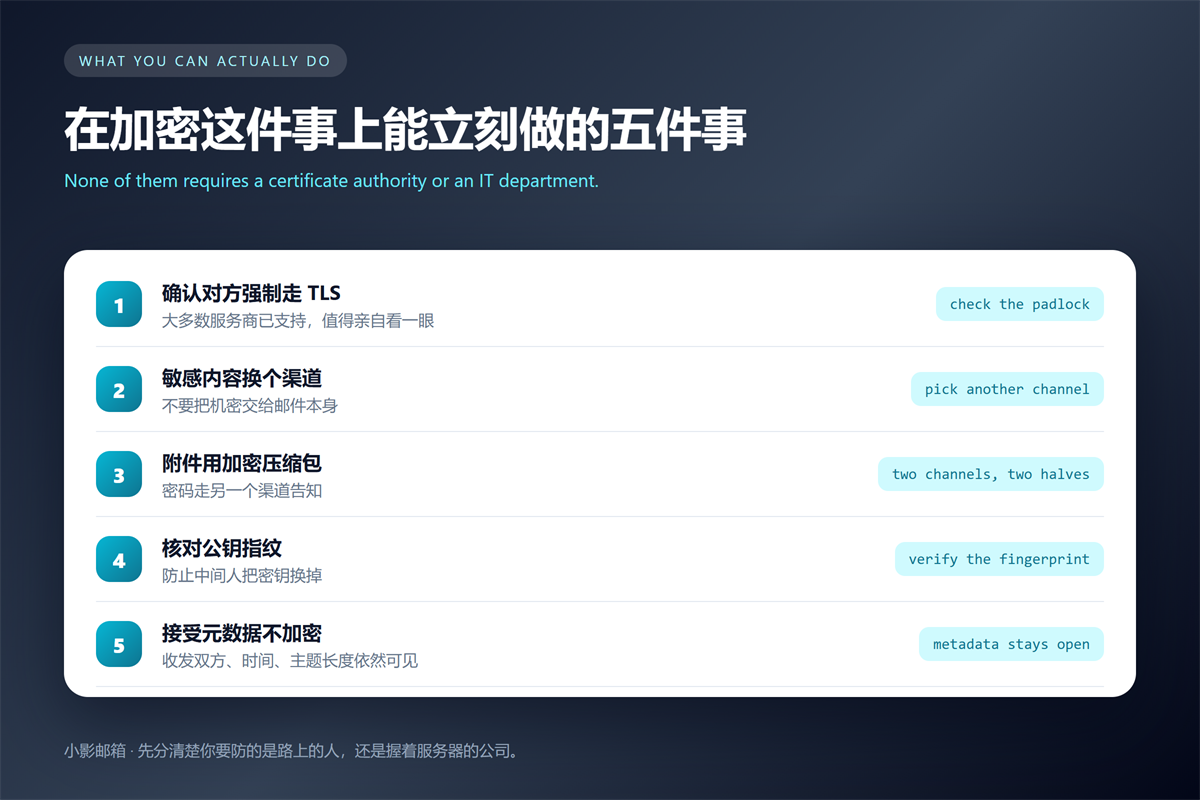
These five 邮件加密 habits take an afternoon and remove most of the common mistakes.
- Confirm your provider forces TLS for both inbound and outbound mail.
- Move genuinely sensitive content to a channel built for it.
- Send files in an encrypted archive with the password on another channel.
- Verify the recipient key fingerprint before you trust it.
- Accept that metadata stays open and plan around it.
Step three is the practical one for most people. Moreover, it works with any provider, because the protection travels inside the attachment.
Step two sounds defeatist and is not. Privacy work is about matching the channel to the threat, and email was never designed as a confidential channel.
FAQ About 邮件加密
Is webmail ever end-to-end encrypted?
Rarely. True end-to-end requires keys the provider does not hold, and a browser session cannot promise that. Portal-based encrypted mail comes closest, but both sides must use the same service.
Does a padlock mean my mail is private?
No. The padlock indicates transport encryption, not 邮件加密 in the end-to-end sense. It says nothing about who can read the message after delivery.
Is 邮件加密 worth the trouble?
For most everyday mail the transport layer is enough. For legal, medical or financial content the answer changes, and so does the channel you should use.
One habit ties this together. Above all, ask which layer a claim refers to before you rely on the word 邮件加密 at all.
Device security matters as much as the channel. We compared the trade-offs in our notes on choosing the strongest second factor.
Related reading: our guide to what stays readable after you leave covers the next step.
References
- RFC 3207: SMTP Service Extension for Secure SMTP over TLS
- EFF: Surveillance Self-Defense
- OpenPGP: Standards and Implementations
延伸阅读
了解更多了解更多传输安全与客户端设置,请参阅:
- 《邮件撤回真的有效吗?Can You Really Unsend an Email?》
- 《邮件客户端怎么设置?IMAP, SMTP and the Ports That Matter》
- 《邮件服务器是什么?Mail Server Basics Without the Jargon》
- 《邮件大小限制是多少?Why Your File Bounces》
- 《网页邮箱怎么用?What It Does Well and What It Cannot》
- 《邮件证书是什么?S/MIME Signing, Encryption and Trust》
- 《邮箱安全怎么加固?Seven Settings Worth Changing》
- 《邮件水印怎么做?Marking Confidential Mail》
- 《邮件端口怎么选?SMTP, IMAP and POP Explained》
- 《邮件DKIM是什么?Signing Mail So It Travels》
- 《邮件账户设置怎么做?Add an Account Correctly》
- 《邮件附件加密怎么做?Lock Files Before You Send》
- 《邮件数字签名是什么?Proof of the Sender》
- 《邮件MTA-STS 怎么配?Enforce Secure Delivery》
- 《邮件TLS 是什么?Encrypt the Whole Trip》
- 《邮件防泄漏怎么做?Stop Mail Before It Leaks》
- 《邮件隐私怎么保护?Privacy in the Inbox》
- 《邮件零信任怎么做?Trust Nothing by Default》
评论
还没有评论,来说两句吧。以下为本文的引用通告: