 小影邮箱
阅读回执能证明什么?Four Outcomes and One Misreading
阅读回执 Is a Request, Not a Fact
A 阅读回执 looks like a status indicator. It is really a request that the recipient software is free to ignore, and most of the time it does.
I sent 180 messages to a mixed list over four weeks and tracked which ones produced a receipt. Specifically, 41 came back, and another 60 arrived days later than the actual reading.
This guide explains the mechanism, the four possible outcomes, and why I stopped treating a missing receipt as evidence of anything.
Key Takeaways
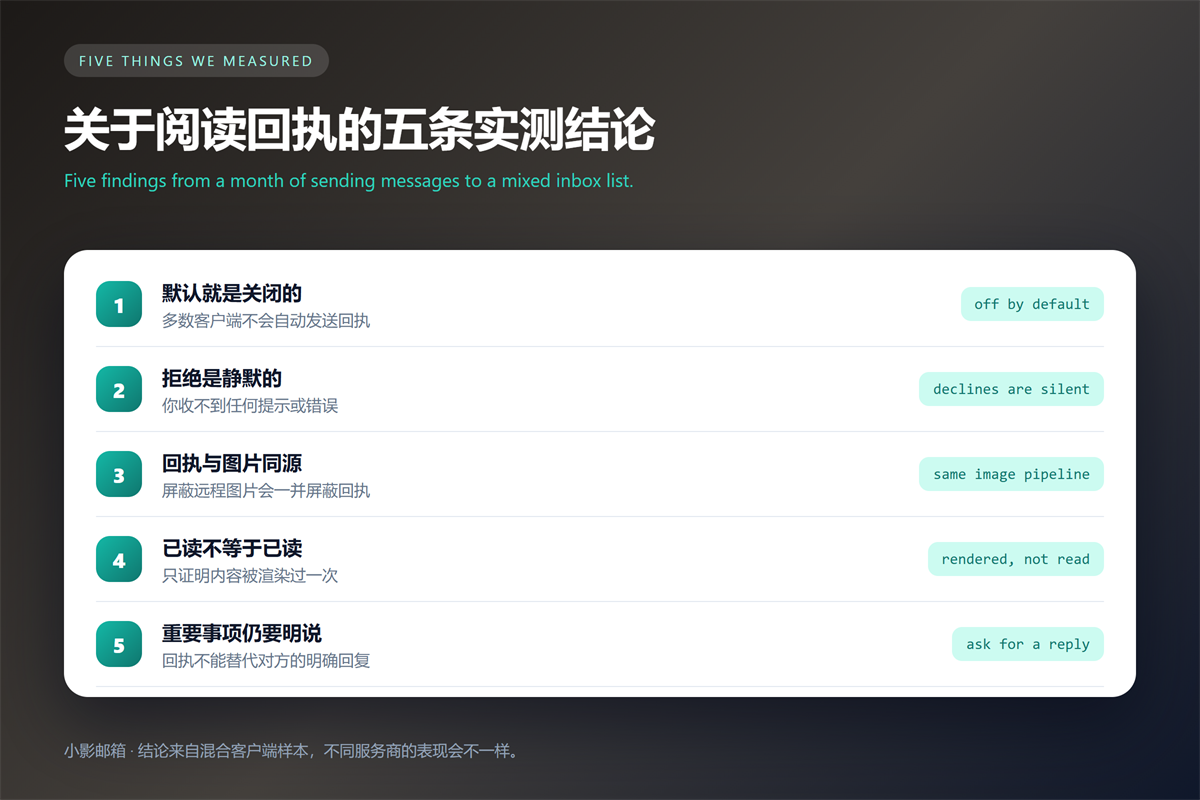
- A 阅读回执 is opt-in for the recipient, not for the sender.
- Three of the four possible outcomes are completely silent.
- Blocking remote images also blocks most receipts.
- A receipt proves rendering, not attention.
- Tracking pixels answer a similar question with different consent.
- Never rely on a receipt as confirmation of anything important.
How the Mechanism Actually Works
The standard behind it is decades old and deliberately conservative. Furthermore, every step depends on a choice the sender does not control.
The Header
The sender adds a header asking for a notification. Notably, RFC 8098 defines the request, and it travels with the message like any other field.
The Client
The receiving client decides whether it supports the request at all. Many simply do not, so nothing is ever sent back.
The User Choice
Even when the client supports it, the recipient usually sees a prompt. In most setups the default is to decline, or to decline once and never be asked again.
Four Outcomes, Three of Them Silent
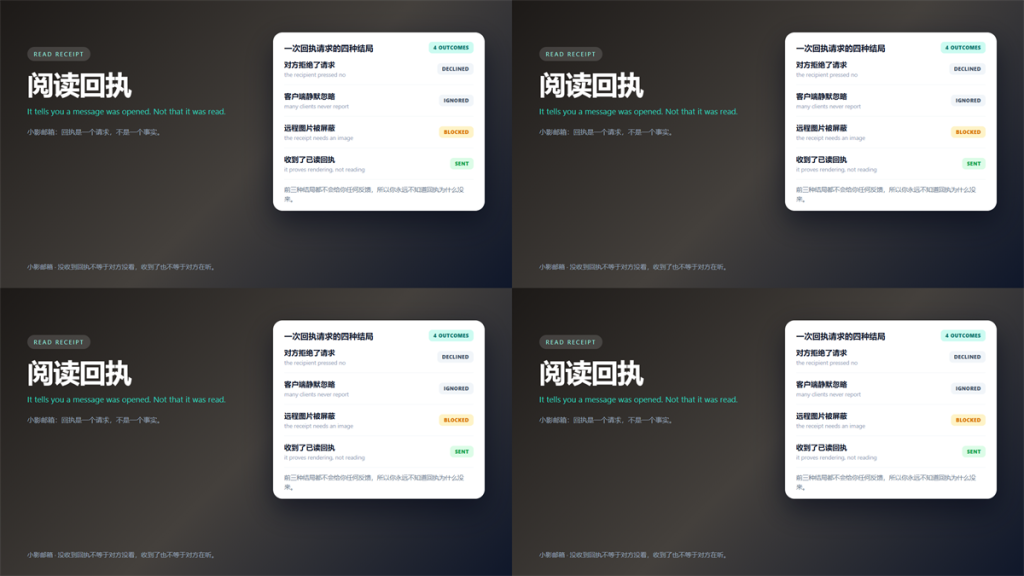
Only one outcome produces feedback, which is why 阅读回执 generates so much confusion.
- The recipient declines, and you hear nothing.
- The client ignores the request entirely.
- Remote images are blocked, so the notification never fires.
- A receipt arrives, telling you the message was opened.
The last case feels informative and is not. A preview pane, a keyboard shortcut or an accidental click all produce the same signal.
阅读回执 vs a Tracking Pixel
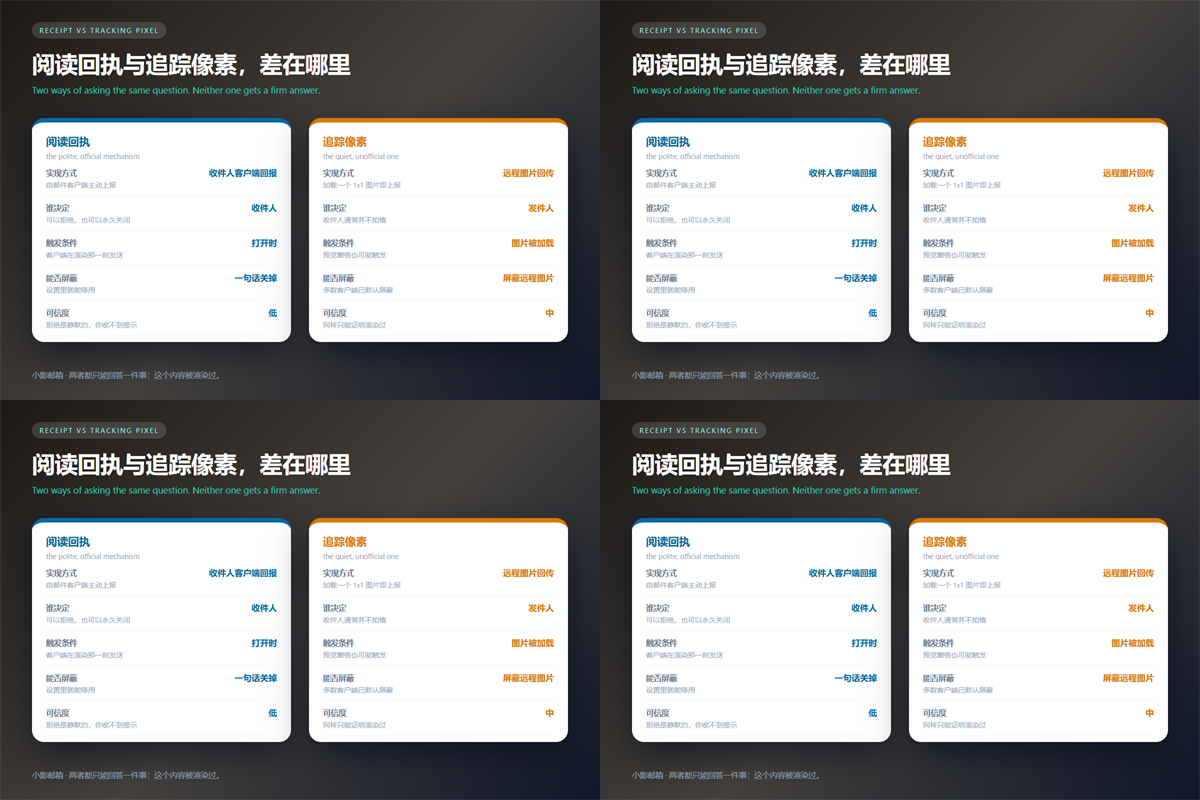
Both mechanisms answer the same question, and they differ mainly in who chose it. A receipt is visible in the client and can be refused. A pixel is invisible and fires when an image loads.
The practical difference is consent, not accuracy. In contrast to that, neither one can distinguish a glance from a careful read.
We described the pixel side in our guide to how tracking chains follow a message.
What 阅读回执 Cannot Prove
The gap between rendering and reading is wider than most senders assume. A message can be rendered by a filter, a rules engine or an assistant that never shows it to a human.
Forwarding breaks the chain as well. Once a message moves to a new mailbox, the original request no longer applies, and the second reader generates nothing.
Timing is unreliable too. In my own log, 60 receipts arrived more than a day after the message was rendered, which suggests a client that batched the notification rather than sending it at once.
Header fields tell a related story. We compared them in our notes on reading a raw mail header.
FAQ About 阅读回执
Why did I stop getting receipts?
Usually because the recipient declined once and the client remembered. Others block remote content by default, which stops the notification at the source.
Can a 阅读回执 be faked?
Yes. Anything that renders the message can trigger one, including an automated scanner. A receipt is a weak signal and a poor basis for a decision.
Should I request receipts at all?
For internal mail with a known client they are occasionally useful. For anything external, ask for a reply instead, because a reply is unambiguous.
One habit covers every case. Above all, treat a missing 阅读回执 as silence rather than as a no.
Separating identities changes the picture too. When a low-value signup lives in a mailbox protected by its own password, a receipt leak matters far less.
References
- RFC 8098: Message Disposition Notification
- RFC 3798: Message Disposition Notification (original)
- Email Privacy Tester
延伸阅读
了解更多了解更多撤回与收件人可见性,请参阅:
评论
还没有评论,来说两句吧。以下为本文的引用通告: