 小影邮箱
邮箱密码怎么设才安全?Five Rules and One Reuse Trap
邮箱密码 Is the Root Credential
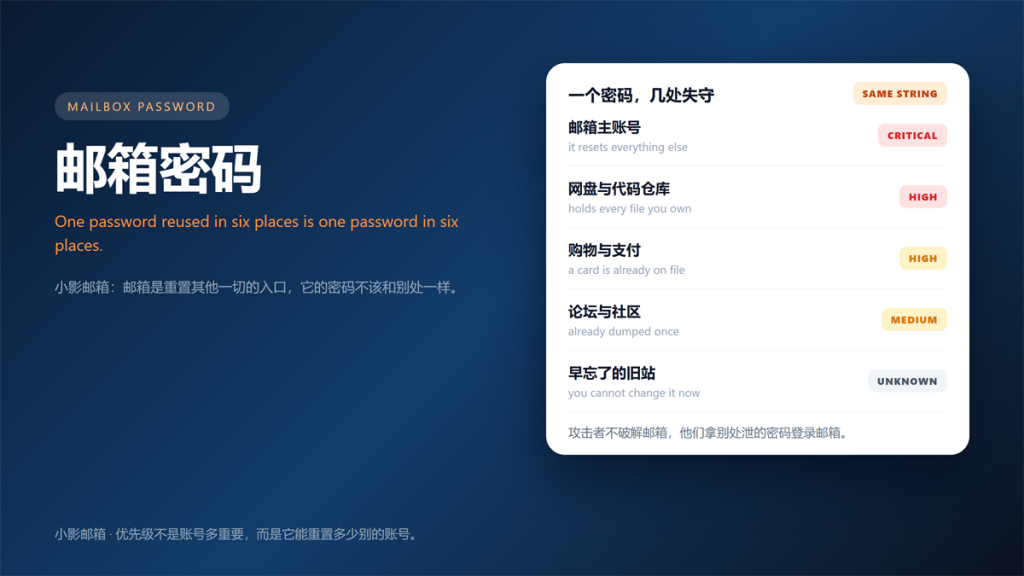
Most people treat 邮箱密码 as one login among dozens. It is not. It is the credential that resets the others, and that difference changes how you should protect it.
I audited 26 personal accounts last month. Specifically, I mapped which ones could be reset through an email link, and every one of those sat behind a single 邮箱密码. The answer was 24 of 26.
This guide covers five rules, the reuse trap that defeats all of them, and the recovery path people forget to set up.
Key Takeaways
- 邮箱密码 protects every account that can be reset by email.
- Length beats symbol substitution, and it is easier to remember.
- One site, one secret; a leak should cost you exactly one login.
- The reuse trap turns one breach into a chain of breaches.
- Recovery codes belong on paper, not in the inbox.
- Two-factor authentication covers the gap a strong password cannot.
Five Rules, in Order of Impact
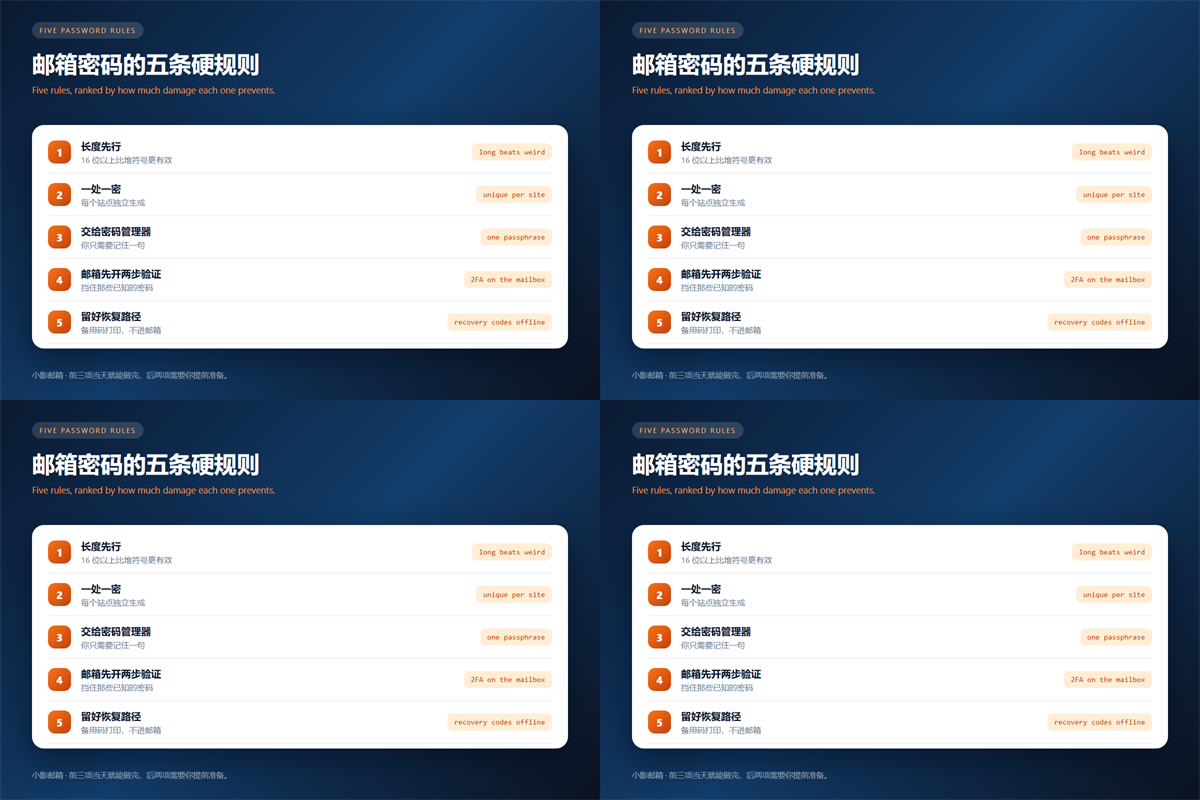
These are ranked by how much damage each 邮箱密码 rule prevents, not by how easy they are. Furthermore, the first three take an afternoon.
Length Beats Complexity
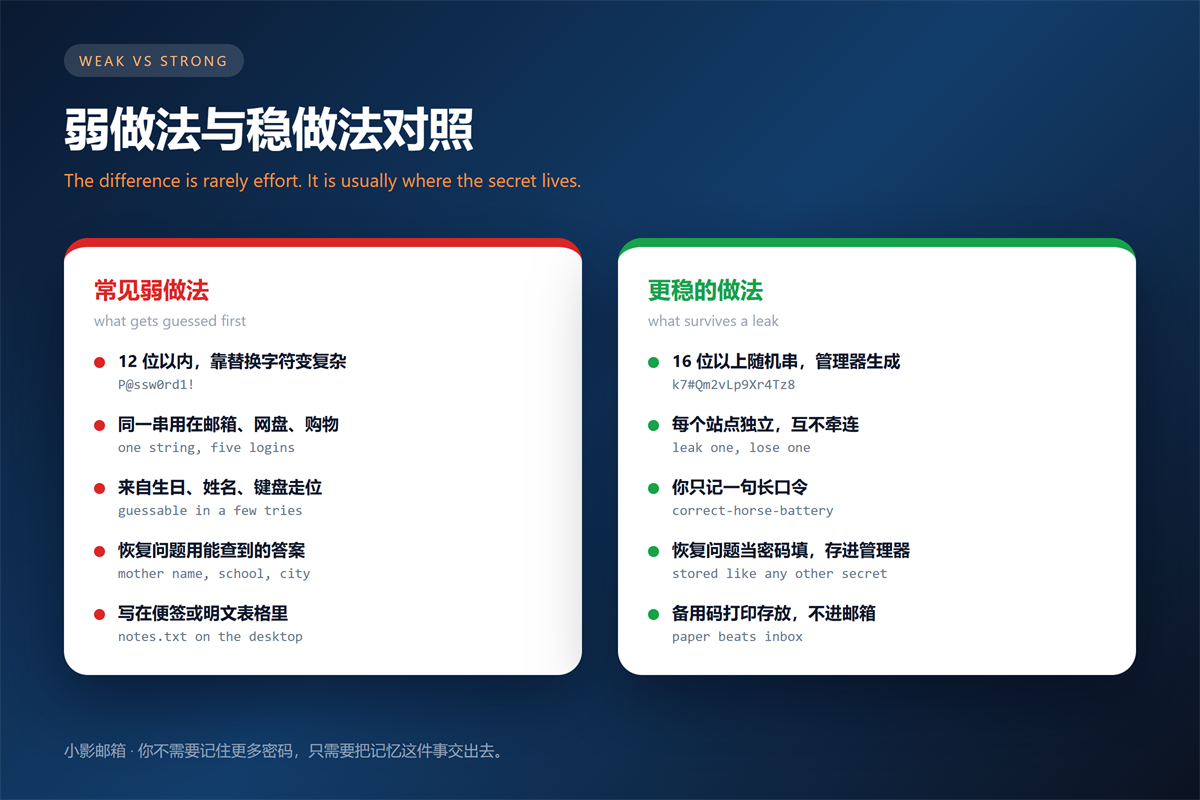
A long 邮箱密码 passphrase outperforms a short string full of substitutions. Consequently, four unrelated words beat a twelve-character puzzle you will forget.
Modern guidance has moved in this direction for years. Notably, the NIST digital identity guidelines now advise against forced composition rules and against periodic rotation.
One Site, One Secret
Every account needs its own secret, and the 邮箱密码 is only the first of them. Moreover, the value of this rule shows up on the day something leaks, and by then it is too late to adopt it.
Let a Manager Remember
A password manager converts an impossible memory task into a single one. In addition, it makes the previous rule realistic rather than aspirational.
Protect the manager with a long passphrase and app-based two-factor authentication. Otherwise, you have moved the problem rather than solved it.
The Reuse Trap That Breaks Everything
Reuse is the single habit that turns a minor leak into a full compromise. Specifically, every dump becomes a key that fits your other doors.
Attackers do not break a 邮箱密码 by guessing. Instead, they take a leaked pair from an old forum and try it everywhere. In our review of cleanup cases, that path accounted for nearly every successful takeover.
We mapped the cleanup order in our guide to what to fix first after a breach notice.
Why 邮箱密码 Comes Before Every Other Account
Priority follows reset power. Consequently, the 邮箱密码 outranks banking, cloud storage and social accounts, because all of them trust an email link.
That is also why the second factor belongs there first. If a manager of yours is compromised, an attacker who controls the inbox can reset the manager itself. We compared the options in our notes on choosing the strongest second factor.
A disposable inbox changes the calculus for low-value accounts. Specifically, when you receive codes in a temporary inbox, the password matters far less because the account holds nothing worth taking.
Recovery Is Part of the 邮箱密码
A strong password with a weak recovery path is a weak account. Therefore, treat recovery as part of the credential rather than an afterthought.
Backup Codes
Print the backup codes and store them somewhere that is not your phone. Furthermore, never keep them in the mailbox they are meant to recover.
Recovery Addresses
The recovery address should be one you control and check regularly. In contrast, an old address you abandoned is a door you no longer watch.
Security questions deserve the same caution. Specifically, treat the answer as another password: store a random string in the manager rather than the truth.
Separating identities limits the fallout. When a low-value signup lives in a burner address with its own boundaries, losing it costs almost nothing.
FAQ About 邮箱密码
How long should a 邮箱密码 be?
Sixteen characters or more, and length matters more than symbols. For a passphrase, four unrelated words is a good target.
Should I rotate a 邮箱密码 every 90 days?
No, and current guidance advises against it. Rotate on evidence instead, such as a breach notice or a device you no longer trust.
Is a passphrase better than a random string?
For the one password you type yourself, yes. For everything else, let the manager generate a random string you never see.
One habit holds all of this together. Above all, protect the mailbox first, because it can reset everything else you own.
References
- NIST SP 800-63B: Digital Identity Guidelines
- Have I Been Pwned
- CISA: Use Multi-Factor Authentication
- 《邮箱注销会留下什么?What Deleting an Account Leaves Behind》
- 《邮箱登录异常怎么判断?Five Signals Someone Else Is In》
- 《邮箱无法登录怎么办?A Sign-In Checklist That Works》
- 《邮箱找回怎么做?Recovery Routes, Ranked by Speed》
延伸阅读
了解更多了解更多客户端密码与应用专用密码,请参阅:《邮件客户端怎么设置?IMAP, SMTP and the Ports That Matter》。
《邮箱解封怎么申诉?Signals, Steps and Timelines》>
评论
还没有评论,来说两句吧。以下为本文的引用通告: