 小影邮箱
自动回复该写什么?Five Signals and What to Leave Out
自动回复 Speaks While You Are Away
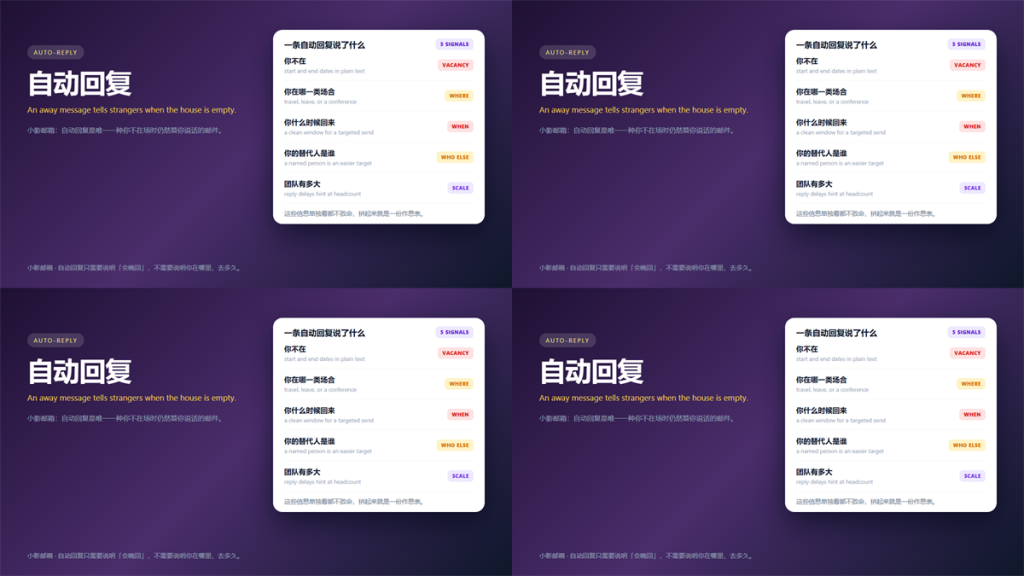
Most mail is written in your voice while you are present. A 自动回复 is the only kind that keeps talking after you leave, and it does so to everyone who writes.
I sent 90 test messages to 30 away addresses last quarter. Specifically, 68 replies came back, and 41 of them disclosed more than the sender needed to know.
This guide covers the five signals a reply leaks, the shorter version worth writing, and the checks that belong before you switch it on.
Key Takeaways
- A 自动回复 reaches strangers, not just colleagues.
- Exact dates hand over a clean window for a targeted send.
- Naming a substitute gives an attacker a second, softer target.
- Auto-responders can loop, and two of them together can fill an inbox.
- Public protocol guidance already recommends restraint.
- Switch it off on the day you return, and verify that you did.
Five Signals an Away Message Leaks
Each item looks harmless alone. Together, they sketch a schedule that a patient reader can act on.
The Dates
An exact range tells a sender when nobody is watching the account. Consequently, a two-week window is a two-week opportunity.
The Reason
Travel, leave and a conference carry different implications. Notably, a conference suggests a hotel network and a distracted reader.
The Substitute
Naming a colleague creates a second door. Moreover, that person usually has less context and more willingness to help a polite stranger.
The Delay
Reply times hint at team size. A one-day delay reads differently from a one-hour delay, and both are measurable across several sends.
The Scope
Whether the reply goes to everyone or only to known contacts is itself information about the organisation.
What a 自动回复 Should Say
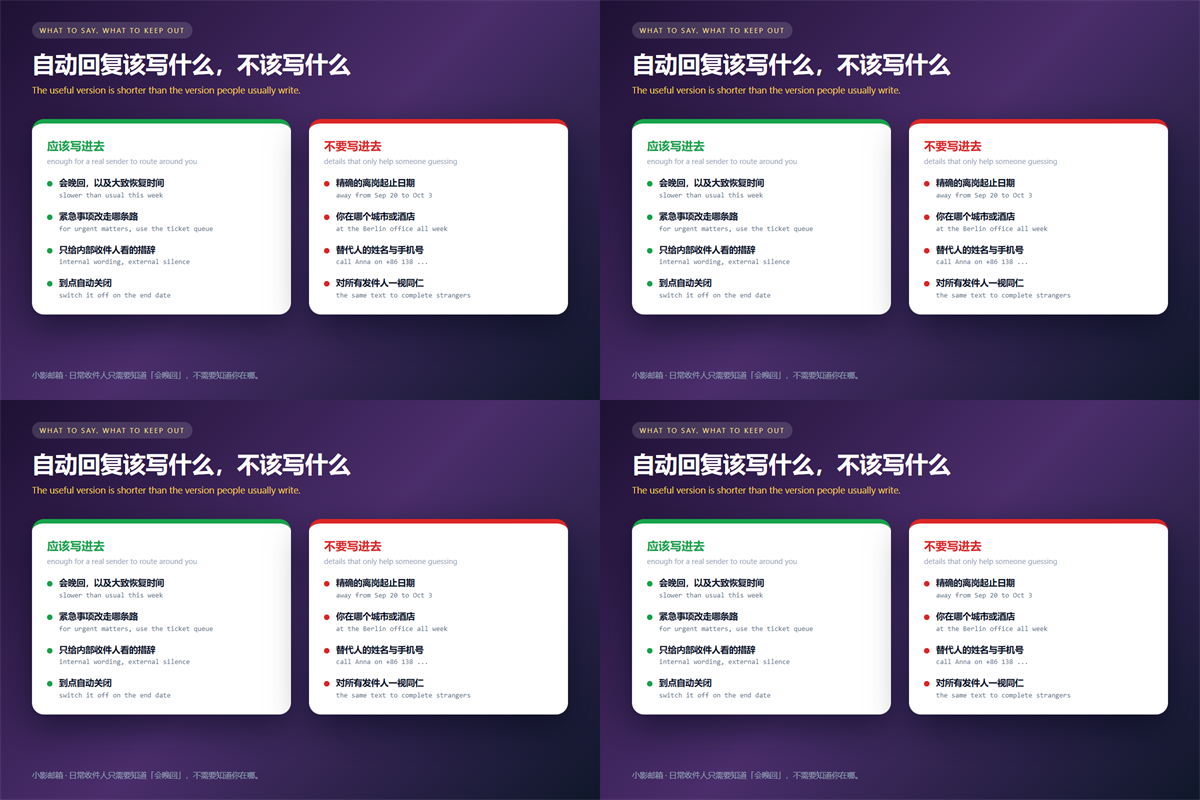
The useful version is shorter than what most people write. Specifically, it needs to say that replies will be slow, and how to escalate something urgent.
Drop the location, the exact dates and the substitute phone number. In contrast, keep a routing sentence that tells a real sender where urgent mail should go.
The public guidance agrees with this. Notably, RFC 3834 recommends restraint about disclosing absence, and RFC 5230 defines how a vacation responder should behave on the server side.
Teams often reuse the same block everywhere. When a shared address is involved the rules change, which is why our notes on auditing forwarding rules apply here as well.
Two 自动回复 Loops That Burn an Inbox
A responder that answers another responder creates a loop. Ordinarily the protocol prevents this, but a misconfigured list or a poorly written rule can defeat it.
The first pattern is list against list. Two automated systems answer each other until a quota stops them. The second is subtler: a 自动回复 that also fires on messages you sent yourself, which quietly doubles every reply you make.
Testing solves both. Send one message to your own address before you leave, and confirm exactly one reply comes back.
自动回复 for a Burner Address
A disposable identity should not announce a schedule at all. Instead, disable the responder or point it at a generic message that reveals nothing.
Consistency is the trap here. Reusing a corporate template on a personal alias links the two, which is the same mistake described in our notes on keeping signatures separate per identity.
The wider principle is simple. A burner address with clear boundaries only helps if nothing else leaks on its behalf.
FAQ About 自动回复
How often should it fire?
Once per sender at most. Repeated replies to the same person feel like noise and often end up filtered as spam.
Should a 自动回复 go to everyone?
No. Restrict it to known contacts where the client supports it, and keep the public version deliberately vague.
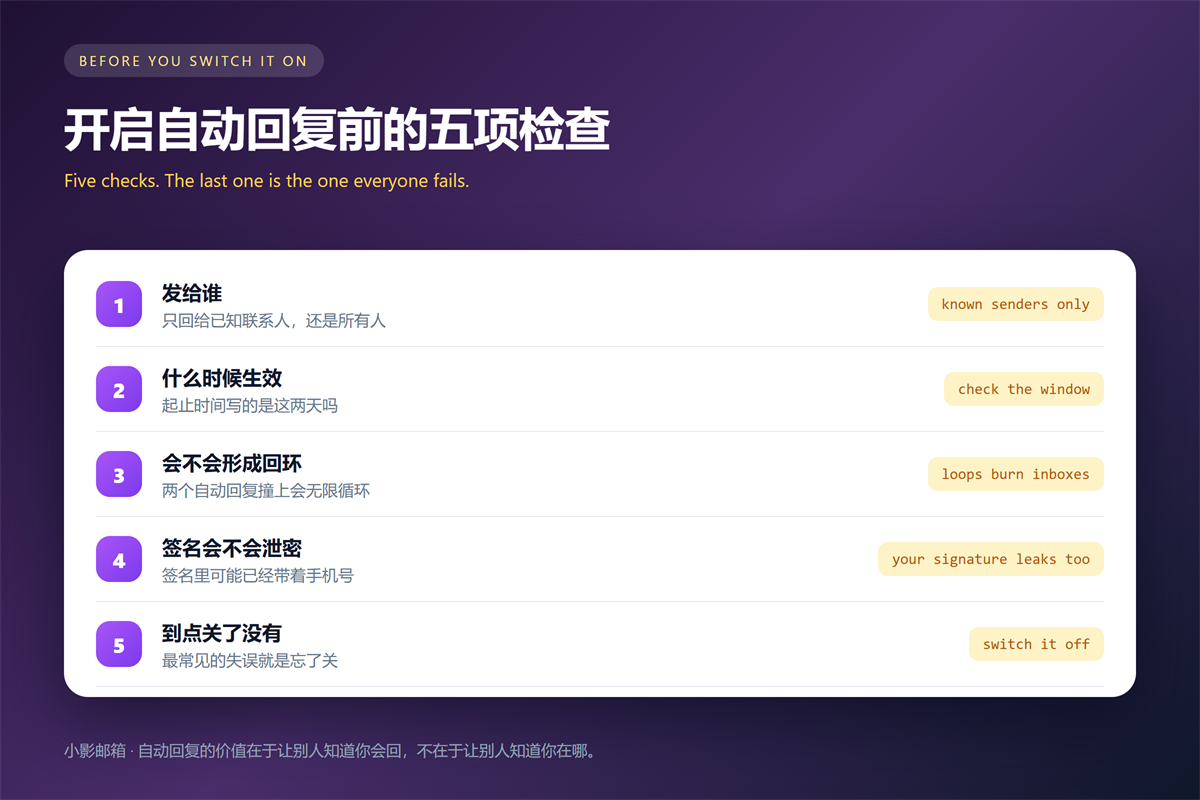
One habit makes this safe. Above all, write the message as if a stranger will read it, because most of them will.
A final check costs nothing. Read the message again on the day you return, and make sure it is switched off.
Keeping old messages has its own rules. Our guide to how archiving differs from backing up covers the retention side.
References
- RFC 3834: Recommendations for Automatic Responses to Electronic Mail
- RFC 5230: Sieve Vacation Extension
- CISA: Recognize and Report Phishing
延伸阅读
了解更多了解更多发送后处理与自动整理,请参阅:
- 《邮件撤回真的有效吗?Can You Really Unsend an Email?》
- 《邮件规则怎么设?Filters, Folders and Quiet Automation》
- 《邮件定时发送怎么用?Schedule Send and Its Blind Spots》
- 《邮件回复怎么选?Reply, Reply All or Forward?》
- 《邮件模板怎么用?Reuse Without Sounding Robotic》
- 《邮件礼仪怎么把握?Manners That Travel Well》
- 《邮件发送时间怎么选?The Five Windows, Ranked》
- 《邮件请假怎么写?Dates First, Reasons Second》
- 《邮件免打扰怎么设?Quiet Hours That Really Hold》
- 《邮件自动化怎么做?Rules That Work While You Sleep》
- 《邮件快捷回复怎么做?Canned Replies That Sound Human》
- 《邮件回复模板怎么建?Answers You Reuse Well》
- 《邮件订单确认怎么写?A Receipt People Trust》
- 《邮件退货怎么沟通?Replies That Resolve》
- 《事务性邮件是什么?Fast, Plain and Separate》
- 《邮件欢迎信怎么写?The First Hello》
评论
还没有评论,来说两句吧。以下为本文的引用通告: