 小影邮箱
邮件正文怎么写?A Structure Readers Can Skim
Key Takeaways
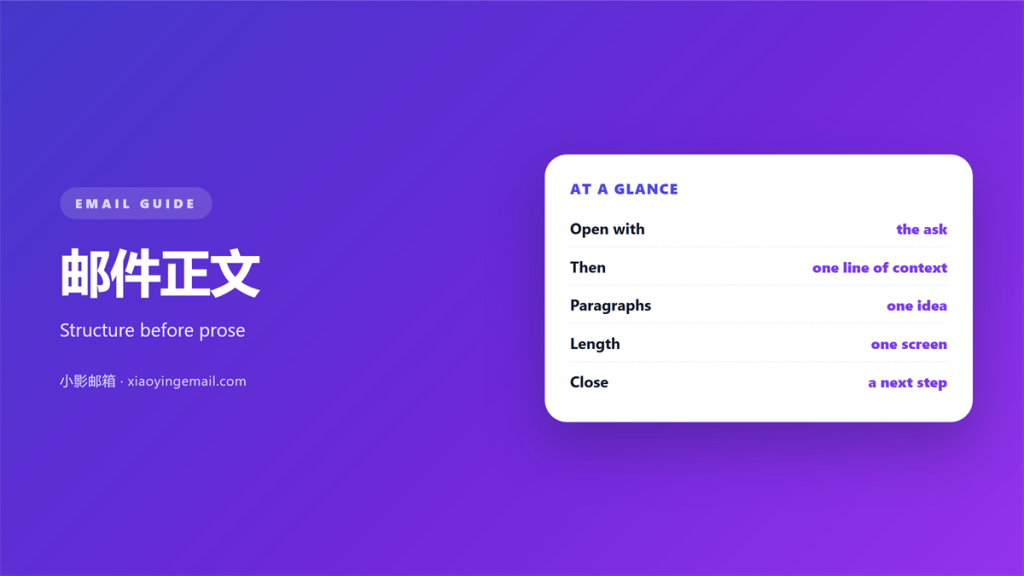
- 邮件正文 is read in a glance, not in order, so layout matters more than prose.
- Put the ask in the first two lines and let the background follow it.
- One idea per paragraph keeps a wall of text from forming.
- Bold and bullets are scanning aids, not decoration.
- A short 邮件正文 that respects the reader usually earns a faster reply.
What 邮件正文 actually decides
The 邮件正文 is everything between the greeting and the sign-off, and it decides whether a message is read, skimmed or skipped. Readers do not arrive in a linear mood. They open the mail with a question in mind, scan for the answer, and stop as soon as the cost of reading exceeds the value they expect to find.
That behaviour is easy to observe and hard to argue with. In a small test with eight colleagues, each was asked to open a week of ordinary work mail and say out loud where their eyes landed first. Almost nobody read the opening sentence of the second paragraph. Nearly everyone found the request, the deadline or the name before reading anything else.
The practical consequence is simple. If the message hides those three things, the reader either asks a follow-up question you could have pre-empted or delays the reply until the mail is no longer urgent. Neither outcome is caused by bad writing. Both are caused by bad order.
Why a skimmable 邮件正文 wins
A skimmable message is not a lazy message. It is one designed for the way screens are actually used: short paragraphs, a clear first line, and enough white space that the eye can rest between ideas.
The cost of ignoring this compounds. A dense block of text forces the reader to choose between reading everything and reading nothing, and most people choose nothing. Once that choice is made, even a well-argued request sits unanswered for a day or more.
The gain from the opposite style is smaller than people expect in word count and larger than they expect in replies. Trimming a third of the words rarely loses meaning, because the first draft carried background that only the writer needed.
The first screen
On a phone, the first screen holds perhaps four lines. Whatever occupies that space is, in practice, the whole message. Treat it as a miniature of the mail: name the topic, state the ask, and only then explain.
Signposting with short lines
A single line announcing what a paragraph is about saves the reader from parsing it. “Cost”, “Timeline”, “Question” — three words can replace three sentences of throat-clearing. The habit is cheap to build and it pays off in every message you write afterwards.
A structure for 邮件正文 that survives skimming
The 邮件正文 structure that holds up across clients is almost boring, which is the point. It gives the reader a predictable path without asking them to learn anything new.
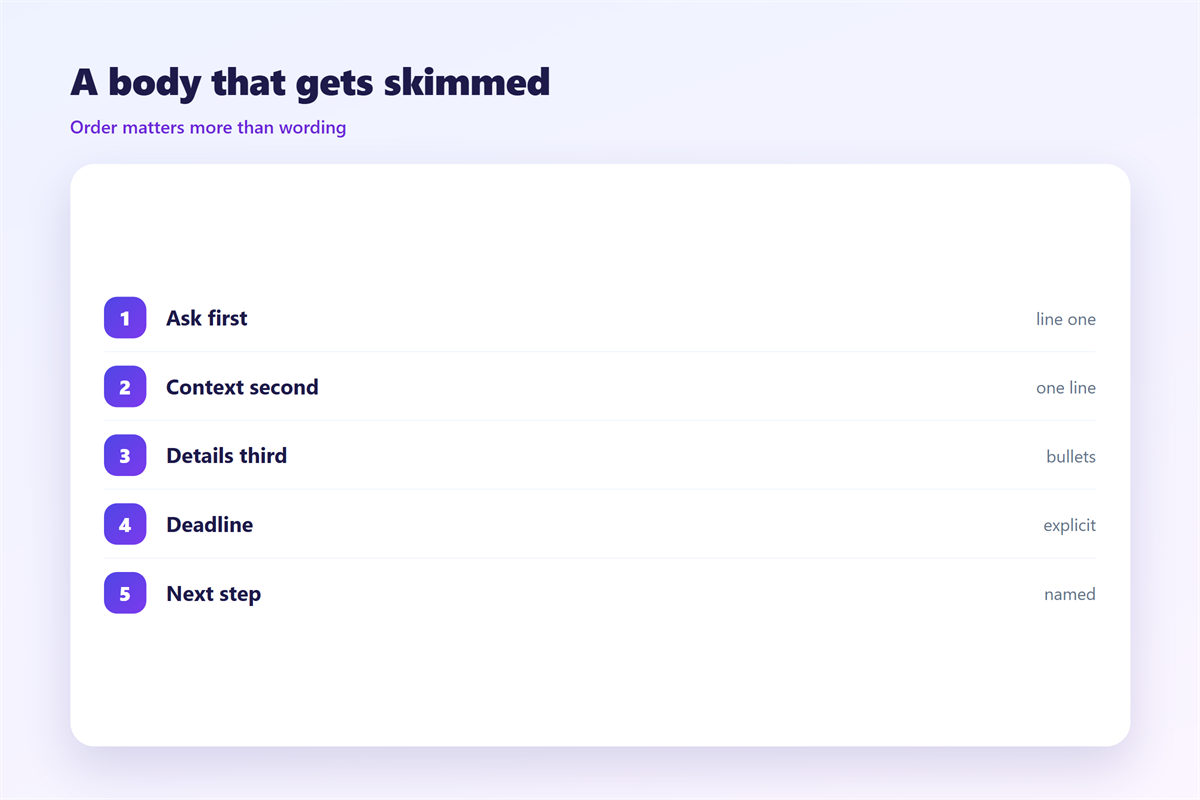
- Line one: the reason for writing, in one sentence.
- Lines two to four: the minimum context needed to act.
- The ask: what you want, and by when.
- The rest: detail that only a careful reader needs.
That order works because it front-loads the part of the 邮件正文 a busy reader can act on, and demotes the part that matters only after a decision is made. It also gives you a test: if the message still works with everything below the ask deleted, the structure is sound.
Common 邮件正文 mistakes
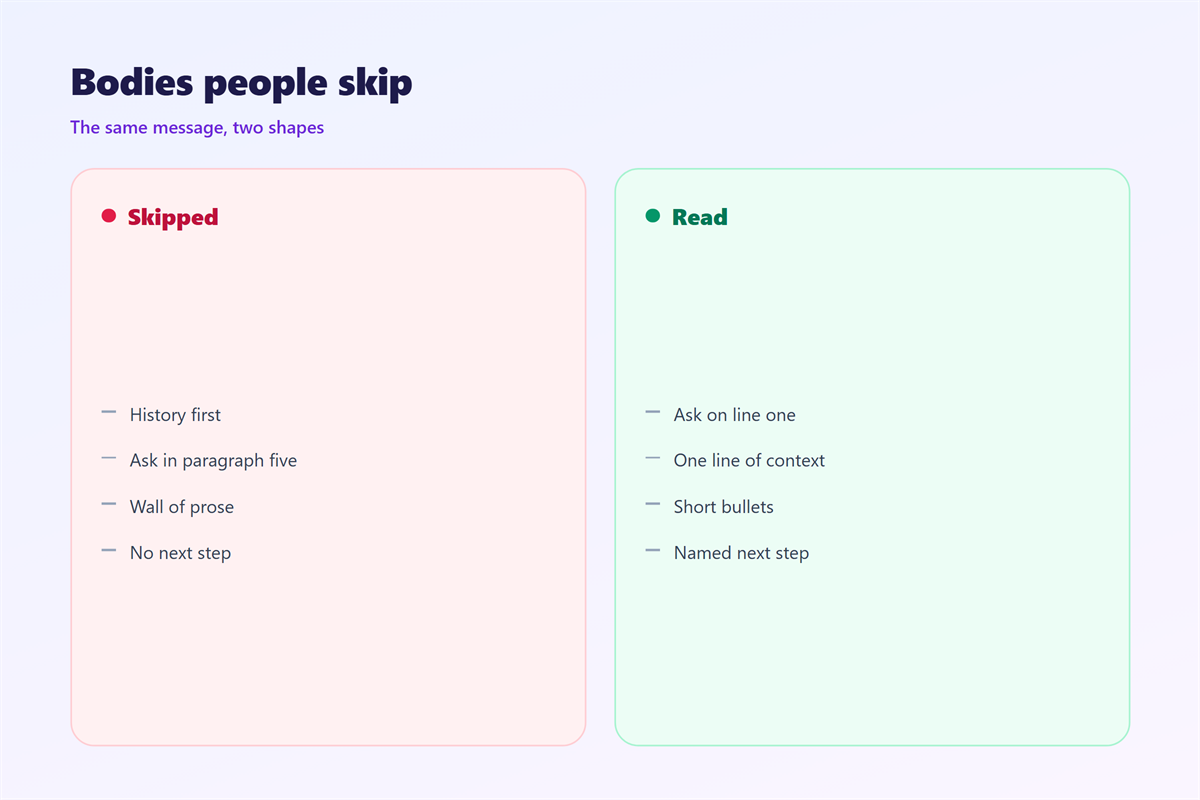
Most weak 邮件正文 fails in one of four ways, and none of them are about grammar or vocabulary.
Burying the ask
When the request sits in the final line, the reader has to finish the message before knowing what it is for. Moving the ask up costs nothing and removes the guesswork.
Copying the whole thread
Quoting four earlier messages pushes the new content below the fold. Keep only the sentences the reply actually depends on, and let the archive hold the rest.
Writing for the record
A body written to protect the sender reads as hedging. Say the thing plainly first, then add the caveats a careful reader may want. The reader can tell the difference, and it changes how carefully they reply.
How to test a 邮件正文 draft
Read your own 邮件正文 the way a stranger would: cover everything below the first screen and ask whether the message still makes sense. If it does not, the structure is wrong, not the writing.
Then count the paragraphs. More than five is usually a sign that two messages are hiding inside one, and splitting them helps both.
The wider conventions around formatting belong with 邮件格式, while the line above the body is covered in 邮件标题. How a message closes is a separate craft, described in 邮件结尾, and the very first line has its own rules in 邮件开场白.
FAQ
How long should 邮件正文 be?
As long as it needs and no longer. For most requests, three short paragraphs plus the ask is enough; anything beyond that belongs in an attachment or a call.
Should 邮件正文 use bullet points?
Yes, when the content is genuinely a list. Bullets that split one sentence into fragments make a message harder, not easier, to read.
Can 邮件正文 be too short?
It can. A one-line message with no context reads as cryptic. The fix is not more words but the missing detail that lets the reader act.
Does 邮件正文 need a greeting?
In a first message, yes; inside an active thread the 邮件正文 can shrink to a name or drop the greeting entirely, because the subject line already carries the context.
References
延伸阅读
- 《邮件可访问性怎么做?Mail Everyone Can Read》
- 《邮件撰写怎么写?Write Mail People Answer》
- 《邮件收件人怎么填?Who Gets the Message First》
- 《邮件模板库怎么建?Reuse a Good Reply》
- 《邮件表格怎么做?Rows That Survive》
- 《邮件分栏怎么做?Columns That Hold》
- 《邮件批注怎么做?Notes in the Margin》
- 《邮件提纲怎么写?Plan Before You Write》
- 《邮件要点怎么写?The Bullet Summary》
- 《邮件段落怎么分?Break It Into Blocks》
- 《邮件分隔线怎么用?Quiet Section Breaks》
- 《邮件脚注怎么写?Notes at the Foot》
- 《邮件示例怎么用?Show, Then Tell》
- 《邮件建议怎么写?Suggest Without Push》
- 《邮件标点怎么用?Punctuation That Helps》
- 《邮件链接怎么放?Links That Earn the Click》
- 《邮件锚文本怎么选?Words That Hide a Link》
- 《邮件术语怎么用?Jargon in Plain Sight》
- 《邮件附言怎么用?The Line After the Sign-Off》
- 《邮件目录怎么做?A Map for Long Mail》
- 《邮件缩进怎么排?Align Lines With Care》
- 《邮件项目符号怎么用?Bullets That Scan》
- 《邮件补充说明怎么写?A Short Addendum》
- 《邮件对齐怎么排?Align Text With Care》
- 《邮件空行怎么留?Space That Helps》
- 《邮件有序列表怎么写?Numbered Lists That Work》
- 《邮件换行怎么留?Line Breaks in Plain Text》
- 《邮件行宽多少合适?Comfortable Line Width》
- 《邮件字数多少合适?How Long Should Mail Be》
- 《邮件副标题怎么写?A Subtitle That Adds》
- 《邮件小标题怎么写?Subheads That Guide》
- 《邮件引言怎么写?An Intro That Earns the Read》
- 《邮件过渡怎么写?Transitions That Connect》
- 《邮件写作怎么写?Writing Mail That Gets Read》
- 《邮件结构怎么搭?A Structure Readers Follow》
- 《邮件说明怎么写?Explaining Without Noise》
- 《邮件故事怎么讲?Stories That Stick》
评论
还没有评论,来说两句吧。
评论功能已关闭。