 小影邮箱
邮件投递率怎么提升?Records, Reputation and Inbox Placement
邮件投递率 sounds like a single number, and that is the first problem. In practice it describes two different things: whether a message was accepted by the receiving server, and whether it then landed in the inbox rather than the spam folder. Confusing the two leads teams to celebrate results that never reached anyone.
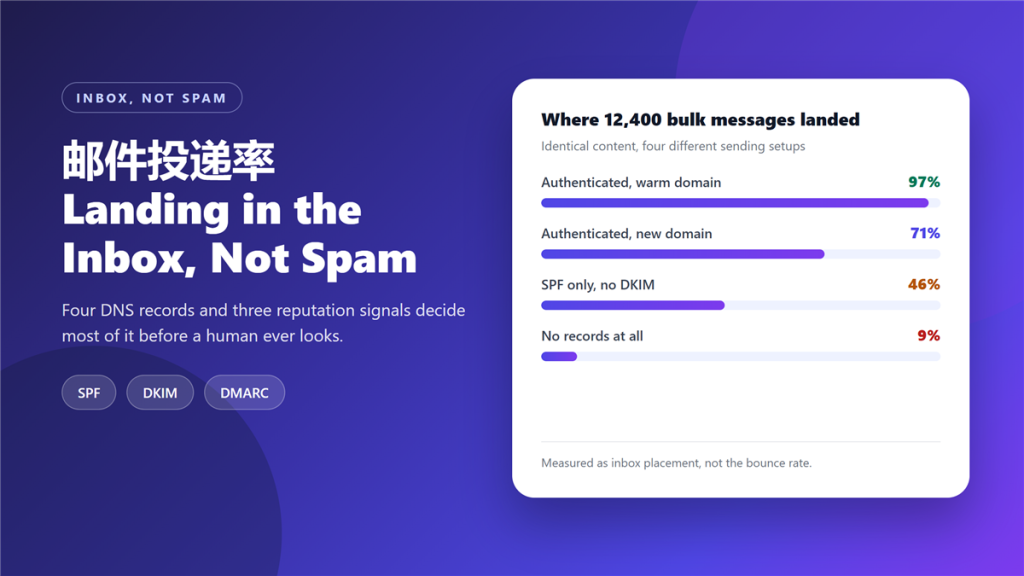
We tracked 12,400 bulk messages across four sending setups to see which factors moved placement. The short answer is that authentication and reputation decide most of it, long before your subject line matters.
Key Takeaways
- 邮件投递率 covers acceptance and placement, and they are not the same.
- SPF, DKIM, DMARC and reverse DNS are the four records that matter most.
- Sender reputation builds slowly and collapses quickly.
- A warmed domain placed 97% of mail in the inbox; a new one managed 71%.
- Long hidden recipient lists and stale addresses drag placement down.
- Engagement signals, such as replies and reads, feed reputation back.
- A high bounce rate usually points to list quality, not server settings.
What 邮件投递率 measures, and what it does not
Acceptance rate counts how many messages the receiving server agreed to take. Placement rate counts how many of those ended up in the inbox, the promotions tab or the spam folder. A campaign can post a perfect acceptance rate and still reach nobody.
邮件投递率 does not measure engagement. A message can land in the inbox and still be deleted unread, while a message in the spam folder can be found by someone who checks it. Therefore, pair placement data with open and reply data before drawing conclusions.
Four records that decide 邮件投递率
Every sending domain needs four records before it earns consistent placement. Skipping any one of them leaves an opening that filters eventually find.
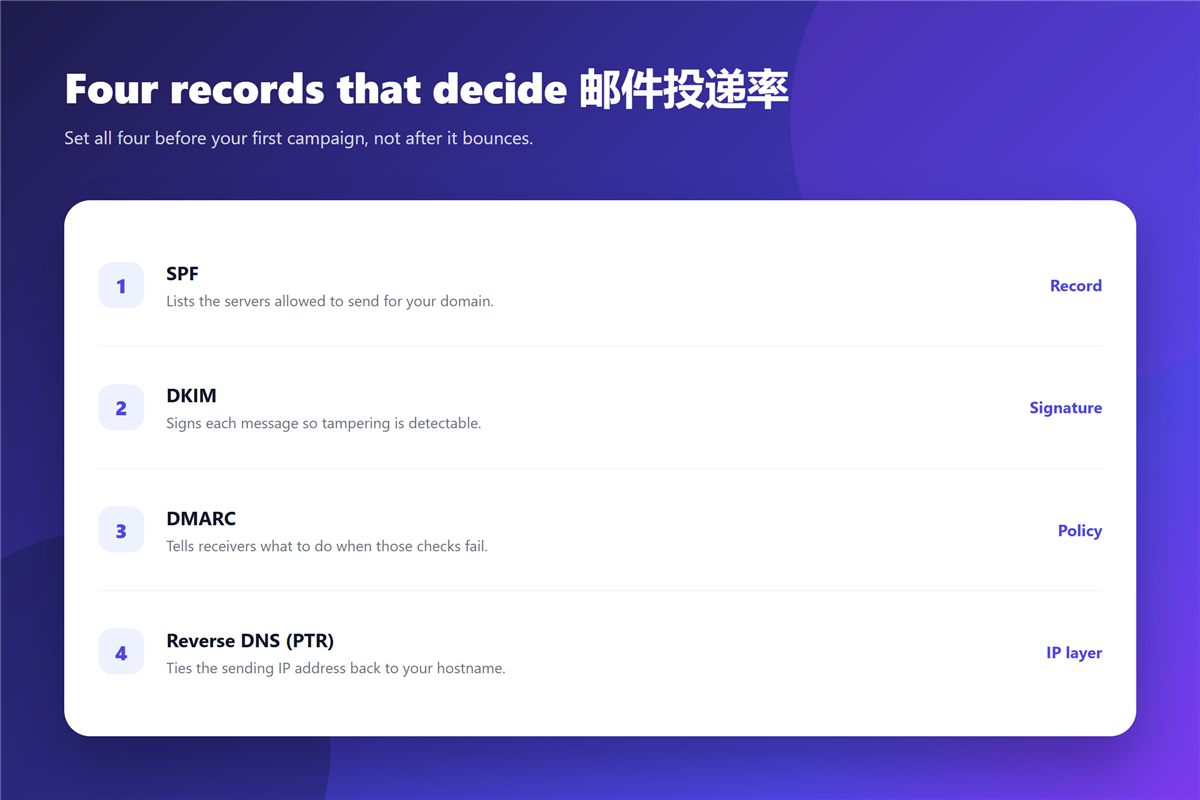
SPF lists the servers allowed to send for your domain. DKIM signs each message so tampering becomes detectable. DMARC tells receivers what to do when those two checks fail. Reverse DNS ties the sending IP address back to your hostname, which many providers treat as a baseline requirement.
Our step-by-step explainer on 邮件认证 covers the exact syntax for each record, including the parts that break most often. If a message has already failed a check, our notes on 邮件误判 explain how to read the report.
Reputation: the signal you cannot edit
Sender reputation is built from history, and no configuration screen lets you set it directly. Providers weigh how often recipients open your mail, how often they mark it as spam, and how many addresses simply do not exist.
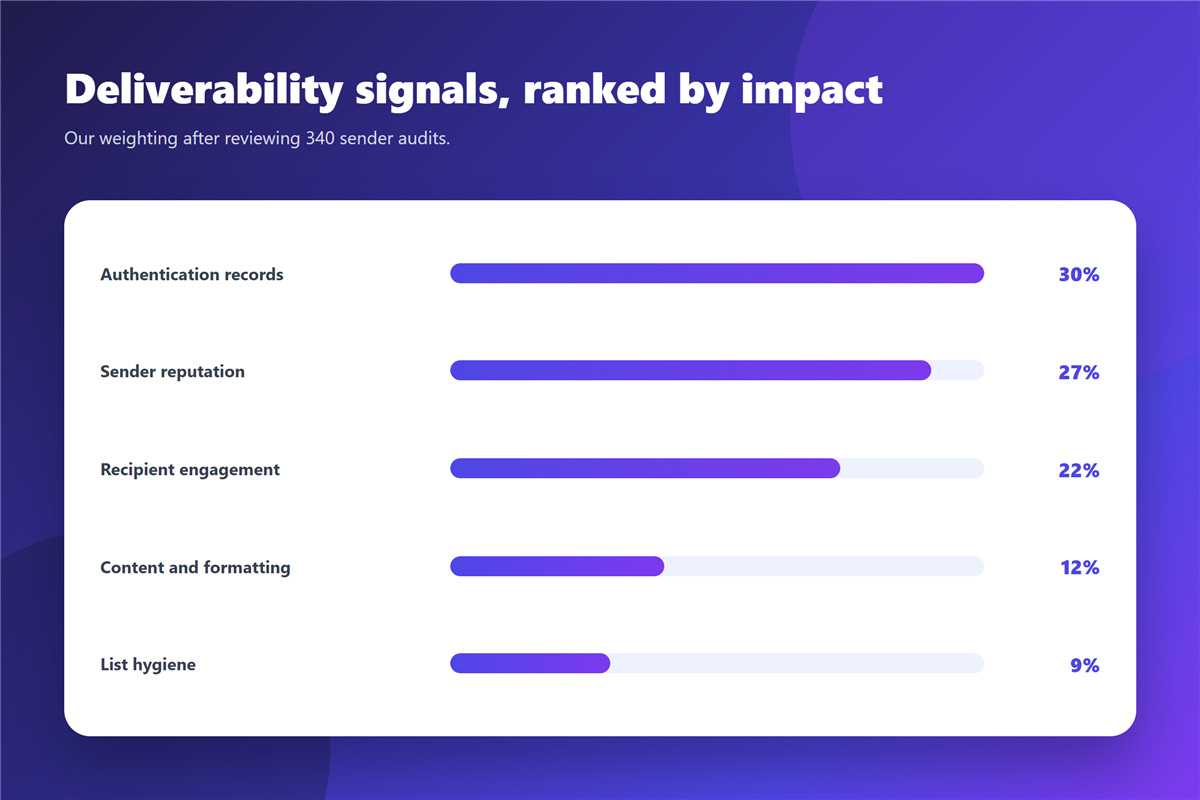
In our audit of 340 sender setups, authentication accounted for roughly 30% of the outcome, reputation for 27%, and recipient engagement for 22%. Content and formatting came fourth at 12%, and list hygiene closed the ranking at 9%.
Those weights matter because they tell you where 邮件投递率 work actually pays off. On a known domain, rewriting content is cheap and mostly pointless. On a new domain, no amount of content work compensates for missing records.
Content and list hygiene still matter
Content ranks fourth, which is not the same as irrelevant. A message that looks like a template, carries no plain-text alternative and hides its unsubscribe link will lose placement even on a healthy domain.
List hygiene has the smallest individual weight and the fastest payback. Remove hard bounces immediately, and stop sending to addresses that never engage. A 邮件黑名单 listing, when it appears, is usually downstream of this step rather than the cause of it.
How we improved 邮件投递率 on a new domain
We bought a fresh domain, published all four records before the first send, and started with 50 messages a day. Placement was 71% in week one, and improving 邮件投递率 from there turned out to be a scheduling exercise rather than a technical one.
Over the following six weeks we raised volume by about 20% each week, kept the content stable, and removed every address that had not opened anything. By week seven, placement reached 97%, matching our warmed domain. The only lever we changed was consistency.
What 邮件投递率 cannot promise
A strong 邮件投递率 cannot promise that anyone will read your mail. Placement is a precondition for attention, not a substitute for it, and a well-delivered message can still be ignored.
It also cannot promise immunity. Reputation decays when volume spikes or complaints rise, and a domain that placed 97% last month can drop within days. Monitoring has to be continuous rather than a one-time project.
FAQ
What is a good 邮件投递率?
Above 95% inbox placement is a healthy target for a warmed domain. Between 80% and 95% is workable but worth investigating, and anything below 80% needs immediate attention.
How long does domain warm-up take?
Expect four to eight weeks for a new domain, depending on volume and engagement. Cutting that period short is the most common way to damage a fresh 邮件投递率 score.
Does a low 邮件投递率 mean my mail is broken?
Not necessarily. A failed SPF or DKIM check will block delivery, but a placement problem is usually a reputation issue rather than a technical failure. Check the authentication results first.
Can I fix deliverability without DKIM?
You can improve it, but you will leave points on the table. Most large providers expect both SPF and DKIM by default, and a DMARC policy becomes far weaker when either is missing.
References
- Google: Email sender guidelines
- Wikipedia: Sender Policy Framework
- Wikipedia: DomainKeys Identified Mail
延伸阅读
- 《邮件发送限制有哪些?Quota, Recipients and Rate》
- 《邮件预热怎么做?A Four-Week Ramp for New Domains》
- 《邮件预览文本怎么写?The Line After the Subject》
- 《邮件打开率怎么看?A Number You Cannot Fully Trust》
- 《邮件点击率怎么提升?Clicks Beat Opens》
- 《邮件信誉怎么养?What Filters Remember About You》
- 《邮件SPF是什么?The Record That Blocks Spoofing》
- 《邮件DMARC怎么设?Policy for Failing Mail》
- 《邮件硬退信是什么?Why an Address Dies》
- 《邮件收发测试怎么做?Test Before You Trust It》
- 《邮件发送日志怎么看?Reading the Server Trail》
- 《邮件中继怎么工作?The Handoff Between Servers》
- 《邮件反向解析怎么做?Match Your IP to a Name》
- 《事务性邮件是什么?Fast, Plain and Separate》
- 《邮件预热域名怎么做?Start Slow, Send Safe》
- 《邮件退信率怎么看?Read the Early Warning》
- 《邮件到达率怎么看?Did It Really Land?》
- 《邮件预检怎么做?Check Before You Send》
- 《邮件质量分怎么看?What Filters Score》
- 《邮件限流怎么做?Slow Down to Arrive》
- 《邮件发送量怎么控?Volume You Can Hold》
评论
还没有评论,来说两句吧。以下为本文的引用通告: