 小影邮箱
邮件回复怎么选?Reply, Reply All or Forward?
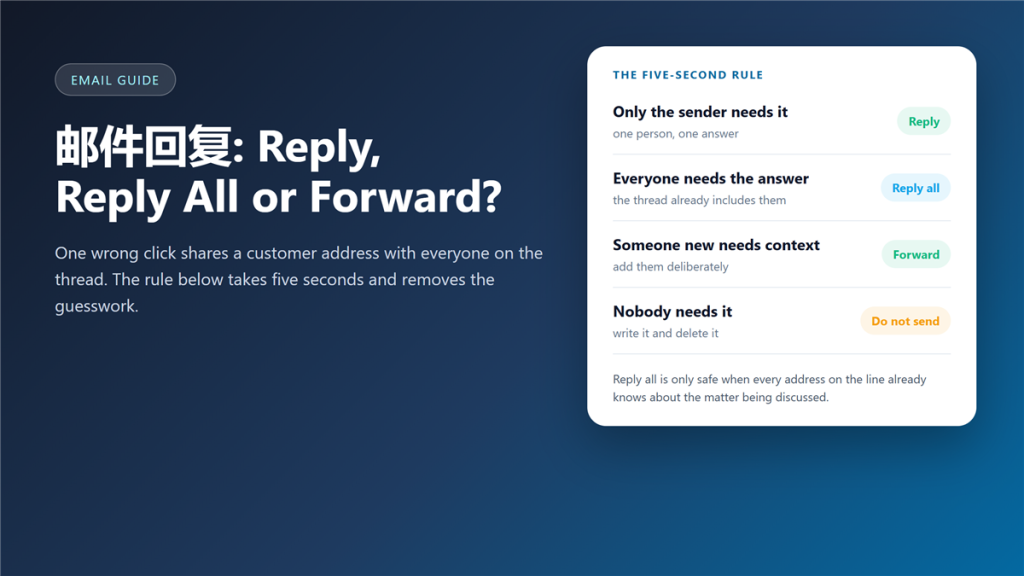
Why 邮件回复 goes wrong so often
邮件回复 is a one-click decision with three possible outcomes, and one of them shares an address list with strangers. I have watched a customer list leak across four companies through a single reply-all, so I now treat the button as a policy question rather than a habit.
The good news is that the decision takes five seconds once you know the question to ask. That is the whole skill behind a good 邮件回复.
Key Takeaways
- Ask one question: who needs to see this answer?
- Reply all exposes every address on the line.
- Forward carries the entire quoted history with it.
- Bcc recipients never appear in a reply all.
- Long threads hide stale information in the quoted text.
- Mobile clients make all three buttons look the same.
- When nobody needs the message, do not send it.
The five-second decision rule
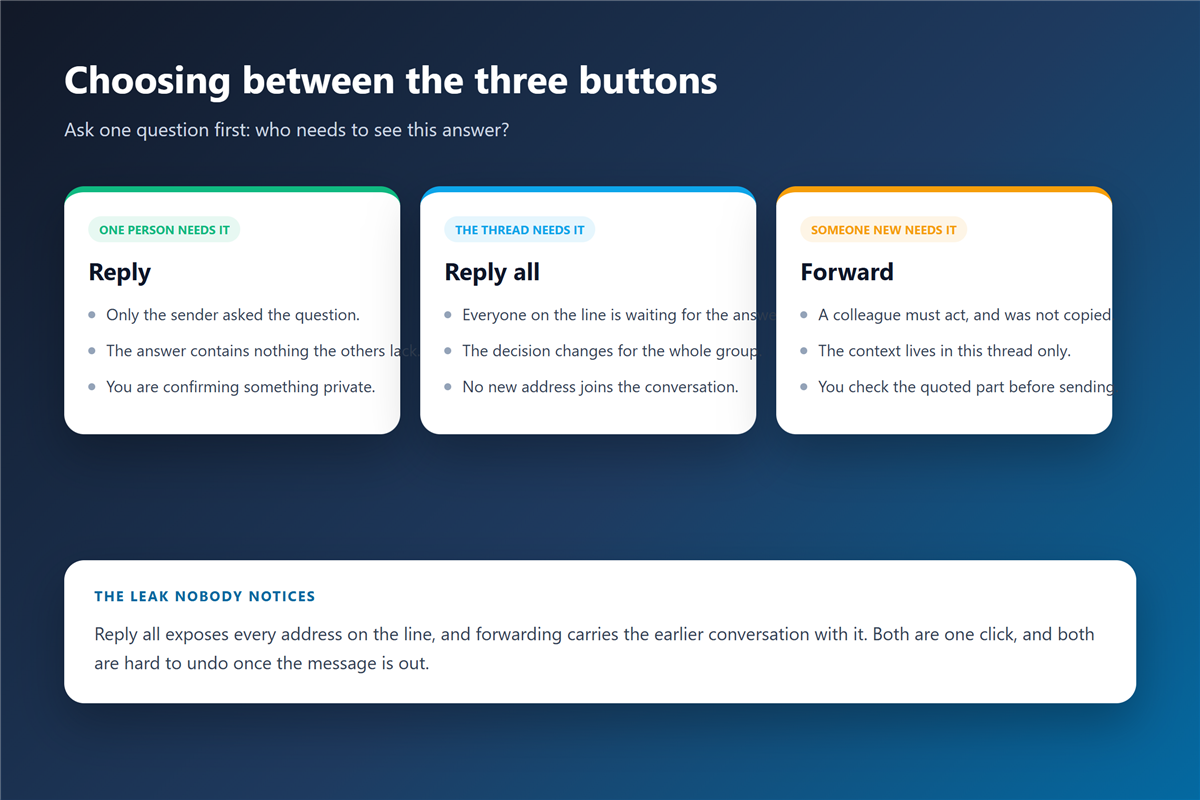
Before clicking anything, ask who needs to see the answer. The answer picks the button for you, and it removes almost every mistake I have seen. A slow 邮件回复 is better than a fast leak.
Reply when only the sender needs it
One person asked the question, so one person gets the answer. Most 邮件回复 falls here, and it is also the option with no side effects.
Reply all when the thread needs it
Everyone on the line is waiting for the same fact. Reply all is correct only when every address already knows what the thread is about.
Forward when someone new needs it
Adding a colleague is a different action from answering. A forward is right here, and it is also where quoting earns its reputation for leaking context.
邮件回复 and the address that leaks
Every address on the line becomes visible the moment somebody uses reply all, which is the entire risk of a careless 邮件抄送. A 邮件回复 sent to a group of customers shares all of their addresses with each other, usually without anyone noticing.
Moreover, the fix is not to ban reply all. The fix is to move the group to Bcc before the first send, which keeps later replies private by default. A filter or 邮件规则 that routes the thread to a folder also keeps the audience visible at a glance.
邮件回复 when the thread is long
A thread that has run for weeks stops being readable. The quoted text below the 邮件回复 grows longer than the answer itself, and the newest reader starts scrolling instead of reading. That is the point where a 邮件回复 stops working as a reply.
Therefore, trim once the thread passes ten messages. Delete the older quote, keep one line of context, and the reply becomes useful again.
邮件回复 on mobile
On a phone, reply and reply all sit one tap apart. That layout is why most 邮件回复 mistakes happen on mobile. I have sent the wrong one twice from a train, and both times the recipient list told me what happened before the message did. A 邮件撤回 request arrived far too late to help.
So when a 邮件回复 matters, use a larger screen. On a desktop client you can read the To line before you type, which is enough to catch the mistake.
Quoting the 邮件回复 history without leaking it
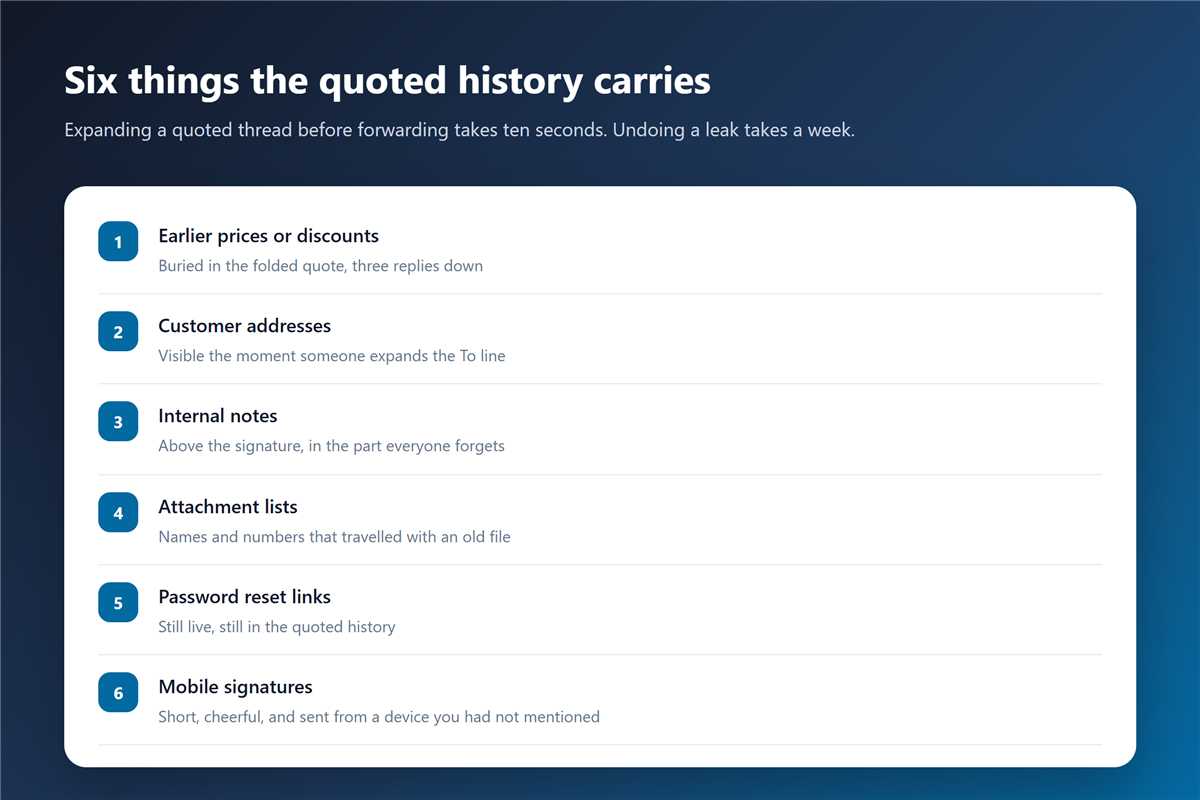
Quoted history is convenient and risky. It carries earlier prices, internal notes and sometimes live password-reset links, all of which travel silently with one forward.
Therefore, expand the quote before you forward. If the history contains a number you would not repeat out loud, remove it instead of relying on the recipient to skip it.
Writing a reply people can act on
A useful 邮件回复 starts with the decision, not the background. Put the answer in the first sentence, then explain, because most readers stop after one line. If you will be away for a few days, an 自动回复 sets that expectation before anyone writes.
Additionally, keep one topic per reply. When a thread needs two answers, send two messages, and each one gets a clearer subject line and a faster response. A tidy 邮件签名 supports that, while a twelve-line one works against it.
Frequently asked questions
What is the difference between 邮件回复 and reply all?
Reply writes to the sender alone; reply all writes to every address on the To and Cc lines. That single difference is the one that leaks.
Does reply all include Bcc recipients?
No. Bcc is hidden from the header itself, so those addresses never appear in a later 邮件回复 from anyone else.
When should I change the subject?
When the thread shifts to a new decision. Rewriting the line keeps the archive searchable, and it tells readers that a new question is being asked.
Is forwarding the same as redirecting?
No. A forward is a new message you write; a redirect passes the original on unchanged, which keeps the original sender visible as the author.
Should I reply to a message sent to me in error?
Best practice is to say so plainly, because a quiet 邮件回复 leaves the sender believing the message arrived where they intended.
References
延伸阅读
- 《邮件模板怎么用?Reuse Without Sounding Robotic》
- 《邮件会话怎么用?Threads, Breakages and Long Discussions》
- 《邮件优先级怎么用?Urgent Labels Nobody Reads》
- 《邮件列表是什么?Group Addresses and Reply Rules》
- 《邮件礼仪怎么把握?Manners That Travel Well》
- 《邮件发送时间怎么选?The Five Windows, Ranked》
- 《邮件跟进怎么写?Timing, Wording and the Third Try》
- 《求职邮件怎么写?One Page, One Ask, One Attachment》
- 《投诉邮件怎么写?Evidence, Sequence and Escalation》
- 《道歉邮件怎么写?What to Admit and What to Leave Out》
- 《邮件开场白怎么写?Greetings, First Lines and Reply Rates》
- 《邮件密送怎么用?Who Really Sees the Hidden Copy》
- 《邮件拒绝怎么说?Declining Requests Without Burning Bridges》
- 《邮件请假怎么写?Dates First, Reasons Second》
- 《邮件确认怎么写?What Was Agreed, In Writing》
- 《邮件引用怎么处理?Quoting in Replies Without Clutter》
- 《邮件重发怎么做?Resending Without Confusion》
- 《邮件快捷回复怎么做?Canned Replies That Sound Human》
- 《邮件回复率怎么提高?Getting an Answer Back》
- 《邮件投票怎么做?Settle a Decision Fast》
- 《邮件回执怎么用?A Receipt That Confirms》
- 《邮件澄清怎么写?Setting the Record Right》
- 《邮件回复时限怎么定?How Long to Wait》
- 《邮件投稿怎么约?Inviting Submissions》
- 《邮件回复地址怎么设?Where Replies Land》
评论
还没有评论,来说两句吧。以下为本文的引用通告: