 小影邮箱
邮件礼仪怎么把握?Manners That Travel Well
What 邮件礼仪 actually measures
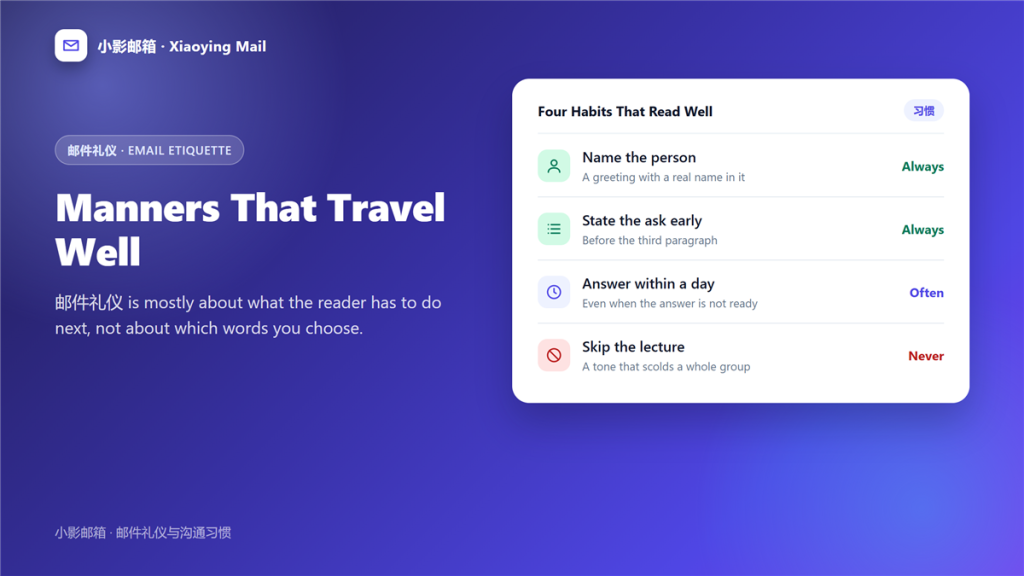
邮件礼仪 is usually described as tone, but it measures something simpler. It measures how much work your message creates for the person reading it.
A colleague once sent me a nine paragraph update with the decision buried in paragraph seven. The wording was warm and the request was polite, and it still wasted ten minutes, because 邮件礼仪 was treated as decoration rather than structure.
Key Takeaways
- 邮件礼仪 is about reducing effort for the reader.
- One topic per message keeps threads readable.
- Reply within one working day, even briefly.
- Quote only the part you are answering.
- Write a subject that names the ask.
- Move to chat after three rounds.
- A polite message is rarely a long one.
Five rules that cover most mail
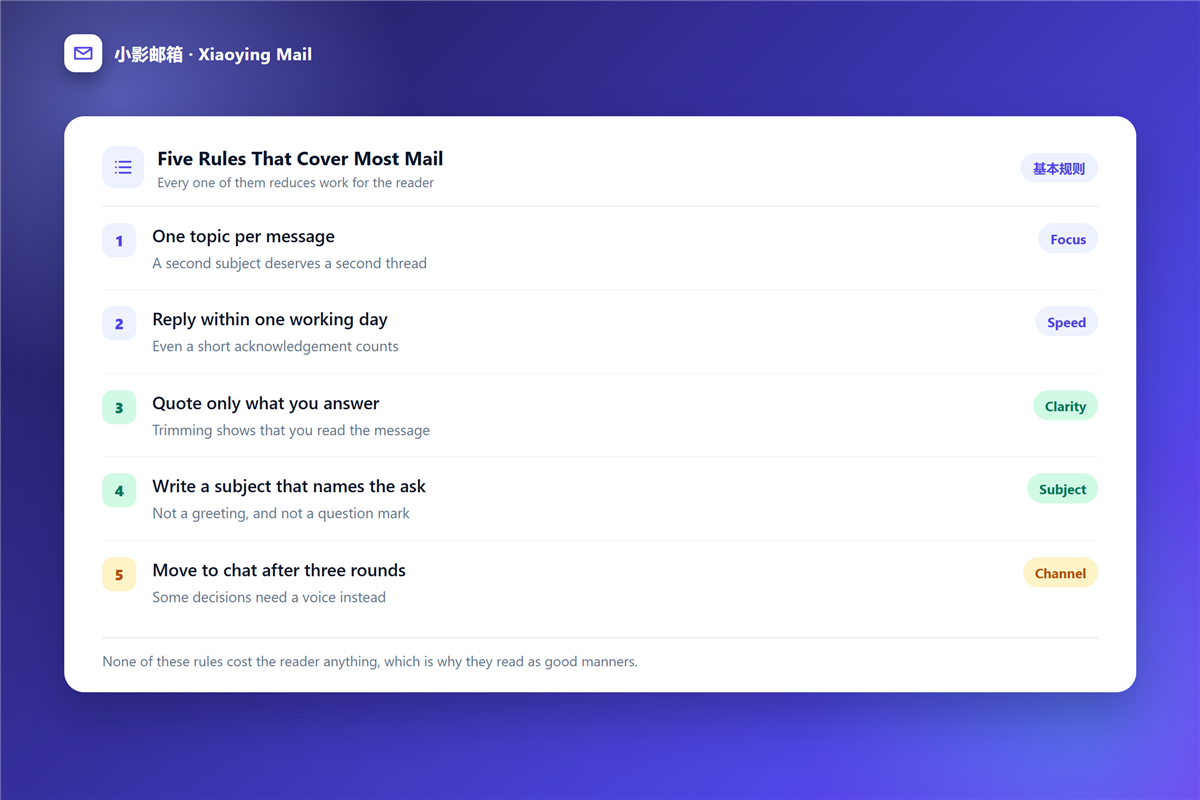
These five habits handle nearly every situation I have seen, which is why 邮件礼仪 rarely needs more than this list.
- One topic per message, because a second subject deserves its own thread.
- Reply within one working day, even if the answer is still forming.
- Quote only what you answer, so the reader can see what changed.
- Write a subject that names the ask rather than the topic.
- Move to chat after three rounds, because some decisions need a voice.
The fourth rule is the one people skip most often. A vague 邮件标题 is a small discourtesy that costs the reader a click every single time.
What 邮件礼仪 looks like in a hurry
Most lapses happen in the ninety seconds before a meeting rather than from rudeness.
Replying on a phone
A one line answer sent from a phone reads as abrupt even when it is not. Notably, adding the words sent from my phone costs nothing and removes the whole impression.
Replying while annoyed
Write the angry version in a draft and delete it. Therefore the final message keeps the facts and loses the temperature, which is the entire purpose of 邮件礼仪.
Where 邮件礼仪 is local
Three habits differ by country, industry and even by company, so read the room before you assume.
Greetings
Some cultures expect a formal salutation and some find it stiff. Consequently, matching the greeting you received is the safest default.
Sign-offs
A closing line is optional in some offices and mandatory in others. Furthermore, a 邮件签名 block can carry the formality that the body does not need.
Reply speed
An hour is slow in one team and fast in another. In particular, an 自动回复 that states your working hours prevents most of that misunderstanding.
Reading as polite without padding
Politeness does not require length, and length is where goodwill usually dies.
Because 邮件礼仪 rewards clarity, five sentences are enough for most messages: a greeting, one line of context, the request, the deadline, and a closing. Anything more belongs in an attachment or in a call.
The same restraint applies to replies. A 邮件回复 that quotes four screens of history in order to answer one question reads as careless, because it moves the work back onto the reader.
When a 邮件礼仪 problem deserves a call
Some subjects do not survive text, and recognising them early saves everybody a week.
Three signs point to a call. The thread has passed three rounds without agreement, somebody has misread your tone twice, or the decision affects money or employment. In each case the problem is the channel rather than the wording.
Frequently asked questions
Does 邮件礼仪 change between countries?
Yes, mostly in greetings and reply expectations. Matching what you receive is a reliable shortcut.
How long should a 邮件礼仪 reply take?
One working day is the common standard. A short acknowledgement inside an hour beats a perfect answer next week.
Is 邮件礼仪 different for internal mail?
Slightly. Colleagues tolerate a shorter greeting, but they notice a missing ask just as quickly.
Can 邮件礼仪 be too formal?
Yes. Over formality reads as distance, and in a small team it can look like a written warning where none was intended.
References
延伸阅读
- 《邮箱地址格式怎么看?Parts, Rules and Common Mistakes》
- 《道歉邮件怎么写?What to Admit and What to Leave Out》
- 《邮件开场白怎么写?Greetings, First Lines and Reply Rates》
- 《邮件拒绝怎么说?Declining Requests Without Burning Bridges》
- 《邮件致谢怎么写?Short, Specific and Sent on Time》
- 《邮件催款怎么写?Firm, Dated and Documented》
- 《邮件辞职怎么写?Clear, Short and Documented》
- 《邮件请假怎么写?Dates First, Reasons Second》
- 《邮件面试怎么沟通?Confirm, Prepare, Follow Up》
- 《邮件语气怎么把握?Formal, Neutral or Warm》
- 《邮件结尾怎么写?Sign-Offs That Fit the Message》
- 《邮件称呼怎么选?Salutations That Fit the Reader》
- 《邮件邀请函怎么写?Invitations People Accept》
- 《邮件撰写怎么写?Write Mail People Answer》
- 《邮件抄送礼仪有哪些?Who to Include and Why》
- 《邮件签名规范怎么定?What Belongs in a Sign Off》
- 《邮件致歉怎么写?Say Sorry and Mean It》
- 《邮件述职怎么写?Reporting on Your Work》
- 《邮件校对怎么做?Catch the Small Slips》
- 《邮件润色怎么做?Say It Better》
- 《邮件加班怎么写?Asking for Extra Hours》
- 《邮件示例怎么用?Show, Then Tell》
- 《邮件入职怎么写?The First Week Mail》
- 《邮件表扬怎么写?Praise That Lands》
- 《邮件转正怎么写?Confirming the Role》
- 《邮件调岗怎么写?Moving to a New Seat》
- 《邮件敬语怎么用?Words of Respect》
- 《邮件缩写怎么用?Short Forms Done Right》
- 《邮件术语怎么用?Jargon in Plain Sight》
- 《邮件取消怎么写?Calling It Off Well》
- 《邮件附言怎么用?The Line After the Sign-Off》
- 《邮件结束语怎么写?The Last Line》
- 《邮件问候语怎么选?A Greeting That Fits》
- 《邮件感谢信怎么写?Thanks That Land》
- 《邮件道歉信怎么写?Apologies That Work》
- 《邮件祝贺信怎么写?Words for Good News》
- 《邮件慰问信怎么写?Saying It Gently》
- 《邮件礼貌用语怎么用?Plain Courtesy》
- 《邮件澄清怎么写?Setting the Record Right》
- 《邮件会后跟进怎么写?After the Meeting Ends》
- 《邮件内部沟通怎么做?Talking Inside the Team》
- 《邮件投稿怎么约?Inviting Submissions》
- 《邮件表情符怎么用?Emoji That Add, Not Distract》
- 《邮件沟通怎么做?Clear and Calm》
评论
还没有评论,来说两句吧。以下为本文的引用通告: